


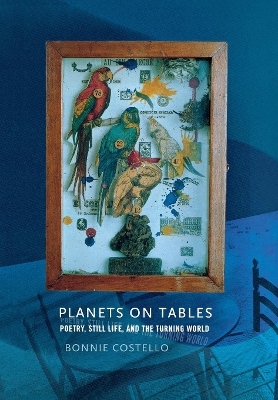
Planets on Tables
Poetry, Still Life, and the Turning World
Seiten
2008
Cornell University Press (Verlag)
978-0-8014-4613-9 (ISBN)
Cornell University Press (Verlag)
978-0-8014-4613-9 (ISBN)
Poets have long been drawn to the images and techniques of still life. Artists and poets alike present intimate worlds where time is suspended in the play of form and color and where history disappears amid everyday things. The genre of still life...
Poets have long been drawn to the images and techniques of still life. Artists and poets alike present intimate worlds where time is suspended in the play of form and color and where history disappears amid everyday things. The genre of still life with its focus on the domestic sphere seemed to some a retreat from the political and economic pressures of the last century. Yet many American artists and writers found in the arrangement of local objects a way to connect the individual to larger public concerns. Indeed, the debates over still life reveal just what is at stake in the long-standing quarrel over poetry's meaning and usefulness.
By exploring literary works of still life by Wallace Stevens, William Carlos Williams, Elizabeth Bishop, and Richard Wilbur—as well as the art of Joseph Cornell—the eminent critic Bonnie Costello considers how exchanges between the arts help to establish vital thresholds between the personal and public realms. In her view, Stevens and Williams bring the turmoil of history into their struggle for local aesthetic order; Bishop "studies history" in the intimate objects and arrangements she finds in her travels; Cornell, an artist inspired by poetry and loved by poets, links his dream boxes to contemporary events; and Richard Wilbur seeks to mend a broken postwar world within the hospitable spheres of art and home. In Planets on Tables, Costello describes a period when some of America's greatest poets and artists found in still life a way to "contemplate the good in the midst of confusion," to bring the distant near, and to resist—rather than escape—the pressures of their times.
Poets have long been drawn to the images and techniques of still life. Artists and poets alike present intimate worlds where time is suspended in the play of form and color and where history disappears amid everyday things. The genre of still life with its focus on the domestic sphere seemed to some a retreat from the political and economic pressures of the last century. Yet many American artists and writers found in the arrangement of local objects a way to connect the individual to larger public concerns. Indeed, the debates over still life reveal just what is at stake in the long-standing quarrel over poetry's meaning and usefulness.
By exploring literary works of still life by Wallace Stevens, William Carlos Williams, Elizabeth Bishop, and Richard Wilbur—as well as the art of Joseph Cornell—the eminent critic Bonnie Costello considers how exchanges between the arts help to establish vital thresholds between the personal and public realms. In her view, Stevens and Williams bring the turmoil of history into their struggle for local aesthetic order; Bishop "studies history" in the intimate objects and arrangements she finds in her travels; Cornell, an artist inspired by poetry and loved by poets, links his dream boxes to contemporary events; and Richard Wilbur seeks to mend a broken postwar world within the hospitable spheres of art and home. In Planets on Tables, Costello describes a period when some of America's greatest poets and artists found in still life a way to "contemplate the good in the midst of confusion," to bring the distant near, and to resist—rather than escape—the pressures of their times.
Bonnie Costello is Professor of English at Boston University. She is the author of Shifting Ground: Reinventing Landscape in Modern American Poetry, Elizabeth Bishop: Questions of Mastery, and Marianne Moore: Imaginary Possessions. She is the editor of The Selected Letters of Marianne Moore.
| Erscheint lt. Verlag | 23.1.2008 |
|---|---|
| Verlagsort | Ithaca |
| Sprache | englisch |
| Maße | 152 x 229 mm |
| Gewicht | 454 g |
| Themenwelt | Geisteswissenschaften ► Sprach- / Literaturwissenschaft ► Anglistik / Amerikanistik |
| Geisteswissenschaften ► Sprach- / Literaturwissenschaft ► Literaturwissenschaft | |
| ISBN-10 | 0-8014-4613-9 / 0801446139 |
| ISBN-13 | 978-0-8014-4613-9 / 9780801446139 |
| Zustand | Neuware |
| Informationen gemäß Produktsicherheitsverordnung (GPSR) | |
| Haben Sie eine Frage zum Produkt? |
Mehr entdecken
aus dem Bereich

aus dem Bereich
Poetik eines sozialen Urteils
Buch | Hardcover (2023)
De Gruyter (Verlag)
CHF 83,90


