


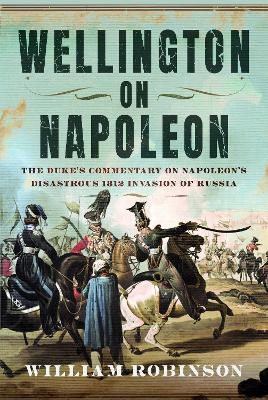
Wellington on Napoleon
The Duke’s Commentary on Napoleon’s Disastrous 1812 Invasion of Russia
Seiten
2026
Pen & Sword Books Ltd (Verlag)
978-1-0361-8500-8 (ISBN)
Pen & Sword Books Ltd (Verlag)
978-1-0361-8500-8 (ISBN)
- Noch nicht erschienen (ca. August 2026)
- Versandkostenfrei
- Auch auf Rechnung
- Artikel merken
The Duke of Wellington had a great reluctance to write a history of any of his campaigns and battles, famously comparing them to the ‘history of a ball’ and discouraging several attempts to publish such works. By 1825, however, the Duke of Wellington was ready to contradict all these points.
Despite a busy schedule, bouts of illness and an immense correspondence, he began to research Napoleon’s invasion of Russia in 1812. He purchased books on the campaign almost immediately after they were published and studied them at length. Using this research, he wrote a memorandum on the campaign.
The resulting work ran to more than 25,000 words and served to demonstrate his true opinion on Napoleon. It was, from start to finish, a relentless blistering attack on Napoleon and his ability; every choice was questioned by Wellington and used to show Napoleon as incompetent and unimaginative. He wrote at length on the battles at Smolensk and Borodino, and he never failed to pin all the blame solely upon Napoleon.
Far from viewing him as a man worth forty-thousand men, he instead decided to attack every decision Napoleon made and to present his own alternatives. As he wrote, Wellington must have felt satisfaction as he criticised his old opponent.
He decided not to publish his writing, and only circulated it with a small group of friends, and, therefore, this work is far less known than his other stated views. Wellington had no desire to become embroiled in a public debate over Napoleon’s ability and legacy, he would be content to praise him in public and keep his real views to himself for his own private satisfaction. This book seeks to finally make these views public once more, and to explore how Wellington reached the conclusions he did; from praising Napoleon to damning him.
Despite a busy schedule, bouts of illness and an immense correspondence, he began to research Napoleon’s invasion of Russia in 1812. He purchased books on the campaign almost immediately after they were published and studied them at length. Using this research, he wrote a memorandum on the campaign.
The resulting work ran to more than 25,000 words and served to demonstrate his true opinion on Napoleon. It was, from start to finish, a relentless blistering attack on Napoleon and his ability; every choice was questioned by Wellington and used to show Napoleon as incompetent and unimaginative. He wrote at length on the battles at Smolensk and Borodino, and he never failed to pin all the blame solely upon Napoleon.
Far from viewing him as a man worth forty-thousand men, he instead decided to attack every decision Napoleon made and to present his own alternatives. As he wrote, Wellington must have felt satisfaction as he criticised his old opponent.
He decided not to publish his writing, and only circulated it with a small group of friends, and, therefore, this work is far less known than his other stated views. Wellington had no desire to become embroiled in a public debate over Napoleon’s ability and legacy, he would be content to praise him in public and keep his real views to himself for his own private satisfaction. This book seeks to finally make these views public once more, and to explore how Wellington reached the conclusions he did; from praising Napoleon to damning him.
WILLIAM ROBINSON is a former student, having graduated from the University of York with a BA in history in 2023. Born in 2002, he has had an interest in history since childhood, particularly in the Napoleonic Wars and the life of the Duke of Wellington. While at university he focused his research on the Duke of Wellington, initially on his military career and relationship with the British government in the years 1809-1814. He has since been working on Wellington’s civilian and political life after 1815, with a special interest in the many memoranda written by Wellington. William currently resides in South Yorkshire
| Erscheint lt. Verlag | 31.8.2026 |
|---|---|
| Zusatzinfo | 8 mono illustrations |
| Verlagsort | Barnsley |
| Sprache | englisch |
| Maße | 156 x 234 mm |
| Themenwelt | Geisteswissenschaften ► Geschichte ► Regional- / Ländergeschichte |
| Geschichte ► Teilgebiete der Geschichte ► Militärgeschichte | |
| ISBN-10 | 1-0361-8500-1 / 1036185001 |
| ISBN-13 | 978-1-0361-8500-8 / 9781036185008 |
| Zustand | Neuware |
| Informationen gemäß Produktsicherheitsverordnung (GPSR) | |
| Haben Sie eine Frage zum Produkt? |
Mehr entdecken
aus dem Bereich

aus dem Bereich
von der Wiederbewaffnung bis zur Zeitenwende
Buch | Softcover (2025)
C.H.Beck (Verlag)
CHF 16,80
Deutschlands großer Volksaufstand
Buch | Softcover (2024)
Propyläen Verlag
CHF 30,80


