


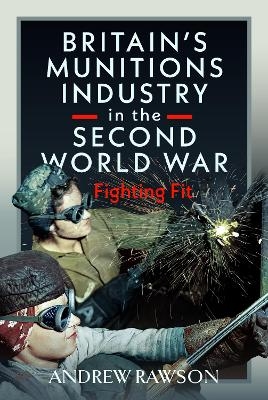
Britain's Munitions Industry in the Second World War
Fighting Fit
Seiten
2026
Pen & Sword Books Ltd (Verlag)
978-1-0361-3612-3 (ISBN)
Pen & Sword Books Ltd (Verlag)
978-1-0361-3612-3 (ISBN)
- Noch nicht erschienen (ca. Juni 2026)
- Versandkostenfrei
- Auch auf Rechnung
- Artikel merken
This is the history of Britain’s armaments industry during the Second World War.
It begins with the rearmament before the war and shows how a shadow industry was prepared, in response to German aggression. See how industry was organised and programmed, before learning how armaments were researched, designed and developed. The narrative then looks at how enlistment was controlled, how skilled workers were deployed and how manufacturing was diluted, to allow tens of thousands of unemployed men and women to play their part.
The story continues with an explanation of the importance of the coal and oil industries, followed by the development of the metal industries. It then looks at the huge amounts of imports and merchant shipping required, as well as the American Lend Lease programme.
See how factories equipped the Royal Air Force, so it could fight the Battle of Britain, and reequipped the British Army following the disaster at Dunkirk. Also learn how the shipyards worked around the clock on warships and merchant ships, so the Royal Navy could defend the nation and protect the supply convoys. See how the lessons learnt on the battlefield helped modify early factory designs into practical ones. Learn how the war changed relations between the government, the employers, the unions, and the workforce. See how issues could cause widespread industrial unrest, as the cost of living rose and the rules became stricter. Also learn how the desire to improve production improved health and safety at work, welfare arrangements and developed management and human resources. We also see how the Luftwaffe attempt to cripple British industry with its aerial Blitz.
The story ends with a nation being pushed to its limits for a second time in thirty years, before suddenly demobilising, again leaving the British people wondering what the future would hold for them.
It begins with the rearmament before the war and shows how a shadow industry was prepared, in response to German aggression. See how industry was organised and programmed, before learning how armaments were researched, designed and developed. The narrative then looks at how enlistment was controlled, how skilled workers were deployed and how manufacturing was diluted, to allow tens of thousands of unemployed men and women to play their part.
The story continues with an explanation of the importance of the coal and oil industries, followed by the development of the metal industries. It then looks at the huge amounts of imports and merchant shipping required, as well as the American Lend Lease programme.
See how factories equipped the Royal Air Force, so it could fight the Battle of Britain, and reequipped the British Army following the disaster at Dunkirk. Also learn how the shipyards worked around the clock on warships and merchant ships, so the Royal Navy could defend the nation and protect the supply convoys. See how the lessons learnt on the battlefield helped modify early factory designs into practical ones. Learn how the war changed relations between the government, the employers, the unions, and the workforce. See how issues could cause widespread industrial unrest, as the cost of living rose and the rules became stricter. Also learn how the desire to improve production improved health and safety at work, welfare arrangements and developed management and human resources. We also see how the Luftwaffe attempt to cripple British industry with its aerial Blitz.
The story ends with a nation being pushed to its limits for a second time in thirty years, before suddenly demobilising, again leaving the British people wondering what the future would hold for them.
ANDREW RAWSON has over forty books to his name, covering subjects from medieval to modern times. He has written eight books for Pen & Sword’s Battleground Europe series and three reference books for the History Press’s Handbook series. He also completed a ten-part series covering the Western Front campaigns, as well as a volume on the conflict’s munitions industry. Andrew has a Master’s degree with Birmingham University and lives in South Yorkshire.
| Erscheint lt. Verlag | 30.6.2026 |
|---|---|
| Zusatzinfo | 16 mono illustrations |
| Verlagsort | Barnsley |
| Sprache | englisch |
| Maße | 156 x 234 mm |
| Themenwelt | Geschichte ► Allgemeine Geschichte ► 1918 bis 1945 |
| Geschichte ► Teilgebiete der Geschichte ► Militärgeschichte | |
| ISBN-10 | 1-0361-3612-4 / 1036136124 |
| ISBN-13 | 978-1-0361-3612-3 / 9781036136123 |
| Zustand | Neuware |
| Informationen gemäß Produktsicherheitsverordnung (GPSR) | |
| Haben Sie eine Frage zum Produkt? |
Mehr entdecken
aus dem Bereich


aus dem Bereich
Deutschland 1933 bis 1945
Buch | Hardcover (2025)
S. Fischer (Verlag)
CHF 47,60
ein Psychologe erlebt das Konzentrationslager
Buch | Hardcover (2024)
Kösel (Verlag)
CHF 30,80


