


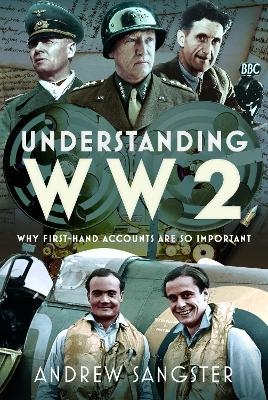
Understanding WW2
Why First-Hand Accounts are so important
Seiten
2026
Pen & Sword Books Ltd (Verlag)
978-1-0361-9413-0 (ISBN)
Pen & Sword Books Ltd (Verlag)
978-1-0361-9413-0 (ISBN)
- Noch nicht erschienen (ca. Mai 2026)
- Portofrei ab CHF 40
- Auch auf Rechnung
- Artikel merken
As oral history gains long-overdue recognition, its power to illuminate the past has never been more vital. From buried time capsules to the preserved voices, letters, diaries, photographs and films of those who lived through history’s most pivotal moments, this book explores how personal testimony shapes our understanding of truth.
Split into six main chapters and focussing on the Second World War years, Andrew Sangster starts by analysing personal letters from key players on both sides – Himmler, Rommel and Patton – before exploring the diaries of Lord Alan Brooke, Goebbels and Galeazzo Ciano, to name but a few. The final chapters explore the significance of the recorded notes from the Nuremberg Trials, before explaining the merits of autobiographies written after the fact.
With honesty and clarity, the author reveals the challenges historians face – how memories can shift, how documents can be altered and how autobiographies, even in their sincerity, must be handled with care. Still, within these fragile records lie invaluable insights: motives, emotions and the human reactions that traditional archives often overlook.
Balanced and engaging, Understanding WW2 is an essential guide to the promise and pitfalls of oral history – and a compelling reminder that the voices of ordinary men and women are as crucial to our collective memory as those of the famous and powerful.
Split into six main chapters and focussing on the Second World War years, Andrew Sangster starts by analysing personal letters from key players on both sides – Himmler, Rommel and Patton – before exploring the diaries of Lord Alan Brooke, Goebbels and Galeazzo Ciano, to name but a few. The final chapters explore the significance of the recorded notes from the Nuremberg Trials, before explaining the merits of autobiographies written after the fact.
With honesty and clarity, the author reveals the challenges historians face – how memories can shift, how documents can be altered and how autobiographies, even in their sincerity, must be handled with care. Still, within these fragile records lie invaluable insights: motives, emotions and the human reactions that traditional archives often overlook.
Balanced and engaging, Understanding WW2 is an essential guide to the promise and pitfalls of oral history – and a compelling reminder that the voices of ordinary men and women are as crucial to our collective memory as those of the famous and powerful.
Andrew Sangster has six degrees, in Law, Theology and four in history including his doctorate. An ordained priest, he has trespassed away from the Church to teaching and the study of history. He has taught in grammar schools and at Eton College, was a headmaster for some nine years and has assisted post-graduate students of history. He has more than twenty published history books both in the United Kingdom and overseas with some co-authored with Pier Paolo Battistelli, the well-known Italian historian. When not called for Church duties he studies the lesser-known aspects of modern history and plays chess for relaxation.
| Erscheint lt. Verlag | 30.5.2026 |
|---|---|
| Zusatzinfo | 26 mono illustrations |
| Verlagsort | Barnsley |
| Sprache | englisch |
| Maße | 156 x 234 mm |
| Themenwelt | Geschichte ► Allgemeine Geschichte ► 1918 bis 1945 |
| Geschichte ► Teilgebiete der Geschichte ► Militärgeschichte | |
| ISBN-10 | 1-0361-9413-2 / 1036194132 |
| ISBN-13 | 978-1-0361-9413-0 / 9781036194130 |
| Zustand | Neuware |
| Informationen gemäß Produktsicherheitsverordnung (GPSR) | |
| Haben Sie eine Frage zum Produkt? |
Mehr entdecken
aus dem Bereich


aus dem Bereich
Deutschland 1933 bis 1945
Buch | Hardcover (2025)
S. Fischer (Verlag)
CHF 47,60
ein Psychologe erlebt das Konzentrationslager
Buch | Hardcover (2024)
Kösel (Verlag)
CHF 30,80


