


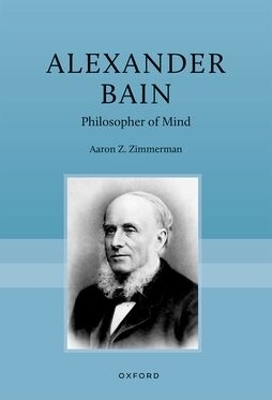
Alexander Bain
Philosopher of Mind
Seiten
2026
Oxford University Press (Verlag)
978-0-19-885366-4 (ISBN)
Oxford University Press (Verlag)
978-0-19-885366-4 (ISBN)
- Noch nicht erschienen (ca. Mai 2026)
- Versandkostenfrei
- Auch auf Rechnung
- Artikel merken
The first volume to uncover the forgotten contributions of a significant philosopher, Alexander Bain (1818-1903) who was once Britain's greatest philosopher of mind and influenced the work of John Stuart Mill, Charles Darwin, William James, and Charles Sanders Peirce. This book explores Bain's contributions to the cognitive sciences and pragmatism.
Alexander Bain (1818–1903) was once Britain's greatest philosopher of mind. Author of The Senses and the Intellect (1855) and The Emotions and the Will (1859), he articulated a comprehensive theory of the human mind, integrating cognitive, developmental, and evolutionary psychology with neuroscience and philosophy. John Stuart Mill utilized Bain's theory of moral judgment to clarify and defend utilitarianism. Charles Darwin leaned on Bain's theory of conscience to explain the evolution of morality. William James used Bain's texts to teach philosophy of mind at Harvard, launching psychology as an independent department of inquiry within American universities.
Charles Sanders Peirce said Bain's theory of belief was the axiom of pragmatism. Bain also founded the journal Mind, doing more than anyone else in his day to build the cognitive sciences into the field it has become.
Mill is still celebrated for his analyses of liberalism and utilitarianism. Darwin remains famous for his theory of natural selection. And James is well known as the father of both pragmatism and empirical psychology in America. Bain stands behind these accomplishments, his role unacknowledged.
Alexander Bain: Philosopher of Mind seeks to rectify this oversight. After introducing the reader to Bain's life and early work, Zimmerman critically analyses Bain's solution to the mind-body problem, describes Bain's contributions to logic and his disagreement with Mill over the meaning of proper names, engages with Bain's theories of freewill, conscience, and moral responsibility, and explains Bain's theory of belief and its role in the genesis of pragmatism. The philosophy that emerges will engage philosophers of mind, cognitive scientists, historians of philosophy, and anyone interested in the "Darwinian revolution" in our understanding of life on Earth.
Alexander Bain (1818–1903) was once Britain's greatest philosopher of mind. Author of The Senses and the Intellect (1855) and The Emotions and the Will (1859), he articulated a comprehensive theory of the human mind, integrating cognitive, developmental, and evolutionary psychology with neuroscience and philosophy. John Stuart Mill utilized Bain's theory of moral judgment to clarify and defend utilitarianism. Charles Darwin leaned on Bain's theory of conscience to explain the evolution of morality. William James used Bain's texts to teach philosophy of mind at Harvard, launching psychology as an independent department of inquiry within American universities.
Charles Sanders Peirce said Bain's theory of belief was the axiom of pragmatism. Bain also founded the journal Mind, doing more than anyone else in his day to build the cognitive sciences into the field it has become.
Mill is still celebrated for his analyses of liberalism and utilitarianism. Darwin remains famous for his theory of natural selection. And James is well known as the father of both pragmatism and empirical psychology in America. Bain stands behind these accomplishments, his role unacknowledged.
Alexander Bain: Philosopher of Mind seeks to rectify this oversight. After introducing the reader to Bain's life and early work, Zimmerman critically analyses Bain's solution to the mind-body problem, describes Bain's contributions to logic and his disagreement with Mill over the meaning of proper names, engages with Bain's theories of freewill, conscience, and moral responsibility, and explains Bain's theory of belief and its role in the genesis of pragmatism. The philosophy that emerges will engage philosophers of mind, cognitive scientists, historians of philosophy, and anyone interested in the "Darwinian revolution" in our understanding of life on Earth.
Aaron Z. Zimmerman is Professor and Chair of Philosophy at the University of California, Santa Barbara, where he has taught since 2002. His is the author of Moral Epistemology (Routledge, 2010), Belief: A Pragmatic Picture (OUP, 2018), and co-editor with Karen Jones and Mark Timmons of The Routledge Handbook of Moral Epistemology (Routledge, 2019). His work is focused on the philosophy of mind, epistemology, moral psychology, and the history of these subjects.
| Erscheint lt. Verlag | 26.5.2026 |
|---|---|
| Verlagsort | Oxford |
| Sprache | englisch |
| Maße | 138 x 216 mm |
| Themenwelt | Geisteswissenschaften ► Philosophie ► Philosophie der Neuzeit |
| Geisteswissenschaften ► Psychologie ► Allgemeine Psychologie | |
| ISBN-10 | 0-19-885366-1 / 0198853661 |
| ISBN-13 | 978-0-19-885366-4 / 9780198853664 |
| Zustand | Neuware |
| Informationen gemäß Produktsicherheitsverordnung (GPSR) | |
| Haben Sie eine Frage zum Produkt? |
Mehr entdecken
aus dem Bereich



aus dem Bereich
ein Dialog mit Simone Weil
Buch | Softcover (2025)
Matthes & Seitz Berlin (Verlag)
CHF 19,55


