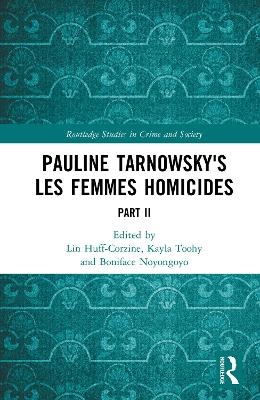
Pauline Tarnowsky's Les Femmes Homicides
Routledge (Verlag)
978-1-032-84467-1 (ISBN)
- Noch nicht erschienen (ca. Juli 2026)
- Versandkostenfrei
- Auch auf Rechnung
- Artikel merken
Translated by Kayla Toohy and Boniface Noyongoyo
This translation of Pauline Tarnowsky’s Les Femmes Homicides presents an important historical work in English for the first time. Tarnowsky, a neuropathologist and one of the first women permitted to attend medical school in Russia, has often been referred to as the “first female criminologist.” In Les Femmes Homicides, she analyzes data collected from a sample primarily composed of rural peasant women, 160 convicted of homicide and a control group of 150 non-criminal women, to examine the relative influence of the “born criminal” theory often associated with Cesare Lombroso, heredity, and the social contexts experienced by women convicted of homicide.
Part I of the text outlines Tarnowsky’s methodology and introduces some of the first motivational categories for women’s homicidal behavior. Part II expands on these categories and further explores the relative importance of causal factors related to biology and social conditions. Her meticulous methodological attention to the intersections of race, environment, time, place, unity, and other social conditions makes this one of the earliest, and still one of the most comprehensive, studies of female homicide offenders.
Tarnowsky draws comparisons between carefully matched criminal and non-criminal populations and employs what we would now recognize as social-scientific reasoning to study and explain homicides committed by women. Ultimately, she challenges and rejects Lombroso’s theory of “born criminals.” This historical work, and its influence on the development of criminological theory, remains essential reading for scholars and students of criminology, homicide studies, social history, gender studies, theory development, the history of ideas, law and criminology, and the social study of science.
Dr. Lin Huff-Corzine is Professor Emerita in Sociology at the University of Central Florida. She is active in the American Society of Criminology where she serves on the Board for the Division of Historical Criminology. She is also a founding member of the Homicide Research Working Group, which recently honored her and colleagues Jay Corzine and John Jarvis with an award that will be given annually in our names for outstanding research related to homicide. Her publications on homicide, domestic violence, and human trafficking appear in a variety of criminology and criminal justice journals. Directly related to this book is a piece with Dr. Kayla Toohy about Tarnowsky's life and scholarship that appeared in the Journal of Criminal Justice. Kayla Toohy is an Assistant Professor in the Criminology and Criminal Justice Department at the University of Tampa. Her research areas primarily focus on studies of lethal violence, taking into consideration macro-level economic and social factors and the geographic distribution of individual crimes using Geographic Information Systems (GIS). Additionally, she has conducted research in the areas of intimate partner violence, family mass murder, historical contributions to criminological literature, and environmental predictors of crime. Her recent publications appear in journals such as the Journal of Criminal Justice, Violence Against Women, the Journal of Mass Violence Research, Security Journal, and Victims & Offenders. Publications that reference information related to Pauline Tarnowsky and her historical contributions to the discipline of criminology include “The life and scholarship of Pauline Tarnowsky: Criminology’s mother,” with Dr. Lin Huff-Corzine, in the Journal of Criminal Justice. The work she has conducted translating Pauline Tarnowsky’s Les Femmes Homicides brought together her two loves of French literature and criminology.
1. Les Femmes Homicides Chapter 7: Homicides Committed Due to Reduced Receptivity 2. Les Femmes Homicides Chapter 8: Homicides Committed Under the Genetic Sense and Its Deviations 3. Les Femmes Homicides Chapter 9: Occasional Homicides and Accidental Murders 4. Les Femmes Homicides Chapter 10: Homicidal Women Affected by Nervous and Psychological Disorders 5. Les Femmes Homicides Chapter 11: Comparisons and Deductions 6. Les Femmes Homicides Chapter 12: Conclusion
| Erscheint lt. Verlag | 7.7.2026 |
|---|---|
| Reihe/Serie | Routledge Studies in Crime and Society |
| Zusatzinfo | 8 Tables, black and white; 39 Halftones, black and white; 39 Illustrations, black and white |
| Verlagsort | London |
| Sprache | englisch |
| Maße | 152 x 229 mm |
| Themenwelt | Geschichte ► Teilgebiete der Geschichte ► Militärgeschichte |
| Recht / Steuern ► Rechtsgeschichte | |
| Recht / Steuern ► Strafrecht ► Kriminologie | |
| Sozialwissenschaften ► Soziologie ► Spezielle Soziologien | |
| ISBN-10 | 1-032-84467-1 / 1032844671 |
| ISBN-13 | 978-1-032-84467-1 / 9781032844671 |
| Zustand | Neuware |
| Informationen gemäß Produktsicherheitsverordnung (GPSR) | |
| Haben Sie eine Frage zum Produkt? |
aus dem Bereich