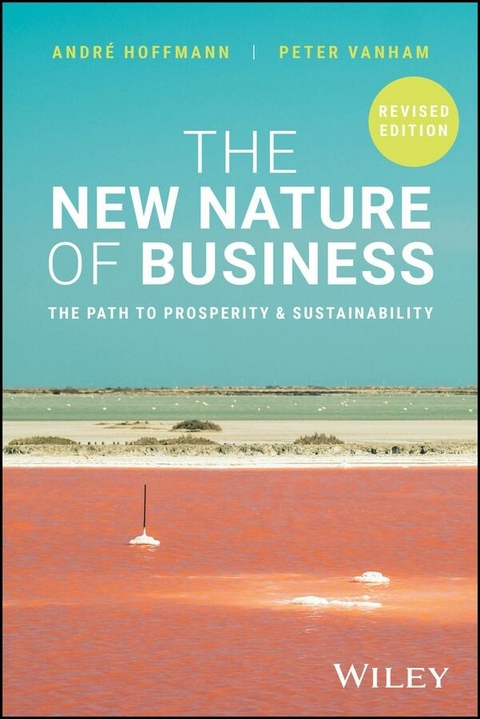
The New Nature of Business (eBook)
272 Seiten
Wiley (Verlag)
978-1-394-42820-5 (ISBN)
Learn how pioneering business leaders are resetting their companies' relationship to nature, society, and our common future
In The New Nature of Business: The Path to Prosperity and Sustainability, businessman Andre Hoffmann and journalist Peter Vanham describe how companies should change their ways to have continued success, and why the current modus operandi is not working. They present a template for creating 'sustainable prosperity', and case-studies of companies that survived and thrived by opting for change. In doing so, they provide a way out of long-standing dilemmas, such as how to balance business needs with impact on nature, shareholders with stakeholders, and short-term vs. long-term profits.
You'll find:
- A first-hand account of global healthcare company Roche's sustainability practice, as told by André (Roche's vice-chairman), chairman Severin Schwan, and several other senior management members
- Case-studies and lessons of organizations with visionary leaders, such as INSEAD, IKEA, Harley Davidson, and Holcim, all of whom have taken a holistic view of their role in the world, and succeeded in doing well while doing good
- Strategies for addressing the negative externalities and trade-offs that arise from doing business; identifying the right metrics and targets to deliver on your purpose; and accounting for human, social, and natural capital, alongside financial capital
- A must-read book for business leaders, entrepreneurs, and changemakers at companies around the world, The New Nature of Business, is also insightful and timely for those who advise or oversee companies and their leadership teams.
ANDRÉ HOFFMANN is co-chair of the World Economic Forum, the international organization for public-private cooperation, alongside Larry Fink. He is also the Co-Founder of InTent, an international platform that accelerates sustainable solutions, and the Vice Chair of Roche Holding, an international pharmaceutical company.
PETER VANHAM is a business journalist, researcher and author, who writes about the global economy and those who shape it. His previous books include Stakeholder Capitalism (written with Klaus Schwab) and Before I Was CEO.
Preface
Humility and courage. If there was ever a time in our lives that we needed these characteristics in our leaders, it is today. We hope that after reading this book, you'll feel inspired to show courage and humility in your life and work as well.
Since we first published The New Nature of Business in the early fall of 2024, much has changed in the world of business, and the world at large. It is no longer universally “en vogue” for business leaders to talk about climate, nature, or even the social responsibility of business. The signs of change are everywhere. In the world of finance, for instance, many banks and asset managers walked away from their joint commitments on “net zero” carbon emissions. The United Nations‐backed Net Zero Banking Alliance subsequently ceased to exist.1 In the United States, many institutions pulled back their work around diversity, equity, and inclusion (DEI) as the government sought to “terminate”2 and “eliminate”3 DEI programs. And in Europe, an increasing number of energy, car, and other large companies have been stepping up their advocacy to roll back or water down sustainability rules.4 Even at the government level, several high‐profile administrations, including that of the United States,5 exited the Paris Climate Agreement, rejected the UN Sustainable Development Goals,6 and/or decreased funding the United Nations and its projects.7
It may seem then that the tide of history is turning away from implementing a new nature of business, which puts the pursuit of inclusive and sustainable prosperity at its core. Yet amid all the turmoil, the need for more humane, social, and nature‐centric businesses has only become more acute. Societal distress and polarization are on the rise, and trust in all institutions, including businesses, is declining, leading to widespread grievance.8 Hundreds of millions of people know all too well that the epidemic of loneliness and isolation is very real,9 that burnout and purposelessness are on the rise, and that all of this is affecting ever more individuals and families. And amid all these human and social challenges, our natural environment keeps deteriorating as well, whether as measured through climate change, biodiversity loss, or other planetary boundaries.10
How do we deal with this dissonance? On the one hand, we know some critical aspects of our individual lives, our societies, and our natural ecosystem are headed in the wrong direction. Yet on the other hand, so many of the choices we make, or that others make on behalf of us, are making matters worse. If society was an individual, we would say it is time for the patient to go and see a doctor, because what we just described is nothing short of schizophrenia. Any cure would surely start by acknowledging this disturbing reality and then taking steps to remediate it. But sadly, the patient in this case is not an individual, and no single doctor can treat, let alone cure, him or her.
So, what can we individually and collectively do? The first step, we believe, is to stop taking actions that contribute to this schizophrenic reality. We should stick with the pursuit of inclusive and sustainable prosperity and follow this compass even as the going gets tough. And, on a more personal level, we should be comforted by the idea that some of the people featured in this book have stuck to the course as well, even in the face of mounting challenges. If they can do it—with humility and courage—so can you (and vice versa!).
* * *
Take Jochen Zeitz, for example, who at the end of 2025 ended his tenure as CEO of motorcycle maker Harley‐Davidson. As you'll learn in this book, when Zeitz initially committed to serve five years as CEO in 2020, he did so with a few key goals in mind, including making Harley more economically and ecologically sustainable and more financially resilient. On the ecological side, he doubled down on developing electric motorcycles. To give the Harley Davidson “LiveWire” unit (as it was called then) the best chance to succeed, Zeitz spun it off as a separate business from Harley in 2022, all while keeping intellectual property sharing and joint manufacturing agreements in place. On the resilience side, Zeitz launched a major initiative for employees, inviting all of them to become Harley shareholders, so they could have a true sense of ownership and shared destiny, and stick with the company through thick and thin. The two initiatives together meant that Harley set itself up for a more resilient and sustainable future.
But Zeitz's actions in yet another aspect of sustainability placed Harley in the eye of the storm of America's culture wars. Under Zeitz, Harley became deeply committed to listening to and including all its stakeholders. On the customer side, Harley adopted the slogan “United We Ride.” The slogan expressed a belief in shared belonging long held by Harley riders, according to Zeitz. And it also signaled to new and potential customers of all walks of life that they were welcome to join the Harley community, broadening the company's base. “Harley's real power is to unite riders from any background, beyond visible differences,” Zeitz explained the slogan to us in a recent interview. “The sense of community is essential: people ride together, help each other out, and celebrate the activity—not their jobs or status. You're a rider. That's all you need to know. Societal divisions aren't celebrated; adventure and belonging are.” Harley's commitment to inclusion also encompassed an “inclusive stakeholder approach” in other fields. “We all do better when all are included” was (and is) Harley's stated logic.11
In the deeply divided United States, however, some came to see this commitment to inclusion as something else. Robby Starbuck, a social media campaigner, in the Summer of 2024 called Harley's views “an expression of the woke agenda of the very far left”12 and characterized the company as having a “total commitment to DEI.”13 He called on his hundreds of thousands of followers and supporters to “turn around and stop all of this wokeness.”14 Starbuck's call to denounce Harley didn't go unanswered. Thousands of Starbuck's followers weighed in, and even Elon Musk engaged with the campaign.15 Ultimately, Harley felt compelled to respond. It said it was “saddened by the negativity” of the social media campaign, and reiterated its support of “inclusion” (but not the “DEI function,” as it clarified it did not have an active program bearing that acronym).
Several media reports suggested that with its response, Harley Davidson had given into Starbuck's demands.16,17 To Zeitz, however, unnuanced media reporting added fuel to the fire of polarization. In Harley's approach to inclusion, he said, “We haven't really changed anything. We changed some of the language, moving from what's seen as ‘woke’ or divisive to unifying, clear language. But other than that, we just stayed the course.”
The same was true for Zeitz's view on sustainability, he said. Even though electric motorcycles are not advancing as quickly as he expected, Zeitz continued to believe it was the right path forward. “Electrification slowed due to lost incentives and technology challenges, but we don't abandon it,” Zeitz said. “You adjust your formula, cut back where smart, pursue new segments, and adapt.”
So, what is the lesson from the storm Zeitz went through as CEO of Harley Davidson? While each business must shape its own response to changing market and political circumstances, ultimately, you need to stick with what you believe in. “If you believe in your direction—that what's good for people and planet is good for business—you stick with that,” Zeitz said. “Markets and political winds may change, and you have to adjust to these realities. But you have to stay true to your vision.”
As for his own future, once his transition was completed, Zeitz told us he wanted to spend more time in Kenya, where he set up Segera and the Zeitz Foundation.18 As Jochen told us, Segera is a 50,000‐acre wildlife conservancy, which contains a sustainable tourism property called “Segera Retreat.” The Zeitz Foundation has various projects on or around Segera focused on its 4C philosophy of achieving true sustainability through a holistic balance between Conservation, Community, Culture and Commerce. One of its projects is “Segera Rhino Sanctuary,” which welcomed endangered eastern black rhinos to Segera in May‐June 2025.19 At the same time, the Segera Safari Retreat ensures the sanctuary also serves as a sustainable source of income for the community.
* * *
Jesper Brodin, whose leadership of IKEA we also feature in this book, provides another example of how individuals can stay true to their values, even as the environment around them changes. After leading IKEA's global retail business for eight years, he too decided to step down at the end of 2025. His decision came amid a challenging global environment for IKEA, in which trade tariffs in the United States, a voluntary lowering of consumer prices, and global economic uncertainty meant that IKEA's revenues and profits dropped in his last year at the...
| Erscheint lt. Verlag | 5.1.2026 |
|---|---|
| Sprache | englisch |
| Themenwelt | Geschichte ► Teilgebiete der Geschichte ► Wirtschaftsgeschichte |
| ISBN-10 | 1-394-42820-0 / 1394428200 |
| ISBN-13 | 978-1-394-42820-5 / 9781394428205 |
| Informationen gemäß Produktsicherheitsverordnung (GPSR) | |
| Haben Sie eine Frage zum Produkt? |
 EPUB (Adobe DRM)
Größe: 12,3 MB
Kopierschutz: Adobe-DRM
Adobe-DRM ist ein Kopierschutz, der das eBook vor Mißbrauch schützen soll. Dabei wird das eBook bereits beim Download auf Ihre persönliche Adobe-ID autorisiert. Lesen können Sie das eBook dann nur auf den Geräten, welche ebenfalls auf Ihre Adobe-ID registriert sind.
Details zum Adobe-DRM
Dateiformat: EPUB (Electronic Publication)
EPUB ist ein offener Standard für eBooks und eignet sich besonders zur Darstellung von Belletristik und Sachbüchern. Der Fließtext wird dynamisch an die Display- und Schriftgröße angepasst. Auch für mobile Lesegeräte ist EPUB daher gut geeignet.
Systemvoraussetzungen:
PC/Mac: Mit einem PC oder Mac können Sie dieses eBook lesen. Sie benötigen eine
eReader: Dieses eBook kann mit (fast) allen eBook-Readern gelesen werden. Mit dem amazon-Kindle ist es aber nicht kompatibel.
Smartphone/Tablet: Egal ob Apple oder Android, dieses eBook können Sie lesen. Sie benötigen eine
Geräteliste und zusätzliche Hinweise
Buying eBooks from abroad
For tax law reasons we can sell eBooks just within Germany and Switzerland. Regrettably we cannot fulfill eBook-orders from other countries.
aus dem Bereich