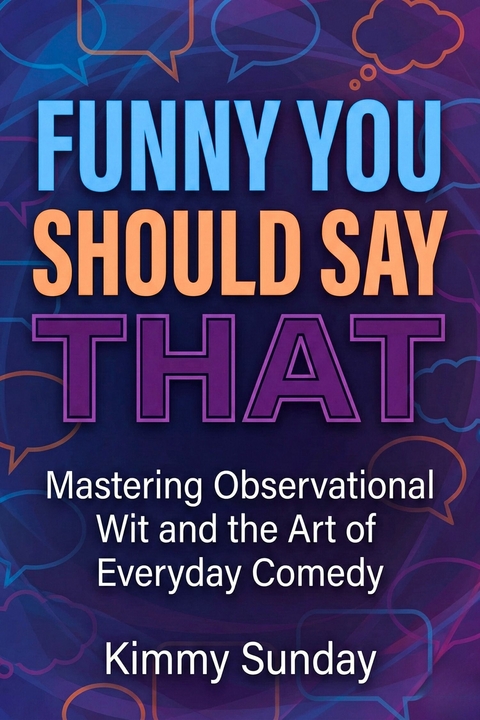
Funny You Should Say That (eBook)
245 Seiten
JNR Publishing (Verlag)
978-0-00-113227-6 (ISBN)
Transform Your Everyday Observations into Razor-Sharp Wit and Hilarious Comedy!
Ever had a thought so funny-so universally true about daily life-that you just knew it could be comedy gold? Do you want to master the art of observational humor and craft witty dialogue that leaves audiences in stitches?
Then Funny You Should Say That: Mastering Observational Wit and the Art of Everyday Comedy by Kimmy Sunday is the indispensable guide you need to sharpen your comedic senses and write material that truly connects.
This comprehensive, step-by-step book demystifies the process of creating hilarious everyday comedy, focusing on the power of keen observation, clever wordplay, and authentic characterization. Kimmy Sunday offers a treasure trove of practical techniques for aspiring sitcom writers, sketch comedians, stand-up artists, humorous bloggers, and anyone who wants to elevate their funny storytelling by mastering observational wit.
With Funny You Should Say That, you'll learn precisely how to:
Uncover Comedic Gems in the Mundane: Develop an unerring eye for the absurdities and ironies hidden in plain sight in your daily routines and interactions.
Craft Memorable, Flawed Characters: Build believable and hilarious characters whose quirks, contradictions, and everyday struggles drive your comedy.
Write Dialogue That Sparkles: Master natural-sounding banter, sophisticated wordplay, subtext, and character-specific voices that bring your scenes to life.
Perfect Your Comedic Timing & Pacing: Understand scene structure, the Rule of Three, the power of pauses, and visual gags to maximize laughs.
Turn Personal Insights into Universal Humor: Authentically mine your own experiences and perspectives to create comedy that resonates deeply.
Sharpen and Edit Your Jokes: Learn to spot flat material, trim setups, polish punchlines, and troubleshoot your writing for maximum comedic impact.
Develop Your Unique Comedic Persona: Cultivate a distinct voice and persona that makes your observational wit stand out.
Master Callbacks & Running Gags: Add layers of cleverness and reward your audience with perfectly timed comedic echoes.
Filled with insightful analysis of comedic principles (including the psychology of why we laugh), practical exercises to hone your skills, case studies of masters of observational comedy, and crucial advice on the ethics and business of humor writing, this book is your complete workshop for mastering everyday comedy.
Funny You Should Say That isn't just about telling you what makes things funny-it shows you how to find it, shape it, and deliver it with precision and flair. It's time to turn those keen observations into comedy that gets everyone saying, 'It's funny you should say that... because it's so true!'
With a comprehensive structure covering everything from sourcing inspiration and navigating cultural sensitivities to collaborating with performers and structuring different comedic forms, Funny You Should Say That is the definitive resource for any writer serious about mastering the art of observational wit and everyday comedy.
1
CHAPTER 1: DEFINING EVERYDAY COMEDY
Well, hello there, future purveyor of punchlines, maestro of the mundane! So, you want to wring laughter from the everyday? Excellent choice. While some comedians chase the fantastical, we, brave souls, are diving headfirst into the glorious, messy, and often downright bizarre reality of day-to-day existence. This isn’t about dragons (unless it’s about the ‘dragon’ of a mother-in-law visiting unexpectedly) or intergalactic space battles (unless it’s the silent, passive-aggressive battle for the last slice of pizza in the office). Everyday comedy is about finding the funny in what’s familiar, what’s relatable, and what makes us all nod and say, “Oh, I’ve so been there.”
1.1 Recognizing Humor in Mundane Situations: The Art of the Comedic Squint
Let’s be honest, life can be a bit of a slog. Alarm clocks shriek, toast burns, emails pile up like uninvited guests, and sometimes the most exciting part of your day is finding a matching pair of socks. But within this tapestry of trivialities lies a goldmine of comedic material. The trick is to develop what I like to call the “comedic squint” – learning to look at ordinary situations from a slightly skewed, playful perspective.
Think about it: comedy isn’t always born from grand, dramatic events. More often, it’s the little absurdities that tickle our funny bones. It’s the universal struggle of assembling flat-pack furniture that comes with instructions seemingly translated from ancient hieroglyphics by a disgruntled intern. It’s the silent fury of getting a parking ticket when you swore you had three minutes left on the meter. It’s the existential crisis you have in the supermarket aisle, staring at fifty-seven varieties of mustard and wondering if your life choices led you to this specific condiment conundrum. These are the moments, dripping with relatability, that are ripe for comedic picking.
To truly master this, you need to cultivate a state of perpetual, playful curiosity. Be an observer, a people-watcher, a collector of quirks. Notice the tiny, often overlooked details: the way your boss’s eye twitches when someone says “synergy,” the elaborate ritual your neighbor performs to retrieve their mail, the synchronized sigh of a crowded elevator when it stops at every single floor. These details are the seasoning in your comedic stew.
But observation alone isn’t enough. Perspective is the magic ingredient. You need to be able to step back, even from your own frustrations, and find the incongruity, the unexpected twist, the element that flips a situation from annoying to amusing. That disastrous first date where you spilled red wine down your white shirt? Mortifying at the time, perhaps, but with the comedic squint, it’s a relatable tale of romantic misadventure. The aim is to train your brain to constantly ask, “What’s funny about this?” even when “this” is your car refusing to start in a torrential downpour. It’s not always easy, especially when you’re the one getting soaked, but it’s a skill that, once honed, will make your world a much funnier place.
1.2 Historical Context: Learning from the Masters of the Mundane – Observational and Situational Comedy
Everyday comedy didn’t just spontaneously appear like a mysterious stain on your favorite carpet. It has a rich lineage, primarily rooted in observational and situational comedy. Understanding these foundations can provide a fantastic springboard for your own work.
Observational comedy, as the name suggests, is all about noticing and commenting on the peculiarities of everyday life. Think of the legendary George Carlin dissecting the absurdity of “stuff” or Jerry Seinfeld questioning the minutiae of social conventions – “What’s the deal with airline peanuts?”. These comedic giants took common experiences, things we all see and do, and held them up to a humorous light, dissecting them with a sharp wit that made us exclaim, “It’s so true!”. They found the universal in the specific, the extraordinary in the ordinary.
Situational comedy (sitcom), on the other hand, crafts humor from the circumstances characters find themselves in, and their often hilariously flawed reactions to those circumstances. Classic sitcoms like “I Love Lucy,” where Lucy Ricardo’s harebrained schemes inevitably led to comical chaos (the chocolate factory scene, anyone?), or “Fawlty Towers,” where Basil Fawlty’s ineptitude and rage created a pressure cooker of hilarity, are prime examples. The humor here often arises from escalating misunderstandings, personality clashes, and characters trying (and failing) to navigate relatively normal settings in increasingly ridiculous ways.
Modern everyday comedy is often a delightful blend of these two traditions. Observational insights provide the relatable core – the “what’s the deal with this?” kernel of truth. Situational frameworks then give these observations a stage to play out, allowing characters to embody and react to these everyday absurdities. The result is a rich, textured humor that audiences connect with on multiple levels, seeing both the funny in the observation and the funny in the characters’ responses to it.
1.3 Why Relatability Resonates: The “Hey, Me Too!” Factor
At its heart, the immense power of everyday comedy lies in one simple, profound word: relatability. When an audience sees their own experiences, frustrations, and foibles reflected on stage, screen, or page, it creates an instant connection, a spark of recognition. It’s that “Hey, me too!” feeling, the quiet (or not-so-quiet) acknowledgment that you’re not alone in your struggles with self-checkout machines or your irrational fear of pigeons.
This shared experience is incredibly validating. The comedian or writer, by highlighting the humor in these common situations, essentially says, “I get it. I’ve been there. Isn’t it ridiculous?”. This is why everyday comedy has such broad appeal; it doesn’t rely on niche knowledge or obscure cultural references. It taps into universal human experiences: the agony of a terrible blind date, the quiet desperation of a never-ending Zoom meeting, the baffling behavior of toddlers, the eternal quest for a comfortable office chair.
When your audience can see themselves in your comedy, they are far more likely to laugh, to engage, and to feel a genuine bond with your work and your characters. This connection is gold. It’s what builds a loyal following and creates comedy that doesn’t just get a quick laugh but lingers in the mind.
Furthermore, relatability can be a surprisingly potent vehicle for social commentary. By finding the humor in the everyday absurdities we all navigate – the baffling bureaucratic processes, the ridiculous consumer trends, the unwritten rules of social media – comedians can offer a subtle but sharp critique of societal norms and values. You can make people think while they’re laughing, prompting conversations and gently challenging assumptions, all under the guise of talking about something as simple as why printers only seem to run out of ink when you have an urgent deadline.
1.4 Balancing Subtle vs. Overt Jokes: The Art of the One-Two Punch and the Slow Burn
Crafting effective everyday comedy involves a delicate dance between the subtle and the overt, the gentle nudge and the comedic slap. Not all jokes need to arrive with a flashing neon sign and a drumroll.
Subtle humor is the ninja of comedy. It creeps up on you. It relies on understatement, irony, wit, and keen observation. It’s the joke that might take a second or two to land, prompting a thoughtful chuckle or a knowing smile as the audience connects the dots. Think of the dry wit in “The Office,” where a character’s subtle eye-roll or a deadpan delivery can speak volumes. This kind of humor adds layers, depth, and sophistication to your work. It trusts the audience’s intelligence.
Overt humor, on the other hand, is the life of the party. It’s more direct, more obvious, and often elicits an immediate, visceral laugh. This can be a well-timed physical gag, a sharp punchline, or an exaggerated reaction. Think of Lucy Ricardo’s face covered in chocolate or a character slipping on a banana peel (a classic for a reason, though perhaps best used with a fresh twist these days!). Overt humor provides those big, satisfying laugh-out-loud moments.
So, which is better? Neither. Or rather, both! The most effective everyday comedy usually employs a mix. Relying too heavily on overt jokes can make your comedy feel one-note, predictable, or even a bit cheap. Conversely, a constant stream of only subtle humor might leave some audience members behind or make the work feel a tad too highbrow or inaccessible.
The real skill lies in understanding the rhythm of your comedy and the needs of your audience. Sometimes you want to build humor slowly with a series of subtle observations, culminating in a more overt...
| Erscheint lt. Verlag | 18.12.2025 |
|---|---|
| Sprache | englisch |
| Themenwelt | Geisteswissenschaften ► Sprach- / Literaturwissenschaft |
| ISBN-10 | 0-00-113227-X / 000113227X |
| ISBN-13 | 978-0-00-113227-6 / 9780001132276 |
| Informationen gemäß Produktsicherheitsverordnung (GPSR) | |
| Haben Sie eine Frage zum Produkt? |
 EPUB (Adobe DRM)
Größe: 2,1 MB
Kopierschutz: Adobe-DRM
Adobe-DRM ist ein Kopierschutz, der das eBook vor Mißbrauch schützen soll. Dabei wird das eBook bereits beim Download auf Ihre persönliche Adobe-ID autorisiert. Lesen können Sie das eBook dann nur auf den Geräten, welche ebenfalls auf Ihre Adobe-ID registriert sind.
Details zum Adobe-DRM
Dateiformat: EPUB (Electronic Publication)
EPUB ist ein offener Standard für eBooks und eignet sich besonders zur Darstellung von Belletristik und Sachbüchern. Der Fließtext wird dynamisch an die Display- und Schriftgröße angepasst. Auch für mobile Lesegeräte ist EPUB daher gut geeignet.
Systemvoraussetzungen:
PC/Mac: Mit einem PC oder Mac können Sie dieses eBook lesen. Sie benötigen eine
eReader: Dieses eBook kann mit (fast) allen eBook-Readern gelesen werden. Mit dem amazon-Kindle ist es aber nicht kompatibel.
Smartphone/Tablet: Egal ob Apple oder Android, dieses eBook können Sie lesen. Sie benötigen eine
Geräteliste und zusätzliche Hinweise
Buying eBooks from abroad
For tax law reasons we can sell eBooks just within Germany and Switzerland. Regrettably we cannot fulfill eBook-orders from other countries.
aus dem Bereich