


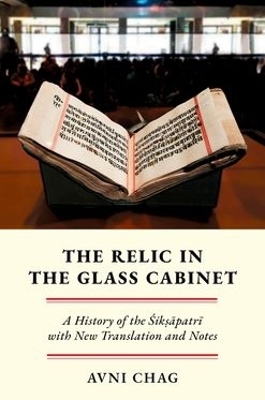
The Relic in the Glass Cabinet
A History of the Śikṣāpatrī with New Translation and Notes
Seiten
2026
Oxford University Press Inc (Verlag)
978-0-19-782763-5 (ISBN)
Oxford University Press Inc (Verlag)
978-0-19-782763-5 (ISBN)
- Noch nicht erschienen (ca. Juli 2026)
- Versandkostenfrei
- Auch auf Rechnung
- Artikel merken
The Shikshapatri (1826) is a scripture presented as a letter to devotees from Swaminarayan (1781-1830), the founder and principal deity of the eponymous Swaminarayan tradition. Designated by millions as a revelatory scripture down to the belief of its divine authorship, the text is treated as a succinct and authoritative index of Swaminarayan beliefs and practices. Early manuscripts of the text are so cherished that some, like the one enclosed in a glass cabinet in the Oxford Bodleian libraries, are treated as relics.
For the first time, Avni Chag's thorough text and historical analysis of the Shikshapatri adds nuance to the story of its canonization. Featuring the first English translation of an earlier, shorter version of the text (1823), The Relic in the Glass Cabinet submits the text's authorship, intent, and historical development to critical scrutiny. Based on a comparative study of two Shikshapatri recensions, Chag demonstrates that the text did not originally align with the specific Vaisnava theological identity it now claims. Instead, doctrinal commitments were added after Swaminarayan's passing, fundamentally reshaping how the text, its author, and his tradition have been understood.
The Relic in the Glass Cabinet offers novel dimensions to existing scholarly interpretations of early Swaminarayan history, theology, and literature. It tells an untold story of the complex histories of textual production, exploring the interplay between historically contingent circumstances and inherited, albeit negotiated, religious ideas and practices, all at the formative moment of a tradition's inception in early nineteenth-century western India, present day Gujarat.
For the first time, Avni Chag's thorough text and historical analysis of the Shikshapatri adds nuance to the story of its canonization. Featuring the first English translation of an earlier, shorter version of the text (1823), The Relic in the Glass Cabinet submits the text's authorship, intent, and historical development to critical scrutiny. Based on a comparative study of two Shikshapatri recensions, Chag demonstrates that the text did not originally align with the specific Vaisnava theological identity it now claims. Instead, doctrinal commitments were added after Swaminarayan's passing, fundamentally reshaping how the text, its author, and his tradition have been understood.
The Relic in the Glass Cabinet offers novel dimensions to existing scholarly interpretations of early Swaminarayan history, theology, and literature. It tells an untold story of the complex histories of textual production, exploring the interplay between historically contingent circumstances and inherited, albeit negotiated, religious ideas and practices, all at the formative moment of a tradition's inception in early nineteenth-century western India, present day Gujarat.
| Erscheint lt. Verlag | 3.7.2026 |
|---|---|
| Reihe/Serie | AAR Religion in Translation |
| Verlagsort | New York |
| Sprache | englisch |
| Maße | 156 x 235 mm |
| Themenwelt | Geisteswissenschaften ► Geschichte ► Regional- / Ländergeschichte |
| Geschichte ► Teilgebiete der Geschichte ► Religionsgeschichte | |
| Geisteswissenschaften ► Religion / Theologie ► Hinduismus | |
| ISBN-10 | 0-19-782763-2 / 0197827632 |
| ISBN-13 | 978-0-19-782763-5 / 9780197827635 |
| Zustand | Neuware |
| Informationen gemäß Produktsicherheitsverordnung (GPSR) | |
| Haben Sie eine Frage zum Produkt? |
Mehr entdecken
aus dem Bereich



aus dem Bereich
von der Antike bis zur Gegenwart
Buch | Softcover (2025)
C.H.Beck (Verlag)
CHF 16,80


