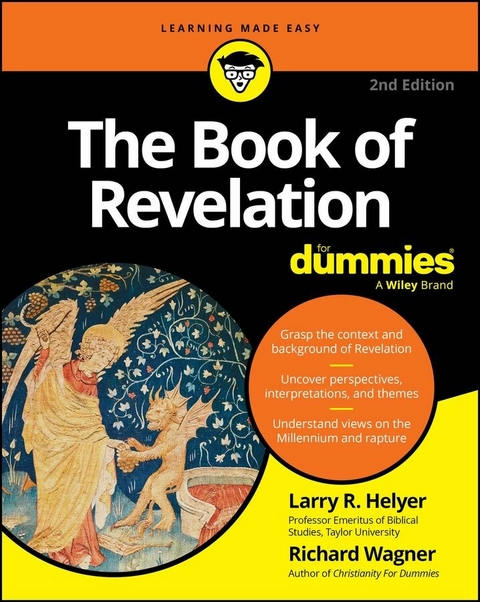
The Book of Revelation For Dummies (eBook)
361 Seiten
For Dummies (Verlag)
978-1-394-37084-9 (ISBN)
An approachable guide to the Apocalypse of John
The Book of Revelation For Dummies, 2nd Edition walks you through one of the Bible's most fascinating, complex, and extraordinary books. Revelation, also commonly known as the End Times, is the final book of the New Testament. This guide decodes the purposes, key themes, and symbolism (such as seals, trumpets, bowls, and more)-exploring what this says about our past, present, and future and how it correlates to the rest of the Bible.
This guide puts Revelation into biblical and historical context and explains the role of the apostle John. You'll learn about the book's prophecies and the different perspectives you can use to understand its lessons in larger contexts.
Inside:
- Find out information that helps you visualize and understand the foundations of Revelation
- See different views and interpretations of Revelation-including premillennialism, amillennialism, and postmillennialism
- Know who the Apostle John is and his significance
- Discover in-depth discussions on Jesus, the Antichrist, heaven, hell, the rapture, and more
Perfect for Christians wanting to better understand the Book of Revelation or anyone wanting to know more, The Book of Revelation For Dummies, 2nd Edition helps you uncover what this book means.
Larry R. Helyer, PhD is Professor Emeritus of Biblical Studies at Taylor University. He holds an M. Div. from Western Seminary and a PhD in New Testament from Fuller Theological Seminary. Larry also serves as a teacher in Providence Bible Academy.
Richard Wagner was the author of C. S. Lewis & Narnia For Dummies, Christianity For Dummies, Christian Prayer For Dummies, The Book of Revelation For Dummies, and more.
Introduction
Acommon cartoon theme involves a person wearing a sandwich sign or carrying a poster that proclaims, “Repent! The end is near!” What’s implied is that some sudden, violent event is just around the corner and that people need to brace themselves for whatever’s coming. And usually, the end that’s near involves something terrifying.
The idea of a dramatic and destructive end to the earth has been around for ages. It’s the stuff of some great sci-fi movies, and a lot of the elements that go into these stories come right out of the Bible. In fact, terms such as repent and antichrist and Armageddon are direct references to messages, characters, and events that make up the book of Revelation. When you examine these themes and images in the context of religion, faith, and biblical history, things get even more interesting.
The book of Revelation is not an easy read. Some people, after slogging through Revelation, seem to suffer from PTRRD: Post-Traumatic Revelation Reading Disorder. Maybe you’ve had this experience. You start reading with a rush of enthusiasm, and all goes well through the first three chapters and their letters to the seven churches. Then things start to get hairy: visions from heaven, creatures with eyes covering their bodies, plagues, horses of different colors, angels everywhere. Seven seals are opened, seven trumpets are sounded, seven bowls are poured out, and things get really confusing. Throw in grapes of wrath, red dragons, giant hail, and something called the rapture, and, well, you get the idea. Lost becomes more than just the name of a television series — it’s the perfect descriptor of your mental state.
My intent is to help you avoid PTRRD. I act as your tour guide to help you navigate the amazing book of Revelation. Even if you can’t figure out every single detail, clues that open large chunks of the text abound. I promise you’ll come away with a better understanding of what Revelation is about, as well as a ton of cool information that you can sprinkle into conversations and impress your friends!
About This Book
The first thing you may discover is that there’s no consensus on how to interpret the book of Revelation. About the only thing all serious students of Revelation can agree on is that in the end, good wins over evil. Theological views about what happens, when it happens, and to whom it happens vary widely. In The Book of Revelation For Dummies, 2nd Edition, I introduce the leading views and point you to some of the most likely meanings.
Revelation is arguably the most perplexing book in all the Bible, so my goal is to be clear and concise. Therefore, I aim for an easy-to-understand, approachable discussion, without trying to bombard you with a lot of theological gobbledygook.
The topics in the book are logically ordered, so you can read from start to finish if you want to. But this is a reference book, so don’t feel you have to read it from cover to cover. You may prefer to browse the Table of Contents, flip through the pages, or thumb through the index to locate a topic that you find particularly engaging.
To make sure you get the most out of this book, keep the following conventions and definitions in mind.
- Apocalypse: The word apocalypse has become associated with a devastating event, including the end of the world. But the primary meaning is “an unveiling or revealing.” The book of Revelation reveals how the world ends and so is called an apocalypse. Scholars refer to any literature that addresses the end of the world as apocalyptic.
-
Bible references: The Bible verses I quote are from the New Revised Standard Version translation, unless otherwise noted. I cite passages using the standard convention, Book chapter: verse. For example, John 3:16 refers to John as a book of the Bible, 3 as a chapter of the book, and 16 as a verse in the chapter. If you don’t see a colon in a Bible reference, the number refers to an entire chapter; in other words, Rev. 4–5 means chapters 4 through 5 of the book of Revelation.
When I refer to the Old Testament, I’m talking about the sacred Scriptures that Christianity shares with Judaism. Jews refer to them as the Tanak, or Hebrew Bible. For Protestants and Jews, they consist of the same 39 books; Catholics include several additional books, collectively called the Apocrypha.
I occasionally refer to Jewish works that aren’t part of the Bible, such as 1 Enoch. If you’re really interested in reading the book of 1 Enoch, check out the English translation with introduction and notes by E. Isaac in James H. Charlesworth, ed., Volume 1. The Old Testament Pseudepigrapha: Apocalyptic Literature & Testaments (Doubleday). See also Larry R. Helyer, Exploring Jewish Literature of the Second Temple Period: A Guide for New Testament Students (InterVarsity).
- Christianity: For the purposes of this book, historic Christianity, biblical Christianity, and orthodox Christianity are interchangeable terms. Each speaks of beliefs that the church has historically held for some 2,000 years. Simply put, Christianity is Trinitarian (believing in one God existing in three persons, Father, Son, and Holy Spirit), based on the life, death, and resurrection Jesus Christ and his teachings, and embraces the entire Bible as authoritative and reliable.
- Dates: When I refer to dates, I use the newer designations BCE (before common era) and CE (common era) rather than the more traditional BC (before Christ) and AD (Anno Domini, in the year of the Lord). If you’re unfamiliar with the newer terms, no sweat. The year 34 BCE is the same as 34 BC, and 1050 CE is equivalent to AD 1050.
- Names of God: Although God has many names, I generally use God and Lord in this book. Also, in accordance with historical usage, I use the traditional masculine pronoun he to refer to God.
-
Prophecy and prophesying: People often think of prophecy as being limited to future events. But from a biblical perspective, prophecy is a noun that refers to something more general: the act of speaking the mind and counsel of God. Biblical prophets were, in a sense, the mouthpiece of God, delivering important information to God’s people. Biblical prophecy, among other things, addressed current events, offered guidance on behavior, revealed elements of the character of God, reassured God’s people, and often predicted future events. Sometimes, prophecy about the future was conditional: If bad behavior continued, bad things would happen; if behavior was brought back in line with God’s will, bad things would be averted. The point is that biblically speaking, prophecy is more about forthtelling (preaching) than foretelling.
Note that prophesy is a verb describing what prophets do: Prophets prophesy prophecy!
- Cross-references: Cross-references to another chapter within this book are capitalized by the word Chapter before the chapter number; when referring to a book of the Bible, the word chapter is lowercased.
Foolish Assumptions
In writing this book, I don’t assume any religious commitment for the reader. Regardless of your faith background, you’re probably curious about biblical prophecy and the book of Revelation. If so, this book’s for you!
Although I don’t assume you have previous knowledge of the Christian Bible, you probably have access to one — either in print or online — so you can check out references to specific Bible passages.
Icons Used in This Book
The icons in this book help you quickly identify specific kinds of information that may be of use to you:
The Remember icon highlights important ideas for you to keep in mind to deepen your understanding of Revelation.
This icon draws attention to important points that help you make sense of Revelation’s prophecy.
Steer clear of the pitfalls flagged in the Warning paragraphs.
The Technical Stuff icon indicates more advanced or scholarly information about the topic being discussed. It’s useful but not essential for an overall understanding of the discussion.
Beyond the Book
If you're looking for a handy reference to quickly access key information, consider visiting the Dummies website to find the Cheat Sheet created for this book. Just head to www.dummies.com and search for “Revelation For Dummies” to get concise summaries and tips.
The Cheat Sheet gives you a brief overview of the book's content, providing both a structured outline of Revelation and clear explanations of key terms to help you understand the different ways it can be interpreted. Important reading strategies are emphasized, and you’ll also find a chart that summarizes the main perspectives on the Millennium, allowing you to quickly compare each viewpoint and see how it influences other themes throughout Revelation.
Where to Go from Here
Revelation For Dummies, 2nd Edition, is organized into four sections:
- Part 1 serves as a guide to the book’s structure; delves into questions about the author’s identity, era, and context; and highlights key Old Testament...
| Erscheint lt. Verlag | 30.12.2025 |
|---|---|
| Sprache | englisch |
| Themenwelt | Geisteswissenschaften ► Religion / Theologie ► Christentum |
| Schlagworte | Antichrist • Apostle John • Bible prophecy • Biblical Prophecy • Christian end times • Christianity for beginners • Christian prophecy • End times • history of revelation • John the Apostle • millennium prophecy • Revelation Prophecy • the rapture |
| ISBN-10 | 1-394-37084-9 / 1394370849 |
| ISBN-13 | 978-1-394-37084-9 / 9781394370849 |
| Informationen gemäß Produktsicherheitsverordnung (GPSR) | |
| Haben Sie eine Frage zum Produkt? |
 EPUB (Adobe DRM)
Kopierschutz: Adobe-DRM
Adobe-DRM ist ein Kopierschutz, der das eBook vor Mißbrauch schützen soll. Dabei wird das eBook bereits beim Download auf Ihre persönliche Adobe-ID autorisiert. Lesen können Sie das eBook dann nur auf den Geräten, welche ebenfalls auf Ihre Adobe-ID registriert sind.
Details zum Adobe-DRM
Dateiformat: EPUB (Electronic Publication)
EPUB ist ein offener Standard für eBooks und eignet sich besonders zur Darstellung von Belletristik und Sachbüchern. Der Fließtext wird dynamisch an die Display- und Schriftgröße angepasst. Auch für mobile Lesegeräte ist EPUB daher gut geeignet.
Systemvoraussetzungen:
PC/Mac: Mit einem PC oder Mac können Sie dieses eBook lesen. Sie benötigen eine
eReader: Dieses eBook kann mit (fast) allen eBook-Readern gelesen werden. Mit dem amazon-Kindle ist es aber nicht kompatibel.
Smartphone/Tablet: Egal ob Apple oder Android, dieses eBook können Sie lesen. Sie benötigen eine
Geräteliste und zusätzliche Hinweise
Buying eBooks from abroad
For tax law reasons we can sell eBooks just within Germany and Switzerland. Regrettably we cannot fulfill eBook-orders from other countries.
aus dem Bereich