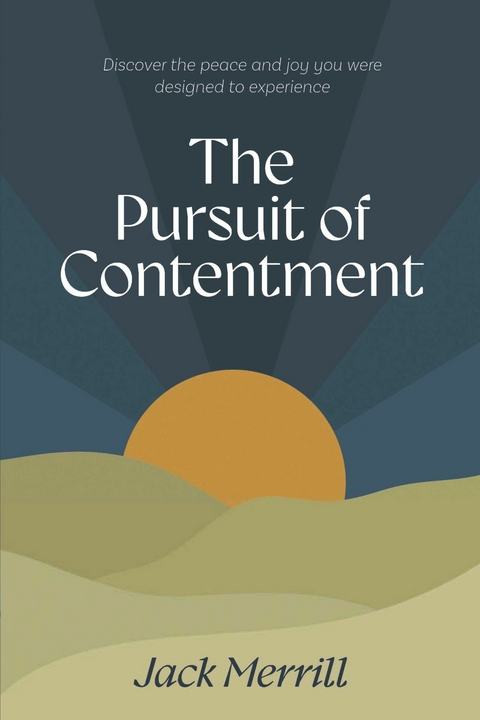
Pursuit of Contentment (eBook)
172 Seiten
Bookbaby (Verlag)
979-8-3509-7914-5 (ISBN)
Jack Merrill is an Associate Pastor at Poinciana Christian Church in Kissimmee, Florida. He loves helping people grow in their faith and educating people on how to apprentice under Jesus. One of the ways he loves doing this is through teaching and preaching. One of his passions is helping people who find themselves burdened with guilt, financial problems, fear, marriage issues, and many other things. His favorite pastime is going to Disney World with his wife of 9 years and two young daughters.
As I prayed for relief from my guilt at Disney World, I was gifted with a conviction to be content. I realized shortly after that I never truly understood what contentment was. I guess I imagined it meant not owning many possessions or intentionally living in poverty. This prompted me to launch an investigation into true contentment, and I found it in a letter written by Paul to the church of Philippi. I am not saying this because I am in need, for I have learned to be content whatever the circumstances. I know what it is to be in need, and I know what it is to have plenty. I have learned the secret of being content in any and every situation, whether well fed or hungry, whether living in plenty or in want. I can do all this through him who gives me strength (Philippians 4:11-13). When I first read this verse, I felt like Paul's Spiritual maturity seemed undesirable or an unrealistic goal to reach. I was taught having less meant you would be less happy and that if you had more, you would be happier. How could you live in a state of contentment regardless of possessions or accomplishments? Perhaps I was confused because I was indirectly taught, for a long time, that contentment was not a good thing. It was a lifestyle adopted by the lazy, or a cop out for those who didn't want more in life. Perhaps we got it wrong. Perhaps Paul was on to something that most of us can't grasp because we have fallen victim to what the world and the devil want us to believe. This is why many of us have not experienced the gift of contentment. If you are new to the importance of contentment, I want to direct you to the ancient language of the New Testament Greek. The first time Paul mentions contentment in verse 11, we see the Greek word autarkes. This is the only time this word is used in the New Testament. It means to be in a "e;happy state of mind"e; or "e;self-sufficiency"e;. In verse 12, Paul uses the word contentment again. This time it has a little bit of a different definition. The word is chortazo, which means "e;Be Full"e; as if someone ate so much and could not take another bite. Now, what's fascinating is the Greek word chortazo is also used by Jesus when he was preaching the sermon on the mount. Blessed are those who hunger and thirst for righteousness, for they will be filled. (Matthew 5:6) Let's translate. Blessed are those who hunger and thirst for righteousness, for they will be content. Now, let's go back to Philippians 4:11-13 I am not saying this because I am in need, for I have learned to be content (In a happy state of mind) whatever the circumstances. I know what it is to be in need, and I know what it is to have plenty. I have learned the secret of being content (Be full in Christ) in any and every situation, whether well fed or hungry, whether living in plenty or in want. I can do all this through him who gives me strength Paul had an appetite for the things of this world just like we all do. Yet, he found contentment because he was filled up on God. He was hungry and thirsty for righteousness and had no more room for the things of this world. This is why materialism had no power over him. This is why his circumstances didn't determine his peace and joy. Paul learned this from Jesus. Contentment allows us to experience peace and joy in ways we've never felt before. It does not take place in the physical; it takes place in the soul. When we are filled up with Christ, it allows us to know who we are in Christ, and it allows Christ to fulfill his work in us. This allowed Paul to rejoice whether he was in his jail cell or feasting with his friends. He had learned to live in either state. How? Paul explains.... I can do all this through him who gives me strength Phil 4:13.
Envy
A heart at peace gives life to the body, but envy rots the bones
(Proverbs 14:30)
A while ago my uncle told me of a time when he had a close encounter with a bear while living in Alaska. He was jogging through the woods when suddenly he found himself a few yards away from a bear. Fortunately, he had bear spray with him. He sprayed the bear, and it ran away. What you need to know is he almost didn’t bring his bear spray with him. His wife (my aunt) convinced him to take it before he went out on his run. So, if you wanted to name this story something you could name it, the time my Aunt Kathy saved my Uncle Mike from a bear. I’m sure she would like that. My Uncle Mike wasn’t ignorant of bears, he just didn’t think during this run that he would encounter one.
Understand that as you continue to take the path that leads to contentment, there is a predator lurking in the shadows waiting to pounce on you. His name is the Devil. He wants to keep you from the fullness of God. That is why he is going to use one of his best obstacles to trip you up. The temptation of envy. If you are not informed or prepared for this temptation, you are going to be like a man in the woods, face to face with a bear, and no bear spray.
I was born in the 90’s, so in my young teenage years I was heavily exposed to MTV Cribs. This popular tv show showcased the homes of well-known celebrities. The celebrity list would include national icons like Lil Wayne, Tony Hawk, Mariah Carey and many more! The houses that were showcased on the show were amazing. Some had private basketball courts, luxurious bedrooms and of course some would even have a fleet of cars. Suddenly, my parents’ house felt smaller, and my basketball hoop in the driveway didn’t seem like anything to brag about. This is what envy does. It makes other people’s lives feel bigger and your life feel smaller. As a teenager I felt if I couldn’t have the mansion anything less would be disappointing.
Years later it is no surprise I felt that same way when I went to Disney World. I observed all the tourists in the Disney parks who seemed to be having more fun than I was because they were eating at the nice restaurants and staying at the luxurious hotels. In my envy, I felt my Disney annual passes were not enough. If I couldn’t eat at the fun restaurants and stay at the nice hotels, anything less would feel like a disappointment. In other words, if I can’t afford to spend a few thousand dollars at Disney world (which I couldn’t afford), Disney wouldn’t be as enjoyable.
Envy is a cunning temptation because it doesn’t display itself like an elephant in your living room. It starts with a gentle whisper. Wouldn’t life be better if you could just have that one thing? We hear the whisper when we are young and your best friend in first grade has a toy you don’t have. We hear the whisper again and begin to believe life would be so much better if we could acquire the game system our cousin just got for Christmas. Before we know it, as adults we chase a lifestyle we see our friends and peers living. We don’t even realize that if we never saw that toy, game system or lifestyle we would never have known what we were missing. That is why most of us feel so empty even after we achieved what we thought would make us happy. Our life has fallen victim to the toxicity of envy. Don’t worry, we aren’t the first ones.
The Origin of Envy
In the Garden of Eden, Eve could eat anything her heart desired. Except for the tree of good and evil. Ironically if this tree had never been in the garden, she would never have known what she was missing. Even as it stood there, Eve wasn’t tempted until the devil told her she would have the knowledge of God if she ate from this tree. She never knew this was an option. She fell for the trap. So did Adam. They were tossed out of the garden. Envy destroyed the perfect unity they had with God. They never knew what the taste of this fruit would cost them. So it goes with envy. Envy is the poison that distracts us from experiencing the gifts God has given us. Think of the beautiful garden of Eden. Eve had it all. Her envy for more knowledge stole all of it away.
A couple of weeks ago my wife and I drove to Winter Park, Florida to go to a store called Trader Joes. We had never been and wanted to check it out. As we were leaving, we were commenting on how beautiful and quiet the store parking lot was. The older you get the more you appreciate these things. We started to discuss how beautiful and safe Winter Park is. We both dreamed and longed to live in a place like that. The average price of a home in Winter Park is just over six hundred thousand dollars. So, it is no surprise why this is such a delightful place to live. We didn’t realize it at the time, but we envied the residents of Winter Park. In our envy, we simply told God our residence was not sufficient. In that moment, we were not content with what we had. You might be thinking we are being too hard on ourselves. It is normal for humans to practice such behavior. Let us be honest. Normal is not working right now. If we looked at the data, we would realize the mental health trends are worsening. Trust me, envy is part of the problem.
According to health studies 42.5 million adults are struggling with anxiety. Then, you have 21.7 million struggling with depression. You might be thinking what these statistics have to do with envy. According to the National library of medicine, they found people who have consistent levels of envy over time lead to inferiority and a depressed state. In clear terms, the longer we live in a state of envy, the more likely we are to become depressed. That is why something that seems harmless like wishing to live in a higher-class neighborhood must be met with caution.
Envy is not just making us anxious and depressed. It is also producing a spirit of entitlement. This idea that we deserve something we do not currently own is contrary to what James tells us in his letter to the church. Every good and perfect gift is from above, coming down from the Father of the heavenly lights, who does not change like shifting shadows (James 1:7). To translate, everything good in your life is from God. If that good thing you would like to buy is not currently in your life, it is not a gift from God. At least not yet. The longer you wish for the things you do not have, the more you will repel God’s present gifts. For example; My wife and I own a 1,400 square foot house in a city called Kissimmee. Our house has 3 beds and 1 bath. We love our house. When we bought it three years ago, we were ecstatic. We were praising God for the provision and the timing. We could not have done it without him. Here is the problem. Three years later we sometimes wish we could have a bigger house. Do we need a bigger house? No. Could we afford a bigger house? Not with these interest rates! Yet sometimes we find ourselves discontented and wanting more. Do you see the contradiction? What happened to the ecstatic couple that was so excited about their current house? Now, they want a new one. What changed? We saw nice houses in a better neighborhood. We saw houses that were better taken care of in a more desirable location. We are back in Eden and have our sights on something we do not currently have.
The side effects of Envy
The problem with envy is that it is not a viable long-term option. It is a never-ending depressing state. We just learned that from the health experts. Even the wisest man to ever live, said this about envy; “A heart at peace gives life to the body, but envy rots the bones” (Proverbs 14:30). There is nothing good that can come from envy. It is like a locust that takes life out of everything good around you. Yet, knowing all of this, why do people still fall into this trap? One, because it is normalized. We are told it is okay to want more, no matter the cost. Being thankful for what you have is contradictory to culture. The other factor is that envy is a sin and like most sin, envy feels good in the moment.
Let us become super transparent for a moment. Whether you are married or single, you have probably been tempted to think about having sexual relations with someone that you are not supposed to. Now, before you get too judgmental or too defensive, the aim here is to be honest with our shortcomings to overcome envy. We mentioned earlier that twenty five percent of married men end up having affairs. Why? Relevance, of course, is a driving factor. The other driving factor is you want what you have never experienced. Especially if you only have ever been with one person intimately. This breeds curiosity, just like it did for Eve in the garden. She was curious to know how the fruit tasted. But, perhaps in your curiosity, you forget the consequences. Your envious nature takes over and you are too enticed to resist.
Now, let us look at the second fastest growing addiction in America. The terrible habit of gambling. Twenty-three million Americans are crippled with gambling debt. As gambling becomes easier and easier, this number is only going to grow. What makes things worse are the opportunities lost over time by people who have gambled away their money. According to a 1996 survey, it is reported that the average gambler lost $115,000 in their lifetime. Imagine what that would be today with record growing inflation. Now, let us take that number of 115,000 (Which would be around 220,000 in 2023) and imagine you start gambling at age twenty and you go till seventy-five. That is...
| Erscheint lt. Verlag | 1.1.2025 |
|---|---|
| Sprache | englisch |
| Themenwelt | Geisteswissenschaften ► Religion / Theologie ► Christentum |
| ISBN-13 | 979-8-3509-7914-5 / 9798350979145 |
| Informationen gemäß Produktsicherheitsverordnung (GPSR) | |
| Haben Sie eine Frage zum Produkt? |
 EPUB (Ohne DRM)
Größe: 675 KB
Digital Rights Management: ohne DRM
Dieses eBook enthält kein DRM oder Kopierschutz. Eine Weitergabe an Dritte ist jedoch rechtlich nicht zulässig, weil Sie beim Kauf nur die Rechte an der persönlichen Nutzung erwerben.
Dateiformat: EPUB (Electronic Publication)
EPUB ist ein offener Standard für eBooks und eignet sich besonders zur Darstellung von Belletristik und Sachbüchern. Der Fließtext wird dynamisch an die Display- und Schriftgröße angepasst. Auch für mobile Lesegeräte ist EPUB daher gut geeignet.
Systemvoraussetzungen:
PC/Mac: Mit einem PC oder Mac können Sie dieses eBook lesen. Sie benötigen dafür die kostenlose Software Adobe Digital Editions.
eReader: Dieses eBook kann mit (fast) allen eBook-Readern gelesen werden. Mit dem amazon-Kindle ist es aber nicht kompatibel.
Smartphone/Tablet: Egal ob Apple oder Android, dieses eBook können Sie lesen. Sie benötigen dafür eine kostenlose App.
Geräteliste und zusätzliche Hinweise
Buying eBooks from abroad
For tax law reasons we can sell eBooks just within Germany and Switzerland. Regrettably we cannot fulfill eBook-orders from other countries.
aus dem Bereich