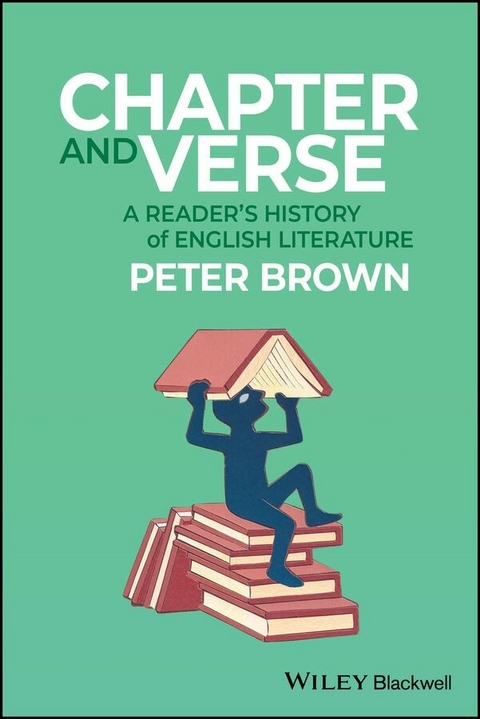
Chapter and Verse (eBook)
288 Seiten
Wiley-Blackwell (Verlag)
978-1-118-89390-6 (ISBN)
Presents a personal and thematic journey through English literature from Chaucer to the present
Chapter and Verse: A Reader's History of English Literature offers a compelling reimagining of literary history-one that places the reader's experience at the heart of the narrative. Unlike traditional surveys of English literature that prioritize chronology and critical consensus, Peter Brown's approach emphasizes the subjective, evolving relationship between reader and text. This unique perspective addresses a long-standing gap in the field, emphasizing the emotional and intellectual engagements that shape how literature is received, remembered, and reinterpreted across a lifetime.
Structured around thematic chapters-such as 'Performance,' 'Fragments,' and 'Home'- Chapter and Verse spans the medieval to the contemporary, exploring Chaucer, Shakespeare, Eliot, and other canonical figures alongside neglected or overlooked authors such as Charlotte Dacre and Abdulrazak Gurnah. Each chapter blends literary analysis with personal narrative, beginning with formative reading experiences and culminating in a scholarly vantage point honed over decades of teaching. The result is both intimate and instructive, offering detailed engagements with texts and authors contextualized within broader literary movements.
Uniquely integrating personal memoir with a thematic and chronological overview of English literature, Chapter and Verse:
- Explores literature's emotional and transformative power through lived reading experiences
- Reflects decades of university-level teaching across the full span of English literary history
- Provides accessible entry points into complex literary periods through thematic framing
- Includes notes and recommended readings at the end of each chapter to encourage further exploration
- Offers a fresh pedagogical approach that highlights how personal engagement can enhance critical analysis
Chapter and Verse: A Reader's History of English Literature is a must-read for advanced secondary students, undergraduates, and postgraduates studying English literature, as well as general readers seeking a more personal connection to the history of English literature.
PETER BROWN is Professor Emeritus of English at the University of Kent and former Academic Director of its Paris School of Arts and Culture. A Fulbright Scholar and founding editor-in-chief of Literature Compass, he also serves as general editor of the Blackwell Histories of Literature series. His teaching portfolio spans the full breadth of English literary history in both the UK and the US.
Prologue
Reading is a personal matter. We have individual preferences for one kind of writing over another, or for this author rather than that. We react to what we read in personal ways, finding likes and dislikes that are different from those of other readers. Our upbringing, cultural background, moods and personal circumstances all influence what we choose to read and how we respond to it. Occasionally we encounter a description or a poem that affects us deeply on a personal level, even to the point of changing us for better or worse. It is as if the book is reading us rather than being read. Some books have the power to do so again and again. But the book that works its magic for one person may be powerless to affect another.
What is at stake here is the way in which written stories and poems communicate. They do so one to one, directly and intimately, from the author to the reader, no matter how the process is dressed up in character, description, rhyme and other conventional trappings. There is always a person present in a piece of literature, even if it lacks characters: it is the author, engaged in an act of communication designed to appeal to the subjectivity of the reader. That is to say, the appeal is to the reader's imagination, thoughts, feelings and senses.
Defined like this, the personal quality of literary writing is what makes it distinct from other kinds of composition, such as scientific or philosophical writing, which has a more cerebral appeal, using objective evidence and logical argument to persuade its audience of particular conclusions. Which is not to say that literary composition does not appeal to the intellect. Far from it. It is just that the author of a literary work wants to invoke other, complementary, responses as well, and thereby to engage the whole person.
All too often, the personal impact of literature fades and is forgotten. What seemed profound in adolescence may look trite in maturity. But in other cases the original effect endures, clearly remembered and still felt. Then again, there are some works which when first encountered seem remote and inaccessible but which, when revisited, grow in meaning and significance. Over time, we deepen our understanding and appreciation of the works that continue to exert their power over us, and so form our own, individualised, reader's history.
There have been readers' histories as long as there have been readers, in the sense that each reader constructs their own sense of the development of literature, and of the place of one author in relation to another, on the basis of the books they encounter and of the supplementary knowledge they acquire. Nowhere is the existence of such histories more evident than in the records left by writers themselves.1 Geoffrey Chaucer, for example, writing in the later fourteenth century, regularly namedrops the works that he has read and leaves multiple traces of their influence on his own work. In the early 1800s, Jane Austen uses a person's reading history as an indicator of the quality of their character. For an individual's reading history is revealing. Patchy, quirky and idiosyncratic it may be, flitting back and forth between periods and countries, but it is eloquent testimony of that reader's interests, outlook and personality. What can give a reader's history its coherence and fascination is the extent to which it is a record of the books that left a mark, or were associated with a particular set of circumstances, or were channelled – for better or worse – by teachers. There is then a powerful sense of literature as formative and life‐changing, consolatory and uplifting.2
The reader's history stands in contrast to a more recent genre, the history of English literature that, by one means or another, attempts to provide comprehensive, objective coverage. It comes in many shapes and sizes and is invaluable for anyone needing to find their way about an influential body of imaginative writing that spans many centuries. At one extreme is the one‐volume summary that moves rapidly from one author to another, one period to another, without room for much discussion of individual examples. At the other extreme is the multi‐volume series that gives space in each book for the consideration of a single literary movement, such as Romanticism, or a single genre, such as poetry.3 As more writing is produced, and as literary research continues to make discoveries and argue for new syntheses, so histories of English literature need regular revision. They have an interesting history of their own, one that may be traced back to an early survey, Thomas Warton's The History of English Poetry, published in three volumes (1774–1781).4 The appearance of Warton's study at a time when Britain was developing its national identity on the world stage is not entirely coincidental. The history of its literature is one way in which a country promotes its distinctiveness.
Standard histories of English literature tend to neglect the subjective responses of individual readers.5 Beyond the domain of published reviews and memoir the evidence is hard to obtain, harder to quantify, although the more generalised history of reading is now a well‐established subdiscipline.6 Then again, the conventions of academic discourse tend to keep the reader's subjectivity at arm's length. Yet neglecting that personal dimension is an odd omission because without the engagement and purchasing power of readers there would be no literature. The transactions between author and reader are fundamental to literature's success in culture and commerce.
This book is an attempt to put a history of English literature back into the reader's court, by blending the idea of personal encounter with a chronological account of English literature. To do so I draw on my own subjective experiences – not that they are superior to or better than those of any other reader, but they have the benefit of being readily available and might, I hope, prompt similar reflections. Chapter and Verse tells the story of how I first began to understand the mysterious power of literature to attract, include, transport, excite, involve and transform its adherents. It describes some early encounters with texts ranging from comics to adventure stories to the Bible, gives some account of studying literature at school and university, and ends with my eventual discovery of a role as a researcher and teacher of literature.7
That personal narrative is not told in a strict order. It threads through and is subsidiary to the main story of the book, namely the evolution of English literature. Each chapter covers a particular phase, from the Middle Ages to the present day. I make no attempt at exhaustive coverage but instead offer a selection of texts, each discussed in some detail – a luxury not afforded to more exhaustive one‐volume summaries. The choice of texts is from my own reading history, conditioned as it is by many years of teaching in curricula that have covered the canon of literary texts. The selections are in accord with the particular theme that governs each chapter, with my enjoyment of the work of particular authors, and with a desire to provide a sense of coherence both between different texts and between the literary and personal elements. The chosen theme, be it ‘Performance’ or ‘Fragments’, also acts as a window on to a particular phase of English literature, one designed to encourage further exploration. The final section of each chapter provides some notes and further reading for the curious.
Crucial to the realisation of this book has been its own readers. On completing a draft of each chapter, I sent it out to a group of friends deliberately chosen for their diverse backgrounds, among them an earth scientist, a former history teacher, a professional dancer, a mature student studying for a PhD, a counsellor, an artist, a retired clergyman, a playwright, a civil servant. All have their own reading histories and from their different angles they have been generous with their comments and qualifications which I have used in the process of revising the entire book. They are not in any way responsible for the faults, biases and blind spots that remain.
A final word on the title of this book. ‘Chapter and verse’ refers to the customary way of citing biblical texts, which lie at the origins of my awareness of things literary. ‘Chapter and verse’ also alludes to the two major forms of literary expression, prose and poetry. And, as an idiomatic expression, the phrase describes the detail provided in the following pages about English literature and my involvement with it.
Paris and Canterbury 2024
Notes
- 1 For contemporary authors see Pandora Sykes, ed., What Writers Read: 35 Writers on Their Favourite Book (Bloomsbury, 2022).
- 2 A prominent theme in A. L. Rowse, A Cornish Childhood (Cape, 1942), in which see esp. chap. 8: ‘Reading, Writing, Politics, Poetry’. There is a similar vein in Memories & Opinions by Q: An Unfinished Autobiography, ed. S. C. Roberts (Cambridge University Press, 1944), by Rowse's older friend and fellow Cornishman, Arthur Quiller‐Couch who, as King Edward VII Professor of English Literature, was instrumental in founding the English Faculty at the University of Cambridge.
- 3 Examples of the compressed, single‐volume variety are Andrew Sanders, The Short Oxford History of...
| Erscheint lt. Verlag | 24.12.2025 |
|---|---|
| Sprache | englisch |
| Themenwelt | Geisteswissenschaften ► Sprach- / Literaturwissenschaft |
| ISBN-10 | 1-118-89390-5 / 1118893905 |
| ISBN-13 | 978-1-118-89390-6 / 9781118893906 |
| Informationen gemäß Produktsicherheitsverordnung (GPSR) | |
| Haben Sie eine Frage zum Produkt? |
 EPUB (Adobe DRM)
Größe: 580 KB
Kopierschutz: Adobe-DRM
Adobe-DRM ist ein Kopierschutz, der das eBook vor Mißbrauch schützen soll. Dabei wird das eBook bereits beim Download auf Ihre persönliche Adobe-ID autorisiert. Lesen können Sie das eBook dann nur auf den Geräten, welche ebenfalls auf Ihre Adobe-ID registriert sind.
Details zum Adobe-DRM
Dateiformat: EPUB (Electronic Publication)
EPUB ist ein offener Standard für eBooks und eignet sich besonders zur Darstellung von Belletristik und Sachbüchern. Der Fließtext wird dynamisch an die Display- und Schriftgröße angepasst. Auch für mobile Lesegeräte ist EPUB daher gut geeignet.
Systemvoraussetzungen:
PC/Mac: Mit einem PC oder Mac können Sie dieses eBook lesen. Sie benötigen eine
eReader: Dieses eBook kann mit (fast) allen eBook-Readern gelesen werden. Mit dem amazon-Kindle ist es aber nicht kompatibel.
Smartphone/Tablet: Egal ob Apple oder Android, dieses eBook können Sie lesen. Sie benötigen eine
Geräteliste und zusätzliche Hinweise
Buying eBooks from abroad
For tax law reasons we can sell eBooks just within Germany and Switzerland. Regrettably we cannot fulfill eBook-orders from other countries.
aus dem Bereich