


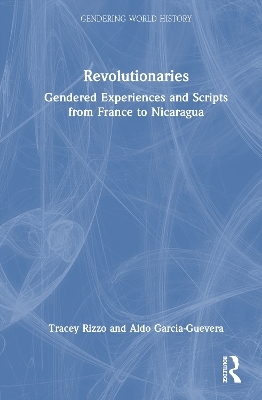
Revolutionaries
Gendered Experiences and Scripts from France to Nicaragua
Seiten
2026
Routledge (Verlag)
978-0-367-61688-5 (ISBN)
Routledge (Verlag)
978-0-367-61688-5 (ISBN)
- Noch nicht erschienen (ca. Juni 2026)
- Versandkostenfrei
- Auch auf Rechnung
- Artikel merken
Revolutionaries traces the gendered experiences of revolution from the 18th century Atlantic Revolutions through the late 20th century. With an explanatory framework that focuses on the evolution of revolutionary ‘scripts,’ Revolutionaries synthesizes the latest scholarship on gender and revolution.
Revolutionaries traces the gendered experiences of revolution from the 18th century Atlantic Revolutions through the late 20th century.
With an explanatory framework that focuses on the evolution of revolutionary ‘scripts,’ Revolutionaries synthesizes the latest micro-historical scholarship on gender and revolution into a survey of two centuries of world history. Because revolutionaries are the most self-aware of historical actors, they adapted the phrases, such as ‘all men are created equal’ and followed the phases – mobilization through victory and consolidation – across one revolution after another. For example, when Nicaraguans commemorated the bicentennial of the French Revolution in 1989--and their Revolution--by paying homage to “Liberty Leading the People” on a postage stamp, they precisely evoked this modern global revolutionary ‘script,’ one they had improved upon. While scholars have identified these phrases and stages, and compared revolutions across time and space, few have focused on gender. Although patriarchy was renovated over and over, when ‘great men’ consolidated power, revolutionaries also rose up again and again, with new tools, determined to widen political and economic rights for women and other excluded groups. Revolutionaries interrogates the great man script that leaves masculinity underexplored while sharing the stories of extraordinary and ordinary women and men and their gendered dreams.
With vignettes, different global examples for each theme, and illustrations and photographs, this is the perfect guide for anyone wanting to find out about the gendered implications of revolutions.
Revolutionaries traces the gendered experiences of revolution from the 18th century Atlantic Revolutions through the late 20th century.
With an explanatory framework that focuses on the evolution of revolutionary ‘scripts,’ Revolutionaries synthesizes the latest micro-historical scholarship on gender and revolution into a survey of two centuries of world history. Because revolutionaries are the most self-aware of historical actors, they adapted the phrases, such as ‘all men are created equal’ and followed the phases – mobilization through victory and consolidation – across one revolution after another. For example, when Nicaraguans commemorated the bicentennial of the French Revolution in 1989--and their Revolution--by paying homage to “Liberty Leading the People” on a postage stamp, they precisely evoked this modern global revolutionary ‘script,’ one they had improved upon. While scholars have identified these phrases and stages, and compared revolutions across time and space, few have focused on gender. Although patriarchy was renovated over and over, when ‘great men’ consolidated power, revolutionaries also rose up again and again, with new tools, determined to widen political and economic rights for women and other excluded groups. Revolutionaries interrogates the great man script that leaves masculinity underexplored while sharing the stories of extraordinary and ordinary women and men and their gendered dreams.
With vignettes, different global examples for each theme, and illustrations and photographs, this is the perfect guide for anyone wanting to find out about the gendered implications of revolutions.
Tracey Rizzo is the coauthor of Intimate Empires: Body, Race and Gender in the Modern World (2016) and co-editor of The French Revolution: a Document Collection (2023). She is editor of Routledge’s “Gendering World History” book series. Dr. Aldo Garcia-Guevara has written articles for The Journal of World History and World History Connected and was an author and editor of Anti-Racist Community Engagement: Principles and Practices, published in 2023. Currently, he is a member of the Latino History Project of Worcester.
Introduction. 1: “Remember the Ladies”. 2: “The Spirit of an Arab Napoleon”. 3: “A Single Family of Workers”. 4: “Not Here as a Woman but as a General”. 5: “Bringing the Western World to Trial”. Bibliography. Index
| Erscheint lt. Verlag | 1.6.2026 |
|---|---|
| Reihe/Serie | Gendering World History |
| Zusatzinfo | 19 Halftones, black and white; 19 Illustrations, black and white |
| Verlagsort | London |
| Sprache | englisch |
| Maße | 156 x 234 mm |
| Themenwelt | Geschichte ► Allgemeine Geschichte ► Neuzeit (bis 1918) |
| Geschichte ► Allgemeine Geschichte ► Zeitgeschichte | |
| Geschichte ► Teilgebiete der Geschichte ► Kulturgeschichte | |
| ISBN-10 | 0-367-61688-2 / 0367616882 |
| ISBN-13 | 978-0-367-61688-5 / 9780367616885 |
| Zustand | Neuware |
| Informationen gemäß Produktsicherheitsverordnung (GPSR) | |
| Haben Sie eine Frage zum Produkt? |
Mehr entdecken
aus dem Bereich

aus dem Bereich
Geschichte einer wilden Handlung
Buch | Hardcover (2024)
C.H.Beck (Verlag)
CHF 47,60


