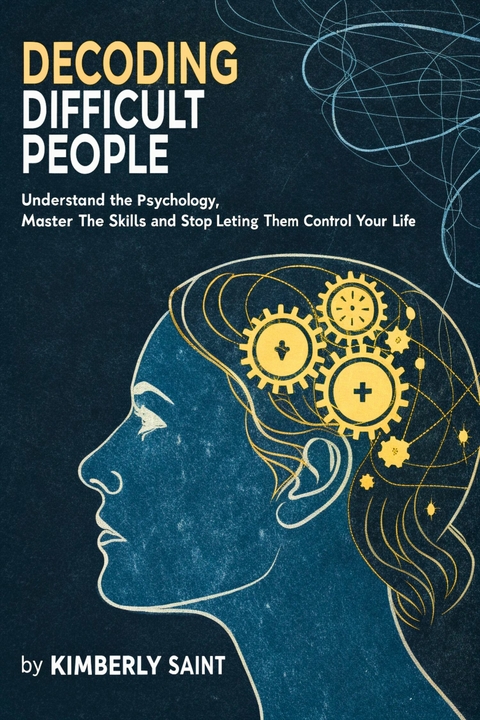
Decoding Difficult People (eBook)
132 Seiten
JNR Publishing (Verlag)
978-0-00-112585-8 (ISBN)
Have you ever felt like you need a secret decoder ring just to understand why certain people act the way they do? Are you baffled and exhausted by the confusing, frustrating, and draining behavior of a coworker, family member, or partner?
You're not just imagining it. The actions of difficult people can feel like an unsolvable puzzle, leaving you stressed, anxious, and questioning yourself. But what if you could finally understand the hidden patterns behind their behavior? What if you had the power to decode their actions and respond in a way that protects your sanity and puts you back in control?
In Decoding Difficult People, author Kimberly Saint hands you the ultimate field guide to the human psyche. This book illuminates the psychological drivers behind the most challenging behaviors-from narcissism and gaslighting to passive-aggression and chronic negativity. More importantly, it provides a step-by-step playbook of communication skills and boundary-setting techniques to handle them effectively.
By reading this book, you will finally learn to:
Understand the 'Secret Language' of Difficult Behavior: Uncover the core needs, fears, and attachment styles that make people act in baffling ways.
Spot Manipulation Tactics Instantly: Recognize gaslighting, guilt-tripping, and emotional blackmail so you can stop them in their tracks.
Master Assertive Communication: Use proven formulas to state your needs clearly and say 'no' without fear or drama.
Become an Expert at Setting Boundaries: Build a 'personal force field' that protects you from negativity, demands, and disrespect.
Handle High-Conflict Personalities: Get specialized strategies for dealing with the most challenging people at work and at home.
If you're tired of feeling confused and powerless, it's time to stop guessing and start decoding. This book is your key to unlocking a new level of understanding and confidence.
Scroll up and click 'Buy Now' to get your essential guide to Decoding Difficult People!
TAGS: difficult people, decoding people, psychology, communication skills, emotional intelligence, narcissism, gaslighting, setting boundaries, conflict resolution, toxic relationships, assertiveness, workplace conflict, family drama, self-awareness
Decoding Difficult People
Understand the Psychology, Master the Skills, and Stop Letting Them Control Your Life
Kimberly Saint
No part of this book may be reproduced or transmitted in any form whatsoever, electronic, or mechanical, including photocopying, recording, or by any informational storage or retrieval system without express permission from the author.
Copyright © 2025 JNR Publishing
All rights reserved
Chapter 1: The Challenge and the Opportunity: Why This Matters
Let's be brutally honest for a moment, shall we? If you've found your way to these words, it’s probably not because your life is an uninterrupted parade of perfectly harmonious interactions. More likely, you've had your share of encounters with individuals who make you want to check the return policy on your sanity, invest in a soundproof bunker, or perhaps take up interpretive dance as a stress-relief mechanism. You know the type: the relative whose holiday dinner commentary could curdle eggnog, the coworker whose negativity is so potent it wilts office plants, or the acquaintance who seems to have a Ph.D. in pushing your buttons. If this sounds familiar, take a deep breath. You're not marooned on a desert island of frustration; you're just experiencing a rather universal slice of the human condition, right up there with stubbing your toe in the dark or discovering that one sock has, yet again, absconded from the laundry. These challenging characters pop up everywhere: in our families, our workplaces, our social circles, and, if we’re truly honest, sometimes staring back at us from the bathroom mirror (but we’ll tiptoe into that minefield later – no finger-pointing just yet!).
But why, you might ask, dedicate an entire book to navigating these human puzzles? Why not just slap a label on them – "Grade-A Jerk," "Queen of Drama," "He-Who-Must-Not-Be-Contradicted" – and then perform an elaborate social evasive maneuver? While that approach might offer a fleeting moment of catharsis, it’s a bit like putting a fancy bandage on a broken leg. It doesn’t get to the heart of the matter. Understanding the intricate dance of difficult interactions is far more than a mere coping mechanism; it’s akin to acquiring a superpower. It's the key to unlocking smoother relationships, a significantly calmer mind, and, frankly, a much more pleasant and productive voyage through this messy, beautiful thing we call life.
The Hidden Tax of Thorny Interactions
Think back to your last run-in with someone you’d classify as "challenging." Pause for a moment and really marinate in the aftermath. How did it leave you feeling? Was it a delightful cocktail of stressed, angry, drained, frustrated, confused, or perhaps all of the above with a cherry of bewilderment on top? These encounters are rarely just fleeting blips of annoyance that we can easily shake off. They carry a significant, often underestimated, cost – a kind of "difficulty tax" levied on our well-being.
Mentally, these interactions can become unwelcome tenants in our headspace, replaying conversations on a loop, fueling "should've said" scenarios, and generally making our brains feel like they’re running a marathon in wellington boots. This mental churn can lead to pervasive anxiety, a dip in our overall mood, and a significant dent in our ability to focus on things that actually matter. It’s hard to be creative or productive when a portion of your brain is permanently assigned to the "Office Grump Rebuttal Committee."
Emotionally, the toll can be even steeper. We might be left feeling hurt, disrespected, invalidated, or inadequate. These feelings don't just evaporate; they can linger, coloring our other interactions and chipping away at our self-esteem. It's like an emotional hangover, but without any of the preceding fun.
And what about the physical cost? Our bodies, bless their resilient hearts, keep a meticulous score. Chronic stress, the kind often generated by repeatedly dealing with difficult individuals, isn't just an abstract concept. It can manifest in very real, very physical ways: persistent headaches, mysterious digestive issues that have your gut performing interpretive acrobatics, a blood pressure that’s aspiring to new heights, and an immune system that seems to have taken an extended vacation, leaving you vulnerable to every passing sniffle. Even if you try to brush off a stressful interaction, your body remembers. It’s the silent accountant of your emotional expenditures.
In the workplace, the impact is often magnified. A difficult colleague or boss can be a human black hole for productivity, sucking in energy and stifling creativity. Think of the collective hours lost to hushed water-cooler conversations dissecting "that email" or the sheer mental gymnastics required to navigate a supervisor's unpredictable moods. A toxic environment fostered by one or two challenging individuals can lead to decreased morale, higher employee turnover, and a workplace culture where walking on eggshells becomes an Olympic sport. Innovation dies where fear and frustration thrive.
In our personal lives, the stakes are arguably even higher. Strained relationships with difficult family members or friends can lead to profound heartache, painful estrangements, and a lingering sense of sadness, obligation, or guilt. These aren't just minor inconveniences; they can impact our deepest sense of belonging and connection. The ripple effects are vast, touching nearly every corner of our existence, often in ways we don't fully appreciate until we take a step back.
Simply trying to "power through" or ignore the problem isn't a sustainable strategy. It’s like trying to run a marathon with a small, sharp pebble in your shoe. At first, it’s an annoyance. But mile after mile, that tiny pebble can cause a serious, debilitating injury. Ignoring persistent interpersonal challenges doesn't make them disappear; it often allows them to fester and grow, causing more significant damage in the long run.
The Goal: Empowerment Through Understanding (Not Mind Control)
So, what’s the grand plan here? Are we aiming to magically transform every challenging person in your life into a delightful cherub who speaks only in affirmations and bakes you cookies? While that would certainly be a lovely outcome (and who doesn’t love cookies?), it’s not entirely realistic. The fundamental truth is this: we can only truly control ourselves – our thoughts, our reactions, our choices. We can't wave a magic wand and change another person's personality, history, or ingrained behavioral patterns, no matter how much we might wish we could.
The primary goal of this book, therefore, is not to teach you mind control or how to perform personality makeovers on others. Instead, it's to equip you with the understanding, tools, and strategies to navigate these challenging interactions more effectively, more confidently, and with far less personal cost. It’s about shifting the power dynamic by changing how you engage.
This means learning to:
-
Understand the "Why": Delve into the psychological drivers that might be fueling their behavior (and, just as importantly, your reactions!).
-
Communicate with Clarity: Learn to express your own needs, feelings, and boundaries more clearly, assertively, and respectfully.
-
Fortify Your Boundaries: Develop, set, and maintain healthy boundaries to protect your emotional, mental, and even physical well-being. Think of boundaries as your personal instruction manual for how you expect to be treated.
-
Manage Your Inner World: Develop strategies to de-escalate conflict when possible, and crucially, to manage your own emotional responses when faced with difficult behavior.
-
Make Conscious Choices: Recognize when a relationship or interaction is truly detrimental and learn how to disengage or distance yourself in a healthy, self-respecting way.
Ultimately, the aim is to dramatically reduce the stress, negativity, and emotional drain that challenging individuals can bring into your life. It’s about fostering healthier relationships where possible, and equally importantly, cultivating a more peaceful and resilient internal state for yourself, regardless of how others choose to behave. This journey is about taking back your power – not by changing them, but by transforming how you understand, react, and interact.
It's about recognizing that while you can't choose every person you encounter, you can choose how you respond, how you protect your energy, and how much power their behavior has over your peace of mind. This understanding, this shift in perspective, is where true empowerment lies.
Ready to dive in and start decoding these human puzzles, starting with the most important one – yourself? Let's get started.
Chapter 1 Takeaways & Reflections
- ...
| Erscheint lt. Verlag | 18.12.2025 |
|---|---|
| Sprache | englisch |
| Themenwelt | Geisteswissenschaften ► Sprach- / Literaturwissenschaft |
| ISBN-10 | 0-00-112585-0 / 0001125850 |
| ISBN-13 | 978-0-00-112585-8 / 9780001125858 |
| Informationen gemäß Produktsicherheitsverordnung (GPSR) | |
| Haben Sie eine Frage zum Produkt? |
 EPUB (Adobe DRM)
Größe: 3,9 MB
Kopierschutz: Adobe-DRM
Adobe-DRM ist ein Kopierschutz, der das eBook vor Mißbrauch schützen soll. Dabei wird das eBook bereits beim Download auf Ihre persönliche Adobe-ID autorisiert. Lesen können Sie das eBook dann nur auf den Geräten, welche ebenfalls auf Ihre Adobe-ID registriert sind.
Details zum Adobe-DRM
Dateiformat: EPUB (Electronic Publication)
EPUB ist ein offener Standard für eBooks und eignet sich besonders zur Darstellung von Belletristik und Sachbüchern. Der Fließtext wird dynamisch an die Display- und Schriftgröße angepasst. Auch für mobile Lesegeräte ist EPUB daher gut geeignet.
Systemvoraussetzungen:
PC/Mac: Mit einem PC oder Mac können Sie dieses eBook lesen. Sie benötigen eine
eReader: Dieses eBook kann mit (fast) allen eBook-Readern gelesen werden. Mit dem amazon-Kindle ist es aber nicht kompatibel.
Smartphone/Tablet: Egal ob Apple oder Android, dieses eBook können Sie lesen. Sie benötigen eine
Geräteliste und zusätzliche Hinweise
Buying eBooks from abroad
For tax law reasons we can sell eBooks just within Germany and Switzerland. Regrettably we cannot fulfill eBook-orders from other countries.
aus dem Bereich