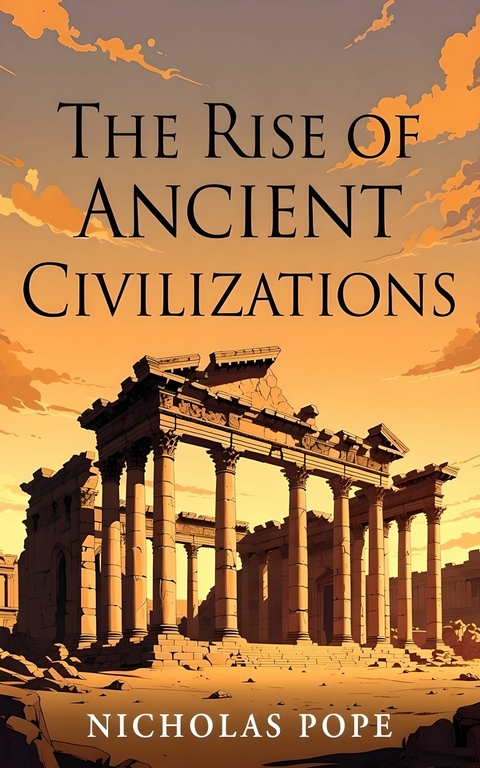
The Rise of Ancient Civilization (eBook)
250 Seiten
Publishdrive (Verlag)
978-0-00-112512-4 (ISBN)
The rise of ancient civilizations represents humanity's first great experiment in creating complex, literate, urban societies. Not all these experiments succeeded. Some civilizations flourished for thousands of years before declining; others burned brightly and vanished quickly. Yet each contributed something to the vast, ongoing conversation that is human culture. In the chapters that follow, we will explore these diverse civilizations, seeking to understand not merely what they built and believed, but what they can teach us about the perennial challenges and possibilities of organized human life.
As we embark on this journey through the ancient world, we should remember that we are not examining dead societies frozen in time but rather tracing the living roots of our own civilization. The farmers of ancient Mesopotamia, the scribes of Egypt, the merchants of Phoenicia, and the philosophers of Athens all contributed to making us who we are. Their triumphs and failures, their wisdom and follies, their monuments and ruins all speak to us across the millennia, if we learn to listen.
Introduction
Somewhere around ten thousand years ago, in the fertile valleys of the Near East, human beings made a decision that would transform the world forever. After countless millennia of wandering as hunter-gatherers, following game across vast landscapes and gathering whatever plants the seasons offered, they chose to stay in one place. They planted seeds, tended crops, and waited for the harvest. This simple act of cultivation set in motion a chain of consequences that would eventually produce the pyramids of Egypt, the philosophy of Athens, the laws of Babylon, and the roads of Rome.
The transition from nomadic bands to settled agricultural communities is what scholars call the Neolithic Revolution, and it represents one of the most profound transformations in human history. With agriculture came surplus food, and with surplus came the possibility of specialization. Not everyone needed to spend their days producing sustenance. Some could become potters, others metalworkers, still others priests or administrators. This division of labor, in turn, enabled the development of increasingly complex social structures, more sophisticated technologies, and eventually, the rise of cities.
But what exactly do we mean when we speak of civilization? The word itself derives from the Latin "civitas," meaning city, and indeed urbanism stands as one of civilization's defining characteristics. Yet a city alone does not make a civilization. True civilization emerges when several key elements combine in a particular place and time. Beyond urban centers, these include the development of writing systems that allow knowledge to be preserved and transmitted across generations, the creation of monumental architecture that demonstrates both technical capability and organized labor, the establishment of social hierarchies with distinct classes performing different functions, and the formation of centralized political authority capable of coordinating large populations.
These characteristics did not appear simultaneously or inevitably wherever agriculture took root. Farming communities existed for thousands of years in many parts of the world without developing into what we would recognize as civilizations. Something more was required, some combination of geographic advantage, population pressure, technological innovation, and perhaps pure historical contingency. The first civilizations arose in particular kinds of places, environments that offered both opportunity and challenge in equal measure.
The great river valleys of the ancient world proved especially conducive to civilizational development. The Tigris and Euphrates in Mesopotamia, the Nile in Egypt, the Indus in South Asia, and the Yellow River in China all became cradles of early complex societies. These rivers provided water for irrigation, enabling intensive agriculture that could support dense populations. They also deposited nutrient-rich silt during seasonal floods, renewing the fertility of the soil year after year. Yet these same rivers could be destructive, requiring coordinated effort to build and maintain irrigation systems, flood controls, and drainage works. The necessity of managing these waterways may have encouraged the development of centralized authority and administrative bureaucracies.
The chronological scope of this book extends from roughly 10,000 BCE, when agriculture first emerged in the Fertile Crescent, to approximately 500 BCE, by which time many of the civilizations that would shape the classical world had already established themselves. This span of ninety-five centuries witnessed transformations of breathtaking scope and pace. At the beginning of this period, the entire human population of Earth numbered perhaps five million people, all of them living in small groups without permanent settlements, writing, or cities. By the end, great empires sprawled across three continents, millions lived in urban centers, libraries preserved the accumulated wisdom of centuries, and philosophers debated the nature of reality, justice, and the good life.
Our journey through these ancient worlds will take us first to Mesopotamia, the land between the rivers, where Sumerian cities rose from the marshlands of southern Iraq to become humanity's first urban civilization. We will explore the evolution of writing from simple pictographic accounting marks to the sophisticated cuneiform script capable of recording everything from business transactions to epic poetry. We will witness the rise and fall of successive empires, from the Akkadians and Babylonians to the mighty Assyrians, each leaving its mark on the legal codes, mathematical systems, and astronomical knowledge that would echo through millennia.
From Mesopotamia, we turn to Egypt, where the predictable flooding of the Nile created an agricultural abundance that supported one of history's most enduring civilizations. The Egypt of the pharaohs fascinates us still with its colossal monuments, its elaborate death rituals, and its artistic achievements. We will examine how Egyptian kings transformed themselves into living gods, how engineers moved massive stone blocks without wheels or pulleys, and how a civilization maintained remarkable cultural continuity for over three thousand years despite periodic upheavals and foreign conquests.
Eastward, in the valley of the Indus River, arose a civilization that in some ways surpassed even Egypt and Mesopotamia in urban planning and public infrastructure, yet remains frustratingly mysterious to us. The cities of Harappa and Mohenjo-daro featured sophisticated drainage systems, standardized brick sizes, and evidence of centralized planning, but their writing system has never been deciphered. We can admire their achievements in metallurgy and trade, yet we cannot read their thoughts or understand their political systems. The Indus Valley civilization reminds us that much of the ancient world remains enigmatic, its secrets still locked in undeciphered texts and unexcavated sites.
In China, along the Yellow River, a distinct civilizational trajectory unfolded, one that would eventually produce the longest continuous cultural tradition in human history. From the Neolithic communities of the Yangshao and Longshan cultures emerged the Bronze Age kingdoms of the Shang and Zhou dynasties. Here we encounter oracle bones used for divination, the early forms of Chinese characters, and the philosophical traditions that would shape East Asian thought for thousands of years. The concepts of the Mandate of Heaven, filial piety, and the harmonious ordering of society all have their roots in ancient China's formative centuries.
The Mediterranean world saw its own distinctive civilizations arise, first among the Minoans of Crete and then the Mycenaean Greeks of the mainland. These palace cultures, with their Linear B tablets and impressive fortifications, would eventually collapse in the general catastrophe that ended the Bronze Age around 1200 BCE. Yet from the ashes of this collapse would eventually emerge classical Greece, whose achievements in philosophy, drama, democracy, and art would profoundly influence all subsequent Western civilization.
The Phoenicians, masters of maritime trade and inventors of the alphabet, connected the various civilizations of the Mediterranean through their commercial networks. Their colonies, most notably Carthage, would themselves become significant powers. Meanwhile, the Hebrew people developed ethical monotheism, a revolutionary concept that would, through Judaism's daughter religions Christianity and Islam, eventually shape the beliefs of billions.
The Persian Empire, stretching from Egypt to India, represented a new model of imperial organization that would influence all subsequent empires. The Achaemenid kings ruled over dozens of different peoples, languages, and cultures, yet maintained administrative coherence through innovative systems of governance. Their confrontation with the Greek city-states in the Persian Wars would become one of history's defining contests between imperial autocracy and civic freedom.
Across the Atlantic, in Mesoamerica, entirely independent civilizations arose with no contact with the Old World. The Olmec, often called the mother culture of Mesoamerica, established patterns of urbanism, monumental sculpture, and ceremonial practice that would be elaborated by the Maya, Zapotec, and eventually the Aztec. That complex civilizations could arise independently on different continents demonstrates that the process, while not inevitable, follows certain patterns inherent in human social organization.
Throughout this book, certain themes recur across different times and places. The relationship between religious authority and political power appears in every ancient civilization, whether in the god-kings of Egypt, the priest-kings of Sumer, or the Mandate of Heaven in China. Trade and cultural exchange constantly pushed civilizations beyond their borders, spreading technologies, ideas, and artistic styles across vast distances. Innovation in one civilization often inspired developments in others, whether in writing systems, metallurgical techniques, or architectural forms.
Yet we must also attend to what made each civilization unique. The particular geographic circumstances, cultural values, and historical experiences of each society produced distinct solutions to common problems. The way Egyptians organized their state differed fundamentally from the city-state system of Mesopotamia, just as Chinese ancestor worship created social patterns unlike anything in the Mediterranean world. Understanding both the universal patterns and the particular variations enriches our appreciation of human cultural diversity.
Why should we, living in the twenty-first century, concern ourselves...
| Erscheint lt. Verlag | 18.12.2025 |
|---|---|
| Sprache | englisch |
| Themenwelt | Geschichte ► Allgemeine Geschichte ► Altertum / Antike |
| ISBN-10 | 0-00-112512-5 / 0001125125 |
| ISBN-13 | 978-0-00-112512-4 / 9780001125124 |
| Informationen gemäß Produktsicherheitsverordnung (GPSR) | |
| Haben Sie eine Frage zum Produkt? |
 EPUB (Adobe DRM)
Größe: 880 KB
Kopierschutz: Adobe-DRM
Adobe-DRM ist ein Kopierschutz, der das eBook vor Mißbrauch schützen soll. Dabei wird das eBook bereits beim Download auf Ihre persönliche Adobe-ID autorisiert. Lesen können Sie das eBook dann nur auf den Geräten, welche ebenfalls auf Ihre Adobe-ID registriert sind.
Details zum Adobe-DRM
Dateiformat: EPUB (Electronic Publication)
EPUB ist ein offener Standard für eBooks und eignet sich besonders zur Darstellung von Belletristik und Sachbüchern. Der Fließtext wird dynamisch an die Display- und Schriftgröße angepasst. Auch für mobile Lesegeräte ist EPUB daher gut geeignet.
Systemvoraussetzungen:
PC/Mac: Mit einem PC oder Mac können Sie dieses eBook lesen. Sie benötigen eine
eReader: Dieses eBook kann mit (fast) allen eBook-Readern gelesen werden. Mit dem amazon-Kindle ist es aber nicht kompatibel.
Smartphone/Tablet: Egal ob Apple oder Android, dieses eBook können Sie lesen. Sie benötigen eine
Geräteliste und zusätzliche Hinweise
Buying eBooks from abroad
For tax law reasons we can sell eBooks just within Germany and Switzerland. Regrettably we cannot fulfill eBook-orders from other countries.
aus dem Bereich