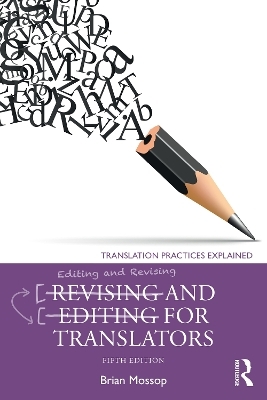
Revising and Editing for Translators
Routledge (Verlag)
978-1-032-80046-2 (ISBN)
- Noch nicht erschienen (ca. Juli 2026)
- Versandkostenfrei
- Auch auf Rechnung
- Artikel merken
Revising and Editing for Translators has long been the go-guide for both translation students learning how to revise the work of others or edit original writing, and professional translators wishing to improve their self-revision ability. Revising and editing are vital reading skills aimed at spotting problematic passages. Changes are then made to meet some standard of quality that varies with the text and to tailor the text to its readership. In a world of AI translation tools, the skills of revising and editing are more important than ever before.
Mossop offers in-depth coverage of a wide range of topics, including copyediting, stylistic editing, checking for consistency, revising procedures and principles, and translation quality assessment—all related to the professional situations in which revisers and editors work.
This fully revised fifth edition provides new chapters on Generative AI, revision of legal translations, and revision of literary translations, along with updated and expanded coverage of revising machine outputs. The inclusion of suggested activities and exercises, numerous real-world examples, and a reference glossary make this an indispensable coursebook for professional translation programmes.
Brian Mossop is an instructor in the MA in Translation Studies program at York University in Toronto. He is the co-editor of Translation Revision and Post-editing ( Routledge 2021)
Acknowledgements
Introduction for All Readers
Introduction for Instructors
1. Why Editing and Revising are Necessary
1.1 The difficulty of writing
1.2 Enforcing rules
1.3 Quality in translation
1.4 Limits to editing and revision
1.5 The proper role of revision
Summary
Further reading
2. The Work of an Editor
2.1 Tasks of editors
2.2 Editing, rewriting and adapting
2.3 Mental editing during translation
2.4 Editing non-native English
2.5 Crowd-sourced editing of User Generated Content
2.6 Degrees of editing
2.7 Editing procedure
Practice
Further reading
3. Copyediting
3.1 House style
3.2 Spelling and typing errors
3.3 Syntax and idiom
3.4 Punctuation
3.5 Usage
Practice
Further reading
4. Stylistic Editing
4.1 Tailoring language to readers
4.2 Smoothing
4.3 Readability versus intelligibility and logic
4.4 Stylistic editing during translation
4.5 Some traps to avoid
Practice
Further reading
5. Structural Editing
5.1 Physical structure of a text
5.2 Problems with prose
5.3 Problems with headings
5.4 Structural editing during translation
Practice
Further reading
6. Content Editing
6.1 Macro-level content editing
6.2 Factual errors
6.3 Logical errors
6.4 Mathematical errors
6.5 Content editing during translation
6.6 Content editing after translation
Practice
7. Trans-editing by Jungmin Hong
7.1 Trans-editing versus translating
7.2 Structural trans-editing
7.3 Content trans-editing
7.4 Combined structural and content trans-editing
7.5 Trans-editing with changed text-type
7.6 Trans-editing from multiple source texts
Exercises and discussion
Further reading
8. Checking for Consistency
8.1 Degrees of consistency
8.2 Pre-arranging consistency
8.3 Translation databases and consistency
8.4 Over-consistency
Practice
Further reading
9. Computer Aids to Checking
9.1 Google to the rescue?
9.2 Bilingual databases
9.3 Work on screen or on paper?
9.4 Editing functions of word processors
9.5 What kind of screen environment?
9.6 Tools specific to revision
Further reading
10. The Work of a Reviser
10.1 Revision: a reading task
10.2 Revision terminology
10.3 Reviser competencies
10.4 Revision and specialization
10.5 The revision function in translation services
10.6 Reliance on self-revision
10.7 Reducing differences among revisers
10.8 Crowd-sourced revision
10.9 Revising translations into the reviser’s second language
10.10 Quality-checking by clients
10.11 The brief
10.12 Balancing the interests of authors, clients, readers and translators
10.13 Evaluation of revisers
10.14 Time and quality
10.15 Quantity of revision
10.16 Quality assessment
10.17 Quality assurance
Practice
Further reading
11. The Revision Parameters
11.1 Accuracy
11.2 Completeness
11.3 Logic
11.4 Facts
11.5 Smoothness
11.6 Tailoring
11.7 Sub-language
11.8 Idiom
11.9 Mechanics
11.10 Layout
11.11 Typography
11.12 Organization
11.13 Client Specifications
11.14 Employer Policies
Further reading
12. Degrees of Revision
12.1 The need for revision by a second translator
12.2 Determining the degree of revision
12.2.1 Which parameters will be checked?
12.2.2 What level of accuracy and writing quality is required?
12.2.3 Full or partial check?
12.2.4 Compare or just re-read?
12.3 Some consequences of less-than-full revision
12.4 The relative importance of transfer and language parameters
12.5 A realistic approach to revision
Practice
Further reading
13. Revision Procedure
13.1 Procedure for finding errors
13.2 Principles for correcting and improving
13.3 Order of operations
13.4 Handling unsolved problems
13.5 Inputting changes
13.6 Checking Presentation
13.7 Preventing strategic errors
13.8 Getting help from the translator
13.9 Procedures, time-saving and quality
Summary of techniques for spotting errors and avoiding introduction of errors
Practice
Further reading
14. Self-Revision
14.1 Integration of self-revision into translation production
14.2 Self-diagnosis
14.3 The term ‘self-revision’
Practice
Further reading
15. Revising the Work of Others
15.1 Relations with revisees
15.2 Diagnosis
15.3 Advice
15.4 Research during revision
Practice
Further reading
16. Revising Computer-Mediated Translations by Carlos Teixeira
16.1 Translation Memory
16.1.1 Repairing Translation Memory suggestions
16.2 Machine Translation
16.2.1 Different ‘levels’ of post-editing
16.2.2 Types of edits required
16.2.3 Examples of post-editing
16.3 Integration of Translation Memory and Machine Translation
16.4 Computer-assisted Literary Translation
16.5 Generative AI and Literary Translation
16.6 Final Considerations
Further reading
17. Generative AI in Revision Workflows by Masaru Yamada
17.1 A revision scenario
17.2 Practical Examples of Prompting Techniques
17.2.1 Zero-Shot Prompt: Quick Grammar and Style Checks
17.2.2 Few-Shot Prompt: Aligning with a Preferred Style
17.2.3 Chain-of-Thought (COT) Prompt: Systematic Error Detection
17.2.4 Summary of Prompting Techniques
17.3 Using GenAI in the Translation and Revision Phases
17.3.1 Translation Phase
17.3.2 Revision Phase
17.4 Benefits, Limitations, and Ethical Considerations
17.4.1 Benefits of Using GenAI
17.4.2 Limitations of GenAI
17.4.3 Ethical Considerations
Conclusion
Further reading
18. Revising legal translations by Valérie Dullion
18.1 Standards of quality in legal translation
18.2 The specialized nature of legal language: key aspects to bear in mind when revising
18.3 Revising legal translations in a professional context
18.4 Revision parameters, degrees of revision and revision procedure
18.5 Common problems at different levels of legal sub-language
18.6 Competencies, profiles and training
Practice
Further reading
19. Revising literary translations by Giovanna Scocchera
19.1 What is revised
19.2 Who revises
19.3 Where and When is a literary translation revised?
19.4 How to revise a literary translation
19.4.1 An 8-step revision procedure
19.4.2 Literary revision tools
19.5 Why is a literary translation revised?
19.6 Machine post-editing of literary texts?
Appendix 1. Summary of Revision Ideas
Appendix 2. Quality Assessment
Appendix 3. Quantitative Grading Scheme
Appendix 4. Sample Revision
Appendix 5. Revising and Editing Vocabulary
Appendix 6. Empirical Research on Revision
Readings
Index
| Erscheint lt. Verlag | 13.7.2026 |
|---|---|
| Reihe/Serie | Translation Practices Explained |
| Zusatzinfo | 12 Tables, black and white; 13 Halftones, color; 2 Halftones, black and white; 13 Illustrations, color; 2 Illustrations, black and white |
| Verlagsort | London |
| Sprache | englisch |
| Maße | 156 x 234 mm |
| Themenwelt | Geisteswissenschaften ► Sprach- / Literaturwissenschaft ► Sprachwissenschaft |
| ISBN-10 | 1-032-80046-1 / 1032800461 |
| ISBN-13 | 978-1-032-80046-2 / 9781032800462 |
| Zustand | Neuware |
| Informationen gemäß Produktsicherheitsverordnung (GPSR) | |
| Haben Sie eine Frage zum Produkt? |
aus dem Bereich