


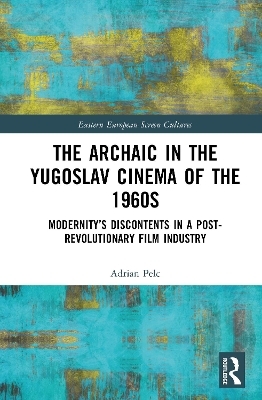
The Archaic in the Yugoslav Cinema of the 1960s
Pallas Publications (Verlag)
978-90-485-6889-5 (ISBN)
- Noch nicht erschienen (ca. Juni 2026)
- Versandkostenfrei
- Auch auf Rechnung
- Artikel merken
This book investigates the “Golden Age” of Yugoslav cinema and sheds light on it from a fresh perspective. By examining various tropes and discourses of the “archaic” that shaped not only the flourishing Yugoslav cinematic modernism of the 1960s but also a broader Yugoslav cultural politics, the book reveals a nuanced panorama of cultural negotiations.
The “archaic” – that which is at odds with modernity – is a peculiar crossroads where Marxism intersects with Balkanism, while both are circumscribed by a general distrust towards representation. The analysis thus opens new perspectives on a politics of aesthetics that shaped some of the most successful Yugoslav films of all time. Furthermore, its findings will be relevant to any context in which a political as well as artistic movement seeks to present itself as avant-garde but is confronted with a discourse assigning it time-lag.
Addressing an academic audience of scholars and postgraduate students interested in Balkan and East European area studies, Slavic studies, cultural studies, film, and postcolonial studies, this book is also of interest to those researching the intersections of time, aesthetics, and politics.
Adrian Pelc is a postdoc assistant in the Department of Slavic Studies, University of Vienna, Austria. His interests include Yugoslav cinema, cultural studies, and critical theory.
Introduction: Entering the Golden Age
1. Coming to Terms: The Archaic
2. The Yugoslav Celluloid Archaic: A Panorama
II. Setting the Figures in Motion: The Game of the Archaic on the Yugoslav 1960s Screen
3. Balkanism: The Time-Lag of Realia
4. In the Future, in the Past, Under the False Appearance of a Present: Miroslav Krleža’s Timings of Yugoslav Culture
5. Bloody Weddings and Funeral Bells: Representations of History in Trajče Popov’s Macedonian Bloody Wedding and Antun Vrdoljak’s When You Hear the Bells
6. Parody and Naiveté: Ante Babaja’s The Birch Tree and Dragoslav Lazić’s Poor Mary
7. Two or Three Things I Know About Burduš: Mića Popović’s Burduš and Aleksandar Petrović’s It Rains in My Village
Closing Remarks on Backwardness and Vitality
III. Revenge on Representation: The “Move 3” in the Game of the Archaic on the Yugoslav 1960s Screen
8. Images, Revolutions (and Their Crusts)
9. Beauty and the Well: Dušan Makavejev’s Love Affair, or The Case of the Missing Switchboard Operator
10. Yet Another Effort Yugoslavs, If You Would Become Communists: Želimir Žilnik’s Early Works
Concluding Remarks on the Game of the Archaic
Bibliography
| Erscheint lt. Verlag | 15.6.2026 |
|---|---|
| Reihe/Serie | Eastern European Screen Cultures |
| Verlagsort | Amsterdam |
| Sprache | englisch |
| Maße | 156 x 234 mm |
| Themenwelt | Geisteswissenschaften ► Geschichte ► Regional- / Ländergeschichte |
| ISBN-10 | 90-485-6889-7 / 9048568897 |
| ISBN-13 | 978-90-485-6889-5 / 9789048568895 |
| Zustand | Neuware |
| Informationen gemäß Produktsicherheitsverordnung (GPSR) | |
| Haben Sie eine Frage zum Produkt? |
aus dem Bereich


