


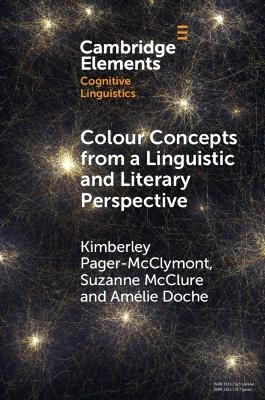
Colour Concepts from a Linguistic and Literary Perspective
Seiten
2026
Cambridge University Press (Verlag)
978-1-009-51135-3 (ISBN)
Cambridge University Press (Verlag)
978-1-009-51135-3 (ISBN)
- Noch nicht erschienen (ca. März 2026)
- Portofrei ab CHF 40
- Auch auf Rechnung
- Artikel merken
This Element adopts a holistic approach to the processing of colours in language and literature, weaving together insights from cognitive linguistics, psychology, and literary studies. Each section draws on cognitive linguistic tools, showcasing how colours shape not just visual but emotional engagement with texts.
This Element adopts a holistic approach to the processing of colours in language and literature, weaving together insights from cognitive linguistics, psychology, and literary studies. Through diverse case studies, it underpins the symbolic power of colours in evoking characters' emotional states, moral traits, and cultural perceptions (Section 2). Section 3 explores how colour metaphors such as discomfort is brown influence readers' cognitive and emotional responses, drawing on psychology research on colour-emotion association. Section 4 examines how the lexeme colourless functions as its own oxymoron and is used figuratively through the metaphor anatomy is mind in Modernist literature. Each section draws on cognitive linguistic tools, showcasing how colours shape not just visual but emotional engagement with texts. By connecting cognitive science, psychology, and literary analysis, this Element offers an interdisciplinary perspective, demonstrating that colours act as stimuli shaping perception, language, and cultural meaning, enriching the literary experience across contexts and cultures.
This Element adopts a holistic approach to the processing of colours in language and literature, weaving together insights from cognitive linguistics, psychology, and literary studies. Through diverse case studies, it underpins the symbolic power of colours in evoking characters' emotional states, moral traits, and cultural perceptions (Section 2). Section 3 explores how colour metaphors such as discomfort is brown influence readers' cognitive and emotional responses, drawing on psychology research on colour-emotion association. Section 4 examines how the lexeme colourless functions as its own oxymoron and is used figuratively through the metaphor anatomy is mind in Modernist literature. Each section draws on cognitive linguistic tools, showcasing how colours shape not just visual but emotional engagement with texts. By connecting cognitive science, psychology, and literary analysis, this Element offers an interdisciplinary perspective, demonstrating that colours act as stimuli shaping perception, language, and cultural meaning, enriching the literary experience across contexts and cultures.
CFG; 1. Introduction; 2. Colour concepts: from verbal to cognitive processes; 3. Colour concepts, metaphor, and psychology; 4. Absence of colour concepts: colourlessness in literary prose; 5. Concluding remarks; References.
| Erscheint lt. Verlag | 31.3.2026 |
|---|---|
| Reihe/Serie | Elements in Cognitive Linguistics |
| Zusatzinfo | Worked examples or Exercises |
| Verlagsort | Cambridge |
| Sprache | englisch |
| Themenwelt | Geisteswissenschaften ► Psychologie ► Allgemeine Psychologie |
| Geisteswissenschaften ► Psychologie ► Verhaltenstherapie | |
| Geisteswissenschaften ► Sprach- / Literaturwissenschaft ► Sprachwissenschaft | |
| ISBN-10 | 1-009-51135-1 / 1009511351 |
| ISBN-13 | 978-1-009-51135-3 / 9781009511353 |
| Zustand | Neuware |
| Informationen gemäß Produktsicherheitsverordnung (GPSR) | |
| Haben Sie eine Frage zum Produkt? |
Mehr entdecken
aus dem Bereich

aus dem Bereich
Lernen, Emotion, Motivation, Gedächtnis
Buch | Softcover (2025)
Beltz (Verlag)
CHF 39,20


