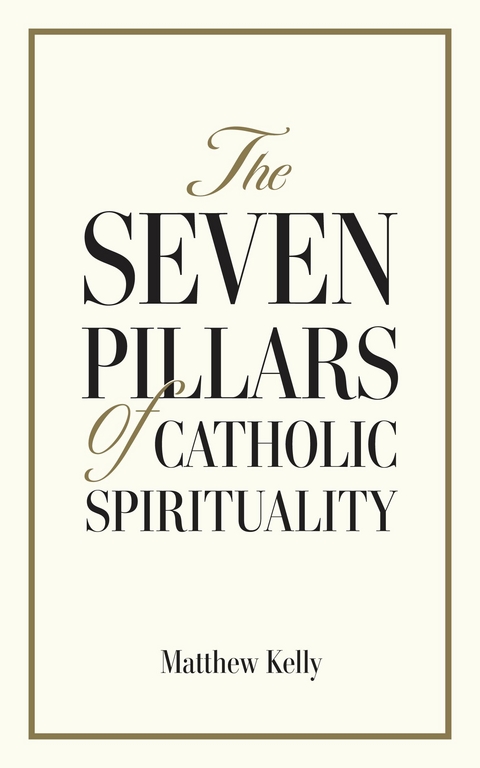
Seven Pillars of Catholic Spirituality (eBook)
170 Seiten
Bookbaby (Verlag)
978-1-63582-599-2 (ISBN)
Matthew Kelly has dedicated his life to helping people become the-best-version-of-themselves. He is the author of more than forty books, including: Life is Messy, I Heard God Laugh, The Rocking Chair Prophet, Holy Moments, and The Fourth Quarter of Your Life. His books have been published in more than thirty languages, have appeared on the most prestigious bestseller lists, and have sold more than seventy million copies.
If your spiritual life were a house, what would it be like? What street would it be on? What part of town would it be in? What would it look like? Would it be a house or a home? Is it in need of renovations? Is it peaceful, noisy, distracting, well-organized, messy?When Matthew Kelly was a teenager, a spiritual mentor entered his life to help him establish seven transformational habits in his life. These seven pillars have been an enduring source of growth and comfort for Kelly over the past four decades. In The Seven Pillars of Catholic Spirituality, Matthew Kelly demonstrates the timeless genius of Catholicism by illustrating the practical and spiritual ways these ancient spiritual habits continue to enrich our daily lives today. Transforming people one at a time is at the heart of God's plan for the world. He has been using these seven habits to transform ordinary people into saints for a long time. Are you willing to let God transform you?
Chapter Two Daily Prayer
Almost every day I meet people who tell me they are writing a book. Others tell me they have always wanted to write a book. I always encourage them, but in my heart I know that very few will actually ever write the book they tell me about. Most people like the idea of writing a book because it intrigues them. They get caught up in the idea of losing themselves in the creative process. But the reality is writing a book is just hard work. The beginning, when you conceive the idea for the book, is wonderful and exciting. But that doesn’t last very long and then the hard work begins. Throughout the process there will be times when you catch a wave of inspiration, but if you wrote only when you felt inspired you would never finish your book.
Writing a book requires daily discipline. You have to work at it every day, even if some days all you do is read over what you wrote yesterday to keep it fresh in your mind. Writing a book requires the discipline to write when you feel like it and when you don’t. Most people don’t have this discipline, which is why many who start writing a book never finish it. When we think of writing a book we conjure romantic images of the artist at work in an inspirational setting, effortlessly penning page after page. The truth is, as already mentioned, writing a book is mostly hard work, and we are still just talking about writing a book. We have not spoken of writing a good book or even a great book yet.
Prayer is similar in many ways. Many people fail to establish a daily habit of prayer in their lives because they approach it with the wrong expectations. Consciously or subconsciously, most people approach prayer expecting it to be easy. The truth is, prayer is perhaps the most difficult thing we will ever do. From time to time, we may get carried away by a moment of inspiration in our prayer, but for the most part prayer is hard work—work well worth doing, but hard work nonetheless.
You don’t become a great athlete by training only when you feel like it. You don’t become a great writer by writing only when you feel inspired to write. And the saints did not become such fine ambassadors of God on earth by praying only when they felt like praying. In each case, a daily discipline is required.
Many years ago I saw a violinist interviewed. At the time he was considered the best in the world. He explained to the interviewer that he practiced for eight to ten hours each day. The interviewer implied that surely at this stage in his career he could ease up a little with the practice. The violinist smiled and said, “If I miss practice one day and perform the next night, I am the only person who can tell. But I can tell. My performance is off. If I missed practice every day for a week and then performed, there would only be a handful of people in any audience who would be able to tell that my performance was off. But if I missed practice for two weeks, or three weeks, almost every person in the audience would be able to tell that I was not performing at my best.”
The same is true of prayer. If you neglect prayer for a day, you are probably the only person who can tell. But you can tell. You have less patience and you are less focused. If you neglect prayer for a week, several people around you will notice the change in you. But if you neglect prayer for two or three weeks, almost everyone around you will recognize that you are not at your best.
Prayer is central to the Christian experience. A Christian life is not sustainable without it, because growth in the Christian life is simply not possible without prayer. Growing in character and virtue, learning to hear the voice of God in our lives and walking where he calls us—all require the discipline of prayer. And it is not enough simply to pray when we feel like it. Prayer requires a daily commitment.
Why Pray?
A few months ago I was visiting a grade school, and a child, perhaps seven years old, asked me, “Why do you pray?” Sometimes a question is so simple and yet so striking that it causes you to pause time and time again to ponder the answer. This child’s question was just such a question for me.
I know all the right answers to the questions. The catechism tells us that the purposes and forms of prayer are adoration, petition, intercession, thanksgiving, and praise. But I knew this answer would not satisfy my curious young friend.
Therese of Lisieux, one of the great teachers of Christian prayer, wrote, “For me, prayer is a surge of the heart; it is a simple look turned toward heaven, it is a cry of recognition and of love, embracing both trial and joy.” But I am fairly sure if I had used that as my answer, the seven-year-old student would have just looked at me with a blank stare.
Dozens of thoughts and answers flashed through my mind, all of which may have suited an adult or a theologian, but I couldn’t find the words to express them to a child. So, I asked him a question instead of answering his. I asked him the same question he had asked me: “Why do you pray?”
He didn’t have to think about it. Spontaneously and casually he said, “Well, God is my friend, and friends like to know what is going on in each other’s lives.”
Sometimes I pray for very selfish reasons. Perhaps I am stressed and overwhelmed, and I go to prayer hoping God will calm my heart and mind and bring peace to my soul. Sometimes I pray for completely altruistic reasons. When some region of the world is torn apart by natural disaster or war, I often find myself driven to prayer. And sometimes I pray for very holy reasons. There are times when I pray not because I want something from God, but just to express my gratitude for all the things, people, and opportunities he has filled my life with. And when I am at my best, I pray simply to be with God and seek his ways.
Most of the time I pray for more practical reasons—three in particular. First, I pray to make sense of things. Life is often complex and confusing, but in the midst of all that, God always seems to present a simple path. The ways of the Lord may not be easy, and at times may be tremendously difficult, but they are almost always simple.
I also pray because I want to live life deeply and deliberately. I am not confused about how precious a gift life is, and I want to fully experience that gift. In high school these words of Thoreau became engraved on my heart: “I went to the woods because I wanted to live deliberately, I wanted to live deep and suck out all the marrow of life, to put to rout all that is not life and not when I had come to die discover that I had not lived.” I go to the woods of prayer each day for the same reason.
The third of the very practical reasons I pray is to build up the kind of inner density required to prevent the culture from swallowing me up.
We live in a time of tremendous cultural pressure. The spirit of the world is powerful and unrelenting, and there is little societal support for those who choose to reject the spirit of the world and embrace the Spirit of God. This is not a popular choice, and as a result, it can often lead to a certain loneliness in our lives.
Osmosis is the scientific theory that essentially states that what is more dense will filter through to what is less dense. If we are going to be true to our values, if we are going to celebrate and defend the-best-version-of-ourselves, we need to build up a certain density within us. This inner strength, or density, will allow us to resist the cultural pressure to abandon our values, our true selves, and God.
If we are going to walk with God and become the-best-version-of-ourselves, we need this inner density, which seems to be created by a combination of grace and discipline. This inner density is not something we can attain for ourselves; it is a gift God freely gives us when we cooperate with his plan for our lives. When we have this density within us, we will have a Christian effect on our environment. When we don’t have this density, our environment has an effect on us. What is more dense filters through to what is less dense, and the cultural density all around us is intense. The most powerful way to build this density, this inner strength, is through prayer and the sacraments. I pray to gather density to survive and thrive in a culture that is often hostile and sometimes violent toward what is good and true and noble.
It is almost twenty years now since I began a serious habit of prayer in my life. Now I cannot imagine a life without prayer. I don’t know how people survive in our crazy, noisy, busy world without the sanctuary of prayer to renew and refresh them. There are many reasons to pray and many ways to pray—what is critical is that we make an effort to create a daily habit of prayer in our lives.
Thought Determines Action
To contemplate is to ponder something deeply. As Christians we are called to think on a deeper level, and to live on a deeper level. Daily prayer makes this possible. It is in our prayer that we move beyond the fleeting thoughts of life and begin to lead meaningful lives of contemplation.
Contemplation is not just for monks and nuns. In truth, we all lead lives of contemplation, but we spend our lives contemplating very different things. What do you contemplate? Is it the riches of the world? Is it every woman who passes you in the street? Do you ponder the latest fashions? The local gossip? Or do you contemplate the wonders of God, the glory of his creation, and the joys of the spiritual life?
It is not necessary to go...
| Erscheint lt. Verlag | 10.12.2025 |
|---|---|
| Sprache | englisch |
| Themenwelt | Geisteswissenschaften ► Religion / Theologie ► Christentum |
| ISBN-10 | 1-63582-599-7 / 1635825997 |
| ISBN-13 | 978-1-63582-599-2 / 9781635825992 |
| Informationen gemäß Produktsicherheitsverordnung (GPSR) | |
| Haben Sie eine Frage zum Produkt? |
 EPUB (Ohne DRM)
Größe: 472 KB
Digital Rights Management: ohne DRM
Dieses eBook enthält kein DRM oder Kopierschutz. Eine Weitergabe an Dritte ist jedoch rechtlich nicht zulässig, weil Sie beim Kauf nur die Rechte an der persönlichen Nutzung erwerben.
Dateiformat: EPUB (Electronic Publication)
EPUB ist ein offener Standard für eBooks und eignet sich besonders zur Darstellung von Belletristik und Sachbüchern. Der Fließtext wird dynamisch an die Display- und Schriftgröße angepasst. Auch für mobile Lesegeräte ist EPUB daher gut geeignet.
Systemvoraussetzungen:
PC/Mac: Mit einem PC oder Mac können Sie dieses eBook lesen. Sie benötigen dafür die kostenlose Software Adobe Digital Editions.
eReader: Dieses eBook kann mit (fast) allen eBook-Readern gelesen werden. Mit dem amazon-Kindle ist es aber nicht kompatibel.
Smartphone/Tablet: Egal ob Apple oder Android, dieses eBook können Sie lesen. Sie benötigen dafür eine kostenlose App.
Geräteliste und zusätzliche Hinweise
Buying eBooks from abroad
For tax law reasons we can sell eBooks just within Germany and Switzerland. Regrettably we cannot fulfill eBook-orders from other countries.
aus dem Bereich