


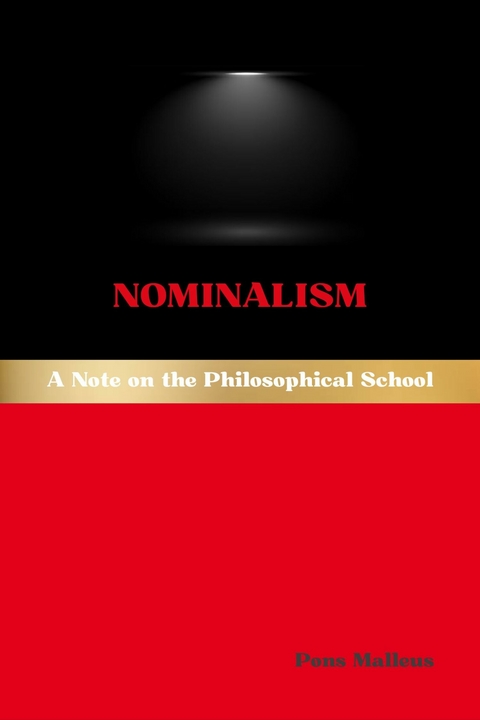
Nominalism (eBook)
107 Seiten
Publishdrive (Verlag)
9780001119437 (ISBN)
Nominalism is one of the most enduring and provocative philosophical doctrines in the history of Western thought. It raises a deceptively simple question that has echoed across centuries: Do universals exist? When we speak of 'redness,' 'justice,' or 'humanity,' are we referring to real entities with existence beyond individual things, or are we merely using convenient linguistic labels? Nominalism asserts the latter-arguing that only particular things truly exist, and that so-called 'universals' are nothing more than names we assign for practical communication.
This book is an exploration of that idea and its profound implications. What began as a metaphysical stance in medieval philosophy has shaped debates in logic, epistemology, language, science, and even theology. From the early formulations of Roscelin of Compiègne and the rigorous developments of William of Ockham, to modern revivals in analytic philosophy and computer science, Nominalism has acted as both a critique of abstract theorizing and a call to ground our thinking in the particular and the concrete.
The philosophical tension between universals and particulars-between the abstract and the real-runs deep in human thought. Plato famously championed the opposite view, positing a realm of Forms in which universals exist independently and eternally. Nominalism, by contrast, challenges this metaphysical hierarchy, asserting that only individual objects populate the world and that what we call 'universals' are simply mental constructs or linguistic tools. This clash between Realism and Nominalism is not merely technical or academic; it reflects fundamental differences in how we perceive reality, interpret knowledge, and assign meaning to the world around us.
In writing this book, I have tried to present Nominalism not merely as a doctrine but as a living tradition-one that invites us to examine our assumptions about reality, language, and knowledge. We will travel from its medieval roots through its implications in logic and ontology, and into its intersections with science, linguistics, and digital information theory. We will also consider critiques and counterarguments, for Nominalism has never gone unchallenged. Indeed, the very persistence of the debate is part of what makes it so philosophically rich.
This book assumes no prior expertise in philosophy, though it does not shy away from complexity. My aim is to make the subject accessible without diluting its depth. Key figures and ideas will be introduced carefully, historical contexts will be explained, and technical terms clarified. At the same time, the reader is encouraged to engage actively with the material-to question, to critique, and to form their own view of this provocative tradition.
Nominalism is more than a theory of language or a position in metaphysics. It is a philosophical attitude-skeptical of grand abstractions, attentive to the concrete, and insistent that we examine the way our words shape our understanding of the world. Whether one ultimately agrees with its conclusions or not, to engage with Nominalism is to engage with a powerful and enduring current in human thought.
It is my hope that this book will serve as both an introduction and an invitation: an introduction to the essential debates and thinkers associated with Nominalism, and an invitation to participate in the ongoing philosophical conversation about what truly exists-and how we know.
| Erscheint lt. Verlag | 9.12.2025 |
|---|---|
| Sprache | englisch |
| Themenwelt | Geisteswissenschaften ► Philosophie ► Metaphysik / Ontologie |
| ISBN-13 | 9780001119437 / 9780001119437 |
| Informationen gemäß Produktsicherheitsverordnung (GPSR) | |
| Haben Sie eine Frage zum Produkt? |
 EPUB (Adobe DRM)
Größe: 109 KB
Kopierschutz: Adobe-DRM
Adobe-DRM ist ein Kopierschutz, der das eBook vor Mißbrauch schützen soll. Dabei wird das eBook bereits beim Download auf Ihre persönliche Adobe-ID autorisiert. Lesen können Sie das eBook dann nur auf den Geräten, welche ebenfalls auf Ihre Adobe-ID registriert sind.
Details zum Adobe-DRM
Dateiformat: EPUB (Electronic Publication)
EPUB ist ein offener Standard für eBooks und eignet sich besonders zur Darstellung von Belletristik und Sachbüchern. Der Fließtext wird dynamisch an die Display- und Schriftgröße angepasst. Auch für mobile Lesegeräte ist EPUB daher gut geeignet.
Systemvoraussetzungen:
PC/Mac: Mit einem PC oder Mac können Sie dieses eBook lesen. Sie benötigen eine
eReader: Dieses eBook kann mit (fast) allen eBook-Readern gelesen werden. Mit dem amazon-Kindle ist es aber nicht kompatibel.
Smartphone/Tablet: Egal ob Apple oder Android, dieses eBook können Sie lesen. Sie benötigen eine
Geräteliste und zusätzliche Hinweise
Buying eBooks from abroad
For tax law reasons we can sell eBooks just within Germany and Switzerland. Regrettably we cannot fulfill eBook-orders from other countries.
aus dem Bereich


