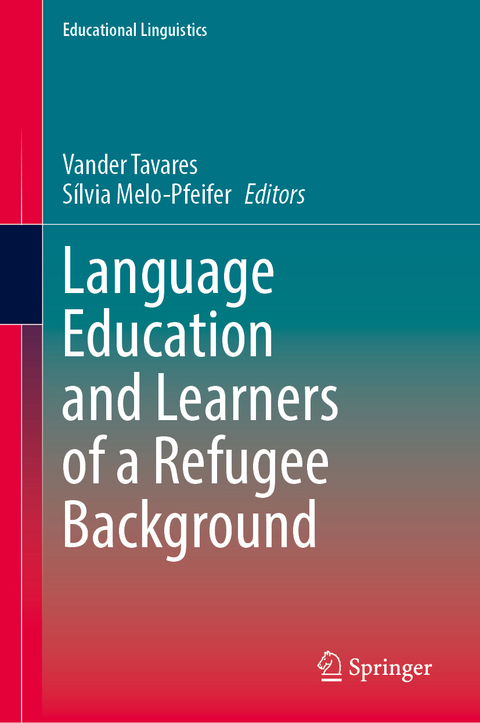
Language Education and Learners of a Refugee Background
Springer International Publishing (Verlag)
978-3-032-16946-4 (ISBN)
- Noch nicht erschienen - erscheint am 29.03.2026
- Versandkostenfrei
- Auch auf Rechnung
- Artikel merken
This book offers a comprehensive and global perspective on language education for learners of a refugee background. It identifies structural and individual challenges refugees face when learning a new language in a variety of sociolinguistic contexts. At the same time, it offers innovative proposals to empower these learners and address the shortcomings of host environments. Readers will gain insight into innovations and interventions within the various dimensions that characterize sustainable and culturally responsive language education for refugees across educational levels from primary to higher and community education. Topics of interest include experiences of researching language education with learners of a refugee background, collaborating with multiple stakeholders, and designing as well as implementing pedagogies that reflect the latest theories of language teaching and learning in multicultural settings, such as translanguaging and plurilingualism. This book is useful to researchers, teachers, and post-graduate students in language education and applied linguistics, as well as policy-makers and community organizations.
Vander Tavares is Associate Professor of Education at the University of Inland Norway and holds a PhD from York University, Canada. His research interests include teacher education, critical second language education, and internationalization of higher education. In 2021, he was the recipient of the Equity, Diversity and Inclusion Award by the Canadian Bureau for International Education (CBIE). He has taught graduate and undergraduate courses in colleges and universities in Canada, Norway and Japan.
Sílvia Melo-Pfeifer is Full Professor of Foreign Language Teacher Education at the University of Hamburg, Germany. She carries out research on pluralistic approaches to language learning and teaching (with particular emphasis on intercomprehension across languages of the same linguistic family), heritage language education, and foreign language teacher education. Methodologically, she has been exploiting the potential of arts-based approaches in raising awareness of what it means to be and become plurilingual.
Chapter 1. Innovative and critical perspectives on language education for learners of a refugee background by Vander Tavares, Sílvia Melo-Pfeifer.- Part 1: Pedagogical approaches in formal education settings and beyond.- Chapter 2. Strategies and tools in formal and informal L2 learning: Adults with migration backgrounds attending Swedish for immigrants (SFI) by Fredrik Olsson, Linda Bradley.- Chapter 3. Beyond textbook knowledge of the host country s language: Migrants language-related tactics when not attending classes by, Marco Santello.- Chapter 4. Pedagogical translanguaging in second language teaching for adult newcomers: Stance, design and shifts by Marianne Eek.- Chapter 5. Culturally sustaining pedagogies for refugee L2 education: A case study of Ukrainian students in Iceland by Vander Tavares, Artëm Ingmar Benediktsson.- Part 2: The role of teacher education and the need for continuous professional development.- Chapter 6. Teaching school staff one of the languages spoken by pupils and families from refugee backgrounds: Implications for practice by Giovanna Fassetta.- Chapter 7. The impact of translanguaging on language acquisition for low-literate refugees and the significance of teacher training by Christina Maligkoudi, Anna Mouti, George Androulakis.- Chapter 8. Fighting against oppression: The role of teacher training in Portuguese as a host language by Carla Alessandra Cursino.- Chapter 9. Teaching materials as language policy instruments: Insights from a Brazilian textbook series for crisis migrants by Bruna Pupatto Ruano, Carla Alessandra Cursino, Elias Ribeiro da Silva, Leandro Rodrigues Alves Diniz.- Part 3: Language learning and its intersections with societal ideologies.- Chapter 10. Between agency and constraint: Refugees additional language learning in a bilingual receiving country context by Wilhelm Barner-Rasmussen, Maria Hokkinen, Maria Ivanova-Gongne, Stefan Lång.- Chapter 11. Visualizing linguistic journeys: Analyzing young immigrant
| Erscheint lt. Verlag | 29.3.2026 |
|---|---|
| Reihe/Serie | Educational Linguistics |
| Zusatzinfo | VIII, 270 p. 19 illus., 18 illus. in color. |
| Verlagsort | Cham |
| Sprache | englisch |
| Maße | 155 x 235 mm |
| Themenwelt | Schulbuch / Wörterbuch ► Wörterbuch / Fremdsprachen |
| Geisteswissenschaften ► Sprach- / Literaturwissenschaft ► Sprachwissenschaft | |
| Sozialwissenschaften ► Pädagogik ► Schulpädagogik / Grundschule | |
| Schlagworte | Global Perspectives on Language Education for Refugees • Language and Identity of Refugee Language Learners • Language Education and Migration • Refugees and Language Learning • Technological Innovations for Refugees and Language Education |
| ISBN-10 | 3-032-16946-1 / 3032169461 |
| ISBN-13 | 978-3-032-16946-4 / 9783032169464 |
| Zustand | Neuware |
| Informationen gemäß Produktsicherheitsverordnung (GPSR) | |
| Haben Sie eine Frage zum Produkt? |
aus dem Bereich