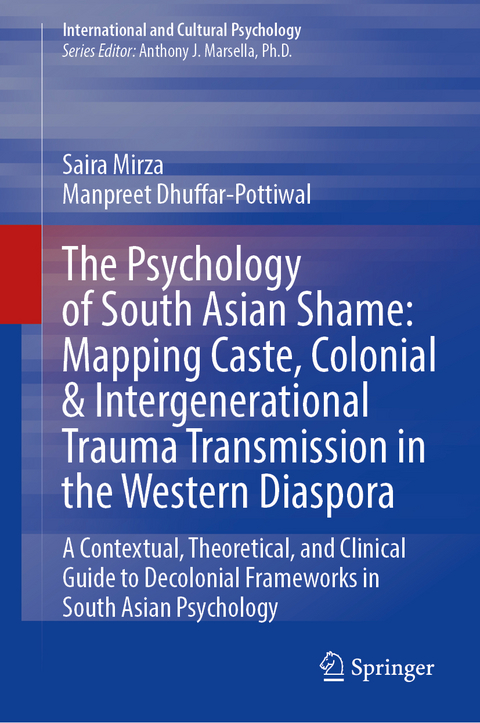
The Psychology of South Asian Shame: Mapping Caste, Colonial & Intergenerational Trauma Transmission in the Western Diaspora
Springer International Publishing (Verlag)
978-3-032-16671-5 (ISBN)
- Noch nicht erschienen - erscheint am 14.07.2026
- Versandkostenfrei
- Auch auf Rechnung
- Artikel merken
This book reveals shame as a political, biological, and cultural inheritance, an architecture of feeling and power that silently shapes identity, belonging, and survival across South Asian diasporas.
At its core, it reframes shame through five interwoven characteristics: polarisation, hierarchy, intersectionality, weaponisation, and neuroticism, revealing how shame functions both as an emotional wound and a system of social control. It divides communities through caste and intragroup conflict; institutionalises inequality by assigning worth at birth; compounds harm through gender, colourism, class, and religion; and is wielded by dominant groups to maintain power. Internalised shame renders superiority and inferiority natural, even moral, turning difference into danger and kin into adversaries.
Drawing on historical analysis, psychological theory, and cultural narrative, the book shows how shame becomes embedded in the nervous system, carried across generations, and sustained by a conspiracy of silence. Colonialism, Partition, migration, and racism shape inner worlds, producing relational wounds that continue to define South Asian families, communities, and diasporic identities.
Introducing a suite of frameworks, the book offers culturally grounded psychological tools:
South Asian Typology of Attachment: how early caregiving is shaped by intergenerational shame, duty, honour, caste, and emotional suppression.
South Asian Ecological Systems theory: how trauma is transmitted through family dynamics, community expectations, caste structures, and ancestral trauma.
South Asian Acculturation theory: how identity and belonging are negotiated across borders.
Caste Trauma Transmission Model: how caste, patriarchy, supremacism, and capitalism reproduce trauma and shame across generations.
South Asian Shame Model: revealing shame as a central organising principle of emotional and relational life, shaping behaviour and culturally patterned psychopathology.
Together, these frameworks move beyond Eurocentric psychology to offer a transformative account of the South Asian psyche. Ultimately, the book calls for breaking silences, challenging hierarchies, and imagining futures grounded in compassion, dignity, justice, and equity.
Saira Mirza, BA, MSc
PhD Researcher, School of Social Sciences, Leeds Trinity University
Saira Mirza is a doctoral researcher specialising in South Asian psychology, migration, identity, and child and family welfare. Her scholarship sits at the intersection of social justice, diaspora studies, and applied psychology, with a sustained focus on community impact and the welfare of disadvantaged children and families. She is the co-editor of the two-volume Migration Psychology series, an interdisciplinary collection exploring the psychological, cultural, and affective dimensions of diasporic life. Alongside her academic work, Saira has extensive professional experience across education, mental health, and community development, delivering evidence-based interventions that support well-being, enhance educational outcomes, and strengthen family and community resilience. Her practice is grounded in intersectional feminism, decolonisation, cultural sensitivity, and a commitment to challenging structural inequities, ensuring that research meaningfully serves vulnerable and marginalised groups.
Dr. Manpreet Dhuffar-Pottiwal, BSc, MSc, PhD, University of the West of England
Dr. Manpreet Dhuffar-Pottiwal is an intersectional feminist psychologist dedicated to the diverse experiences of the South Asian diaspora. As founder of MultiGen Zen CIC, she supports multigenerational families navigating complex cultural expectations and promotes mental well-being through community-based initiatives. Manpreet is a Chartered Psychologist (BPS), CBT Psychotherapist, and Trainee Counselling Psychologist completing her Professional Doctorate in Counselling Psychology. Manpreet also holds a PhD in Behavioural Addictions, with postgraduate training in CBT and Addiction Psychology. Her clinical expertise spans intergenerational trauma transmission, behavioural addictions, and culturally sensitive mental health interventions.
Manpreet contributes to the training of future mental health professionals in academic settings. A TEDx speaker, she shares insights on social justice, South Asian psychology and community support. Her publications and conference work explore compulsive sexual behaviour, shame, and trauma, advancing understanding of behavioural addictions and culturally nuanced mental health care.
Chapter 1: Why a psychology of South Asian shame?.- Chapter 2: Contextualising South Asian shame.- Chapter 3: The intergenerational transmission of trauma and shame.- Chapter 4: The psychology of South Asian shame.- Chapter 5: The South Asian shame model.- Chapter 6: Decolonial approaches to therapy and clinical practice.- Chapter 7: Beyond the clinic: Activism, policy, and decolonisation.
| Erscheint lt. Verlag | 14.7.2026 |
|---|---|
| Reihe/Serie | International and Cultural Psychology |
| Zusatzinfo | Approx. 250 p. 5 illus. |
| Verlagsort | Cham |
| Sprache | englisch |
| Maße | 155 x 235 mm |
| Themenwelt | Geisteswissenschaften ► Psychologie ► Sozialpsychologie |
| Schlagworte | addiciton • Behaviour • caste • Colonialism • cultural psychology • hypersexuality • Migration • Perfectionism • Shame • South Asian diaspora |
| ISBN-10 | 3-032-16671-3 / 3032166713 |
| ISBN-13 | 978-3-032-16671-5 / 9783032166715 |
| Zustand | Neuware |
| Informationen gemäß Produktsicherheitsverordnung (GPSR) | |
| Haben Sie eine Frage zum Produkt? |
aus dem Bereich