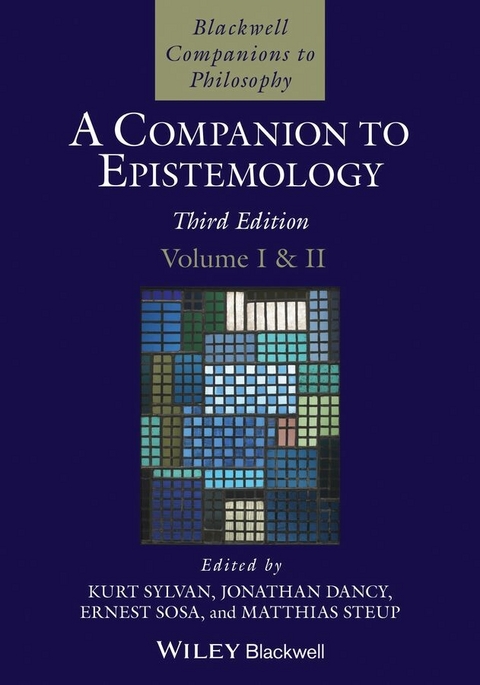
A Companion to Epistemology, 2 Volume Set (eBook)
4056 Seiten
Wiley-Blackwell (Verlag)
978-1-119-75782-5 (ISBN)
A Companion to Epistemology, 2 Volume Set, 3rd Edition
A Companion to Epistemology provides a comprehensive, up-to-date reference for understanding the theory of knowledge. Edited by distinguished scholars, this expanded third edition explores classic questions about knowledge and justified belief alongside contemporary topics such as social and political epistemology, the ethics of belief, and the epistemology of perception. With contributions from established and younger voices in the field, each entry offers insights into key issues, definitions, and debates, creating a rich resource for both introductory and advanced exploration.
Extending its reach with critical coverage of emerging and underexplored areas, this third edition contains more than 50 new survey articles and an updated 'Epistemology A-Z' glossary containing hundreds of entries. It also brings in wider perspectives, covering classical Indian and Islamic epistemology and featuring new entries on historical and present-day women philosophers, for example. With clear explanations and thoughtful analysis, the Companion captures the diversity and relevance of epistemology today.
Ideal for undergraduate and graduate students studying philosophy, cognitive science, or ethics, A Companion to Epistemology is also an indispensable reference for educators, scholars, and researchers. Its accessible yet thorough structure makes it a valuable addition to any academic collection, supporting coursework, independent study, and advanced research.
Kurt Sylvan is Associate Professor of Philosophy at the University of Southampton. Specializing in epistemology, philosophy of mind, and philosophy of practical reason, he has published extensively in leading journals such as Philosophical Review, Mind, and Philosophy and Phenomenological Research. His research focuses on foundational questions about knowledge and the ethics of belief.
Jonathan Dancy is Professor Emeritus of Philosophy at the University of Texas at Austin. Known for his influential work in epistemology, moral philosophy, and the philosophy of practical reason, Dancy is the author of several foundational books, such as Ethics without Principles and Practical Reality. His work has inspired several conferences and edited collections.
Ernest Sosa is Board of Governors Professor of Philosophy at Rutgers University. He previously taught at Brown University for more than forty years. A pioneer in virtue epistemology and inventor of telic virtue epistemology, Sosa has authored many influential books on knowledge and belief, including the multi-volume Apt Belief and Reflective Knowledge: A Virtue Epistemology.
Matthias Steup is Professor of Philosophy at the University of Colorado at Boulder, with prior appointments at Purdue University, Grinnell College, and others. He has published influential articles on the structure of justification, internalism vs. externalism, doxastic control, and the ethics of belief.
A Companion to Epistemology, 2 Volume Set, 3rd Edition A Companion to Epistemology provides a comprehensive, up-to-date reference for understanding the theory of knowledge. Edited by distinguished scholars, this expanded third edition explores classic questions about knowledge and justified belief alongside contemporary topics such as social and political epistemology, the ethics of belief, and the epistemology of perception. With contributions from established and younger voices in the field, each entry offers insights into key issues, definitions, and debates, creating a rich resource for both introductory and advanced exploration. Extending its reach with critical coverage of emerging and underexplored areas, this third edition contains more than 50 new survey articles and an updated "e;Epistemology A-Z"e; glossary containing hundreds of entries. It also brings in wider perspectives, covering classical Indian and Islamic epistemology and featuring new entries on historical and present-day women philosophers, for example. With clear explanations and thoughtful analysis, the Companion captures the diversity and relevance of epistemology today. Ideal for undergraduate and graduate students studying philosophy, cognitive science, or ethics, A Companion to Epistemology is also an indispensable reference for educators, scholars, and researchers. Its accessible yet thorough structure makes it a valuable addition to any academic collection, supporting coursework, independent study, and advanced research.
Notes on Contributors
J. Adam Carter is Professor of Philosophy at the University of Glasgow where he is co‐director of the Cogito Epistemology Research Centre. His recent monographs include Autonomous Knowledge (OUP, 2022), Stratified Virtue Epistemology: A Defence (CUP, 2023), A Telic Theory of Trust (OUP, 2024), Epistemology in the Subpersonal Vale (w/R. Rupert, OUP, forthcoming), and Knowing How and Learning How: An Epistemic Theory of Control (w/T. Kearl, CUP, forthcoming).
Linda Martín Alcoff is Professor of Philosophy at Hunter College, City University of New York. She is also the co‐director of the Mellon Public Humanities and Social Justice Program. She has published over 100 articles and more than 10 edited collections on a wide range of topics, including influential work in feminist epistemology and political epistemology.
Rima Basu is an Associate Professor of Philosophy at Claremont McKenna College. In her work at the intersection of ethics, epistemology, and philosophy of race, she argues that what we owe each other is not just a matter of what we do or what we say, but also what we believe.
Heather D. Battaly is Professor in the Department of Philosophy at the University of Connecticut. She is Editor‐in‐Chief of the Journal of the American Philosophical Association.
Akeel Bilgrami is Sidney Morgenbesser Professor of Philosophy at Columbia University. He has published many highly influential works at the intersection of epistemology and philosophy of mind.
Laurence BonJour is Emeritus Professor of Philosophy at the University of Washington. He is the author of numerous influential articles and books on topics at the foundations of epistemology.
Anthony Booth is currently Professor of Ethics and Epistemology in the Department of Philosophy at the University of Sussex, UK. His main research interests are in the Ethics of Belief, both from Western and Islamic perspectives.
Peter Brössel is Junior Professor of Philosophy at Ruhr‐Universität Bochum. He has written a variety of influential papers in formal epistemology, the epistemology of science, and traditional and social epistemology.
Jessica Brown is Professor of Philosophy in the Department of Philosophy at St Andrews University. Her books include Groups as Epistemic and Moral Agents (OUP, 2024), Fallibilism: Evidence and Knowledge (OUP, 2018), and Anti‐Individualism and Knowledge (MIT, 2004).
Lucy Campbell is Associate Professor in the Philosophy Department at the University of Warwick. Her research interests are in the intersection of epistemology, philosophy of mind, and philosophy of action.
Quassim Cassam is Professor of Philosophy at the University of Warwick. His books include Vices of the Mind: From the Intellectual to the Political (Oxford, 2019) and Extremism: A Philosophical Analysis (Routledge, 2021).
Arindam Chakrabarti is Professor of Philosophy at Ashoka University. He has authored and (co‐)edited several influential books at the intersection of contemporary analytic philosophy and classical Indian philosophy, including Knowing from Words (1994), Universals, Concepts, and Qualities (2006), Comparative Philosophy without Borders (2015), and Realisms Interlinked (2019), as well as many important papers in leading journals.
Juan Comesaña is Professor in the Philosophy Department at Rutgers University, New Brunswick.
Jonathan Dancy is Professor Emeritus of Philosophy at the University of Texas at Austin. Known for his influential work in epistemology, moral philosophy, and the philosophy of practical reason, Dancy is the author of several foundational books, such as Ethics without Principles and Practical Reality.
Nilanjan Das is Associate Professor of Philosophy at the University of Toronto. His primary research interests lie in epistemology and the history of Sanskrit philosophy. In epistemology, his work has focused on norms of evidence management, i.e. norms that govern our practices of gathering and using evidence for practical and theoretical purposes. In the history of Sanskrit philosophy, he has explored debates among Brahmanical and Buddhist thinkers about the nature of the self, knowledge, and self‐knowledge. His forthcoming book The Instability of Reason: Śrīharṣa on the Foundations of Epistemology explores these very themes in the philosophical work of the twelfth‐century Sanskrit intellectual Śrīharṣa.
Kristie Dotson is a University Diversity and Social Transformation Professor in the Departments of Philosophy and Afroamerican and African Studies at the University of Michigan, Ann Arbor. She works in epistemology (especially political epistemology), feminist philosophy (especially Black Feminisms and Women of Color Feminisms), and metaphilosophy.
Anna‐Maria Asunta Eder is a research fellow at the University of Cologne. She has published widely in traditional, formal, and social epistemology, including work on disagreement, higher‐order evidence, and epistemic justification.
Davide Fassio is an Associate Professor in the School of Philosophy at Zhejiang University and Senior Research Associate at the University of Johannesburg. Fassio’s research interests include epistemic normativity, the relation between knowledge and practical rationality, and epistemic paradoxes.
Giada Fratantonio is a Postdoctoral Research Fellow and a research member of the Cogito Epistemology Research Centre in the Department of Philosophy at the University of Glasgow, UK. Her research interests include the nature and normativity of evidence, and how these interact with a cluster of issues in epistemology, ethics, and the law.
Jane Friedman is Associate Professor of Philosophy in the Department of Philosophy at New York University.
Jie Gao is an Associate Professor in the School of Philosophy at Zhejiang University and Senior Research Associate at the University of Johannesburg. Gao is an associate editor of the Asian Journal of Philosophy and co‐founder of the Asian Epistemology Network. Gao’s research is primarily in epistemology, philosophy of mind, and decision theory.
Marc Gasser‐Wingate is an Associate Professor in the Department of Philosophy at Boston University.
Heidi Grasswick is the George Nye & Anne Walker Boardman Professor of Mental and Moral Science in the Department of Philosophy at Middlebury College in Vermont. Her philosophical interests span social epistemology, feminist epistemology, and feminist philosophy of science.
Alan Hájek is a Professor of Philosophy at the Australian National University. He has published widely and influentially in formal epistemology.
Natalie Hannan is Assistant Professor of Philosophy at Providence College. Her research focuses on the intersection of epistemology and ethics in ancient philosophy.
Gilbert Harman was a Professor of Philosophy at Princeton University. He authored numerous influential articles and books on topics at the foundations of epistemology.
Stephan Hartmann is a Professor of Philosophy at the Ludwig Maximilian University of Munich, and also the Chair and Co‐Director of the Munich Center for Mathematical Philosophy.
Ali Hasan is Associate Professor and Chair of the Department of Philosophy at the University of Iowa, Iowa City. His research interests include epistemology, philosophy of mind, and ethics.
Alison Hills is a Professor of Philosophy at Oxford University and a Fellow and Tutor at St John’s College, Oxford.
Paul O. Irikefe is a President’s and Andrew W. Mellon Foundation Postdoctoral Fellow in the Department of Philosophy, UC Irvine. He is also a research associate at the University of Johannesburg, South Africa (African Centre for Epistemology and Philosophy of Science). His research interests include epistemology, metaphilosophy, indigenous epistemology and philosophy, and African philosophy.
Carrie Jenkins is Professor of Philosophy at the University of British Columbia. Her books include Grounding Concepts: An Empirical Basis for Arithmetical Knowledge (OUP, 2007) and Sad Love: Romance and the Search for Meaning (Polity, 2022).
Sophie Keeling is a Ramón y Cajal research fellow at the Universidad Nacional de Educación a Distancia (UNED), Madrid. Her research interests include self‐knowledge, agency, and the reasons for which we believe and act.
Christoph Kelp is Professor of Philosophy and Co‐Director of COGITO Epistemology Research Centre at the University of Glasgow, UK. His books include Inquiry, Knowledge, and Understanding (Oxford University Press, 2021) and Sharing Knowledge: A Functionalist Account of Assertion (with M. Simion, Cambridge University Press, 2021).
Hanti Lin is an Associate Professor in the Department of Philosophy at the University of California, Davis. His research areas include epistemology and the philosophy of science, with interdisciplinary work on scientific inference – situated at the intersection of epistemology and data science. He is also an associate editor of the Harvard Data Science Review, where he serves as one of the co‐editors of the philosophy column titled “Meta Data...
| Erscheint lt. Verlag | 2.12.2025 |
|---|---|
| Reihe/Serie | Blackwell Companions to Philosophy |
| Sprache | englisch |
| Themenwelt | Geisteswissenschaften ► Philosophie ► Erkenntnistheorie / Wissenschaftstheorie |
| Schlagworte | cognitive science epistemology • epistemology companion • epistemology debates • epistemology essays • epistemology reference • Ethics of belief • justified belief • non-western epistemology • Political Epistemology • Social epistemology • Theory of Knowledge |
| ISBN-10 | 1-119-75782-7 / 1119757827 |
| ISBN-13 | 978-1-119-75782-5 / 9781119757825 |
| Informationen gemäß Produktsicherheitsverordnung (GPSR) | |
| Haben Sie eine Frage zum Produkt? |
 EPUB (Adobe DRM)
Kopierschutz: Adobe-DRM
Adobe-DRM ist ein Kopierschutz, der das eBook vor Mißbrauch schützen soll. Dabei wird das eBook bereits beim Download auf Ihre persönliche Adobe-ID autorisiert. Lesen können Sie das eBook dann nur auf den Geräten, welche ebenfalls auf Ihre Adobe-ID registriert sind.
Details zum Adobe-DRM
Dateiformat: EPUB (Electronic Publication)
EPUB ist ein offener Standard für eBooks und eignet sich besonders zur Darstellung von Belletristik und Sachbüchern. Der Fließtext wird dynamisch an die Display- und Schriftgröße angepasst. Auch für mobile Lesegeräte ist EPUB daher gut geeignet.
Systemvoraussetzungen:
PC/Mac: Mit einem PC oder Mac können Sie dieses eBook lesen. Sie benötigen eine
eReader: Dieses eBook kann mit (fast) allen eBook-Readern gelesen werden. Mit dem amazon-Kindle ist es aber nicht kompatibel.
Smartphone/Tablet: Egal ob Apple oder Android, dieses eBook können Sie lesen. Sie benötigen eine
Geräteliste und zusätzliche Hinweise
Buying eBooks from abroad
For tax law reasons we can sell eBooks just within Germany and Switzerland. Regrettably we cannot fulfill eBook-orders from other countries.
aus dem Bereich