Zum Hauptinhalt springen
Nicht aus der Schweiz? Besuchen Sie lehmanns.de
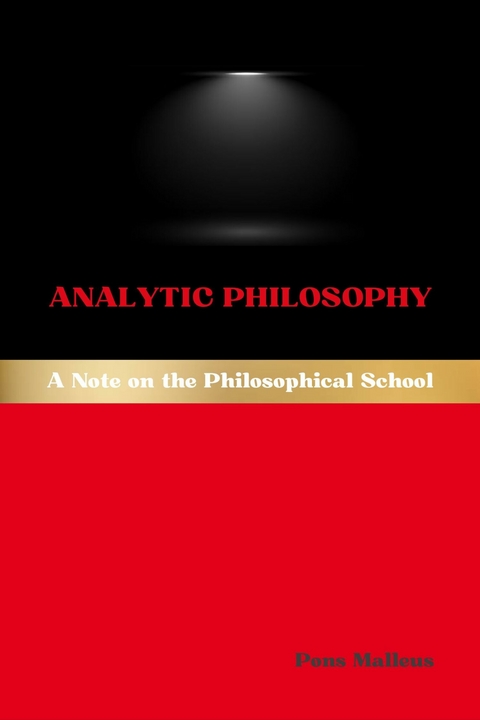
Analytic Philosophy -  Pons Malleus

Analytic Philosophy (eBook)

A Note on the Philosophical School

(Autor)

eBook Download: EPUB
2025 | 1. Auflage
107 Seiten
Publishdrive (Verlag)
978-0-00-111292-6 (ISBN)
Systemvoraussetzungen
5,99 inkl. MwSt
(CHF 5,85)
Der eBook-Verkauf erfolgt durch die Lehmanns Media GmbH (Berlin) zum Preis in Euro inkl. MwSt.
  • Download sofort lieferbar
  • Zahlungsarten anzeigen

This book is an introduction to analytic philosophy-a school of thought that has shaped much of contemporary philosophy in the English-speaking world. Emerging in the early 20th century, analytic philosophy redefined the nature of philosophical inquiry by emphasizing clarity, logical rigor, and linguistic analysis. It distinguished itself from older metaphysical traditions and from the more historically and continentally rooted strands of philosophy by striving to make philosophical problems more tractable, if not always solvable, through careful reasoning and attention to language.


Analytic philosophy is not a unified doctrine. It does not rest on a single set of claims or a common body of conclusions. Instead, it is defined more by its method and temperament: a commitment to argument over rhetoric, to detail over grandeur, and to a disciplined use of language as the primary tool of philosophical investigation. As a result, analytic philosophy has tackled a wide array of subjects-logic, epistemology, philosophy of language, ethics, metaphysics, and philosophy of mind-with a level of precision that has become both its hallmark and its greatest source of criticism.


The origins of this movement can be traced to figures such as Gottlob Frege, Bertrand Russell, G.E. Moore, and Ludwig Wittgenstein, whose early 20th-century writings marked a radical departure from the dominant philosophical paradigms of their time. Frege's innovations in logic and the philosophy of language laid the groundwork for a more rigorous treatment of meaning and reference. Russell's clarity and systematic ambition brought new life to philosophical analysis, while Moore's commonsense realism challenged idealism by demanding that philosophical language mirror ordinary usage. Wittgenstein, in both his early and later work, provided foundational critiques that shifted the course of the movement, influencing generations of thinkers.


This book does not attempt to canonize analytic philosophy or to present it as the only legitimate form of philosophical inquiry. Rather, it aims to offer a critical, accessible, and comprehensive guide to its central ideas, debates, and figures. It explores the internal evolution of the movement-from logical atomism and positivism to ordinary language philosophy and beyond-and it situates analytic thought in dialogue with other traditions, including Continental philosophy, pragmatism, and the natural sciences.


The analytic tradition, like all philosophical traditions, is dynamic. In recent decades, it has expanded in scope, becoming increasingly pluralistic. Topics once considered outside its purview-such as aesthetics, political theory, and feminist philosophy-have entered its discourse. At the same time, its practitioners continue to wrestle with questions about the role of intuition, the limits of language, and the relationship between philosophy and science.


This book is intended for both newcomers and those with a background in philosophy who seek a deeper understanding of the analytic tradition. Each chapter is structured to offer clear exposition alongside critical analysis, with an emphasis on how problems are framed and arguments constructed. Whether you are drawn to the logical elegance of early analytic thought or to its later attention to the messiness of ordinary language, the aim here is to foster engagement-not merely to inform, but to invite philosophical reflection in the analytic spirit.


In that spirit, this book does not offer final answers. Instead, it presents analytic philosophy as an ongoing conversation-one that continues to evolve, challenge, and provoke. To engage with this tradition is to participate in that conversation, and it is my hope that the pages ahead will provide both a map of where it has been and a prompt to consider where it might yet go.

Historical Evolution and Foundations
Early Influences - Frege and Russell:
The framework of Analytic Philosophy traces its roots back to the pioneering contributions of Gottlob Frege and Bertrand Russell, two prominent figures whose work laid the groundwork for the development of this philosophical tradition. Frege, a German mathematician, and logician, is renowned for his significant advancements in the field of mathematical logic. His work 'Begriffsschrift' (Concept Script) introduced a formal language for logic, setting the stage for rigorous reasoning and precise analysis in philosophical discourse. Frege's endeavor to establish a foundation for mathematics through logic significantly influenced the trajectory of Analytic Philosophy. His logical innovations provided a framework for addressing fundamental questions regarding meaning, reference, and truth, which became central themes in subsequent analytic inquiry.
On the other hand, Bertrand Russell, a British philosopher, mathematician, and logician, collaborated with Frege's ideas and extended them further, particularly in the field of logic and language. Russell's pursuit of a logical and formal treatment of mathematics paralleled Frege's efforts, leading to significant collaborative engagement in the discipline of logic. The epoch-making collaboration between Frege and Russell culminated in a joint path-breaking quest to develop a formal foundation for arithmetic and the rest of mathematics. However, their collaboration was not without fractures, as Russell's discovery of the famous 'Russell's paradox' challenged some of the assumptions underlying Frege's system.
Despite these challenges, the foundational work of Frege and Russell set the stage for the burgeoning field of Analytic Philosophy, marking a departure from the prevailing trends in philosophy at the time. Their groundbreaking investigations into the nature of language, meaning, and logic became instrumental in reshaping philosophical inquiry. By delving into the structures of language and thought, Frege and Russell paved the way for a new mode of philosophical analysis that emphasized clarity, precision, and logic in addressing philosophical problems.
The enduring significance of their early influences can be observed in the continued relevance of their ideas within contemporary Analytic Philosophy, serving as the cornerstone for the evolution of philosophical discourse. The legacy of Frege and Russell resides not only in their individual contributions but also in their collective impact on the development of analytical methods and principles.
Wittgenstein's Pioneering Contributions:
Beginning with his work 'Tractatus Logico-Philosophicus', Ludwig Wittgenstein introduced a new way of understanding language and its relation to reality. By exploring the logical structure of propositions and their connection to the world, he laid the foundation for the development of logical atomism, which aimed to analyze complex truths into their simplest components.
Wittgenstein's later work, particularly his posthumously published 'Philosophical Investigations', marked a significant departure from the Tractatus. Here, he delved into the complexities of language games, rule-following, and the nature of meaning. His emphasis on the contextual and pragmatic aspects of language challenged the prevailing theories of his time and paved the way for the emergence of ordinary language philosophy.
Wittgenstein's notion of 'language-games' revolutionized the understanding of how language operates in various social contexts and activities. This conceptual framework offered a fresh perspective on the intricacies of communication, overturning traditional views and prompting a paradigm shift in linguistic philosophy. Wittgenstein's insistence on examining the use of language in concrete situations rather than abstract theorizing proved instrumental in reshaping the direction of analytic philosophy.
His influential ideas extended beyond the field of language, encompassing broader philosophical inquiries into the nature of thought, perception, and consciousness. Wittgenstein's exploration of private language, mental concepts, and the limits of what can be sensibly discussed contributed significantly to the ongoing discourse on the philosophy of mind and cognitive science.
The Vienna Circle and Logical Positivism:
The Vienna Circle, a group of influential philosophers, scientists, and mathematicians, played a pivotal role in the development of analytic philosophy through their espousal of logical positivism. Emerging in the early 20th century, this movement sought to establish a comprehensive framework for scientific knowledge based on logical analysis and empirical verification. The members of the Vienna Circle, including Moritz Schlick, Rudolf Carnap, and Otto Neurath, aimed to create a unified approach to philosophy that was firmly grounded in logic and science.
At the core of logical positivism was the principle of verifiability, which asserted that meaningful statements must be capable of empirical confirmation or refutation. This led to a strong emphasis on the verification principle and the rejection of metaphysical or speculative claims that could not be empirically verified. The Vienna Circle's dedication to the principles of logical empiricism had a profound impact on the philosophical landscape, influencing disciplines beyond philosophy, such as psychology, sociology, and linguistics.
The Vienna Circle's commitment to rigorous logical analysis and the formalization of language paved the way for advancements in the philosophy of science. Their efforts to establish a clear demarcation between empirical science and metaphysical speculation helped to refine the criteria for meaningful discourse within scientific inquiry. Through their writings and discussions, the members of the Vienna Circle sought to elucidate the nature of scientific knowledge and its relationship to the external world.
Additionally, the Vienna Circle was instrumental in popularizing the use of symbolic logic as a tool for clarifying philosophical questions and formalizing scientific theories. This move towards greater precision and formalization in philosophical discourse contributed to the evolution of analytic philosophy and its enduring impact on contemporary philosophical thought.
Cambridge and the Rise of Ordinary Language Philosophy:
In the mid-20th century, the University of Cambridge became a focal point for the development of Ordinary Language Philosophy within the broader Analytic tradition. This philosophical movement, also known as Linguistic Philosophy, sought to scrutinize and refine the role of ordinary language in philosophical inquiry. A key figure in this movement was Ludwig Wittgenstein, whose later work, particularly 'Philosophical Investigations,' profoundly influenced the direction of Ordinary Language Philosophy. Wittgenstein's emphasis on the complexities and nuances of everyday language catalyzed a shift in philosophical methodology, prompting scholars to analyze linguistic usage as a means of uncovering conceptual misunderstandings and clarifying philosophical problems. The work of philosophers such as J.L. Austin, Gilbert Ryle, and Peter Strawson further advanced these investigations at Cambridge. Austin’s groundbreaking work on speech acts and Ryle’s critique of Cartesian dualism contributed to the maturation of Ordinary Language Philosophy. Central to their approach was the rejection of a priori theorizing in favor of close attention to how language is actually used in various contexts. This linguistic turn led to fresh insights into philosophical puzzles concerning perception, intentionality, and knowledge. By closely examining natural language, these philosophers aimed to dissolve traditional philosophical dilemmas and illuminate the way in which language shapes our understanding of the world. Furthermore, their emphasis on the 'ordinary' language of everyday life distinguished their approach from more abstract and formal modes of philosophical analysis. The impact of Cambridge’s Ordinary Language Philosophy reverberated globally, influencing subsequent generations of Analytic philosophers and significantly shaping the trajectory of the field. Through its focus on the practical use of language, this intellectual movement offered a compelling framework for reimagining traditional problems in metaphysics, epistemology, and ethics.
American Pragmatism and Analytic Thought:
American pragmatism played a pivotal role in shaping the landscape of analytic philosophy in the early 20th century. Emerging as a distinct philosophical movement, pragmatism emphasized the practical consequences of ideas and the importance of experience in guiding human knowledge and conduct. Influential figures such as Charles Sanders Peirce, William James, and John Dewey were instrumental in laying the groundwork for the development of pragmatic ideas that would intersect with and influence the trajectory of analytic thought. Peirce's pragmatic maxim, which posited that the meaning of any concept lay in its conceivable effects on our actions and experiences, laid a foundation for the pragmatic approach to understanding truth and meaning. James further expanded on these ideas, emphasizing the empirical and experiential aspects of knowledge, steering the focus towards the functional aspects of beliefs and the validation of concepts through their practical outcomes. Meanwhile, Dewey's instrumentalist view of knowledge underscored the importance of experimentation and adaptation, aligning with the empirically-informed methodologies embraced within the analytical tradition.
The impact of American pragmatism on analytic philosophy extended...

Erscheint lt. Verlag 1.12.2025
Sprache englisch
Themenwelt Geisteswissenschaften
ISBN-10 0-00-111292-9 / 0001112929
ISBN-13 978-0-00-111292-6 / 9780001112926
Informationen gemäß Produktsicherheitsverordnung (GPSR)
Haben Sie eine Frage zum Produkt?
EPUBEPUB (Adobe DRM)
Größe: 116 KB

Kopierschutz: Adobe-DRM
Adobe-DRM ist ein Kopierschutz, der das eBook vor Mißbrauch schützen soll. Dabei wird das eBook bereits beim Download auf Ihre persönliche Adobe-ID autorisiert. Lesen können Sie das eBook dann nur auf den Geräten, welche ebenfalls auf Ihre Adobe-ID registriert sind.
Details zum Adobe-DRM

Dateiformat: EPUB (Electronic Publication)
EPUB ist ein offener Standard für eBooks und eignet sich besonders zur Darstellung von Belle­tristik und Sach­büchern. Der Fließ­text wird dynamisch an die Display- und Schrift­größe ange­passt. Auch für mobile Lese­geräte ist EPUB daher gut geeignet.

Systemvoraussetzungen:
PC/Mac: Mit einem PC oder Mac können Sie dieses eBook lesen. Sie benötigen eine Adobe-ID und die Software Adobe Digital Editions (kostenlos). Von der Benutzung der OverDrive Media Console raten wir Ihnen ab. Erfahrungsgemäß treten hier gehäuft Probleme mit dem Adobe DRM auf.
eReader: Dieses eBook kann mit (fast) allen eBook-Readern gelesen werden. Mit dem amazon-Kindle ist es aber nicht kompatibel.
Smartphone/Tablet: Egal ob Apple oder Android, dieses eBook können Sie lesen. Sie benötigen eine Adobe-ID sowie eine kostenlose App.
Geräteliste und zusätzliche Hinweise

Buying eBooks from abroad
For tax law reasons we can sell eBooks just within Germany and Switzerland. Regrettably we cannot fulfill eBook-orders from other countries.

Mehr entdecken
aus dem Bereich
Strategien und Hilfen für die Alltagsbewältigung

von Roberto D' Amelio; Wolfgang Retz …

eBook Download (2024)
Kohlhammer Verlag
CHF 25,35