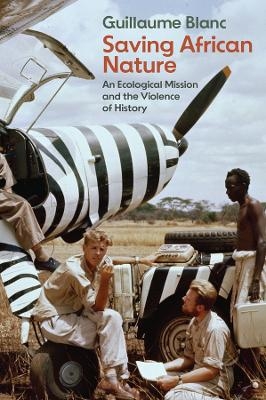
Saving African Nature
Polity Press (Verlag)
978-1-5095-6869-7 (ISBN)
- Noch nicht erschienen (ca. Mai 2026)
- Portofrei ab CHF 40
- Auch auf Rechnung
- Artikel merken
But how did this happen? Who organized this continuity between the colonial era and the era of independence? Guillaume Blanc answers these questions by immersing himself at the heart of a strange global ecological mission, launched in 1961: the 'African Special Project'. He tells the story of this project, but rather than following a single narrative thread, he brings to life four worlds: the world of gentleman experts who saw Africa as the world's last natural refuge; the world of East African colonists who were retraining as international experts; the world of African leaders who sought to control their peoples while satisfying the demands of their Western partners; and finally, the world of local farmers and their families living on the land who were forced to adapt or abandon their homes. These men do not speak of the same nature, but step by step, their worlds draw closer together until they meet – and this is where violence erupts.
This well-researched book lays bare the violence inherent in the creation of African game reserves and national parks and documents a hidden dimension of colonialism and its legacies. It will be of great interest to students and scholars in environmental history, political ecology and postcolonial studies, as well as to anyone interested in African nature and wildlife and the game parks that are visited every year by millions.
Guillaume Blanc is Professor in Contemporary History at Sciences Po Bordeaux.
Introduction. Violence in a natural world: from why to how
In the light of the present
Seizing the moment
Making choices
A gallery of institutions
A gallery of actors
Chapter 1. Protecting Africa from the Africans. The world of the expert gentlemen
Arusha 1961. Changing everything in order to keep everything the same
From imperialism to internationalism. History
The rise of a conservationist 'International'
How to conserve: globalize on the one hand, Africanize on the other
Protect the planet, take action in Africa
The experts' (a)political quest
Faces and people of Africa
Chapter 2. Saving the East-African stronghold. The world of those who stayed
Arusha 1961. Working in a liberated Africa
Being part of the transition to independence. History
The East-African International
In the name of the last stronghold of nature
With the 'Africans', against the 'Africans'
An impossible dream
A nightmare
Chapter 3. Governing Ethiopia. The world-nation of African leaders
Arusha 1961. Protecting nature, playing politics
The natural extraversion of the African State. History
Current status: applicant for aid
Accepting dependence
Ethiopia first
Cursed farenj'
Chapter 4. Living in a National Park
The global village of the anonymous
Arusha 1961, nature for some, a way of life for Others
In search of subalterns. History
Tekelakay, or how to resist
Mengest, the local big man
Serateña, invisible employee
Dehaw: the poor man
Yemiyastekaklew, the resourceful one
Epilogue. A little nature, (far) too much humanity
When the postcolonial moment ended
When the time of an enduring postcolony began
Acknowledgements
Acronyms
Bibliography
Notes
Index
| Erscheint lt. Verlag | 29.5.2026 |
|---|---|
| Übersetzer | Helen Morrison |
| Verlagsort | Oxford |
| Sprache | englisch |
| Themenwelt | Geisteswissenschaften ► Geschichte |
| ISBN-10 | 1-5095-6869-7 / 1509568697 |
| ISBN-13 | 978-1-5095-6869-7 / 9781509568697 |
| Zustand | Neuware |
| Informationen gemäß Produktsicherheitsverordnung (GPSR) | |
| Haben Sie eine Frage zum Produkt? |
aus dem Bereich