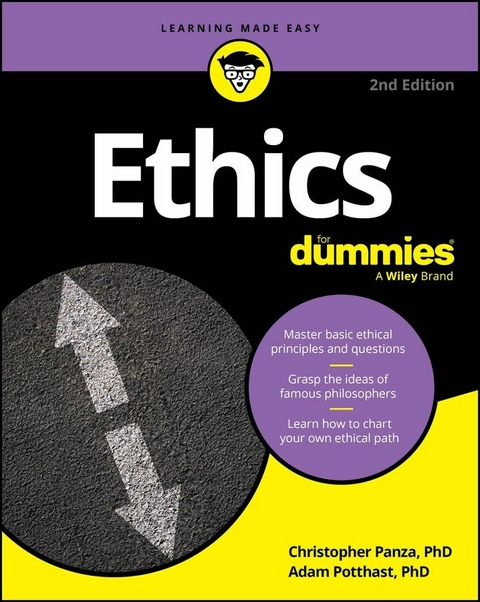
Ethics For Dummies (eBook)
583 Seiten
For Dummies (Verlag)
978-1-394-36637-8 (ISBN)
Your approachable guide to ethical philosophy
Ethics For Dummies, 2nd Edition is an easy-to-grasp introduction to the branch of philosophy that deals with living a good life. Learn about the most important concepts and thinkers in the world of ethics, so you can analyze issues in the modern world from an ethical perspective. Explore standards of right and wrong, fairness, virtues, and how different cultures approach the questions of ethics-this book explains it all in clear and simple terms. Plus, it demystifies the writings of great ethicists like Aristotle, Confucius, Descartes, Kant, and Hume. Throughout the book, you practice theorizing on major ethical questions of today, including AI and social media.
Inside:
- Discover non-Western approaches to ethics, including Hindu, African, and Indigenous ways of thought
- Explore ethical questions around race, social constructs, disability, and beyond
- Get help understanding the writings of Aristotle, Confucius, and other famous ethical philosophers
- Apply ethics to your everyday life, for more confident, reasoned decisions
With Ethics For Dummies, 2nd Edition, become more comfortable with the centuries-old study of ethical philosophy, so you can pass your ethics class-or just pass the ethical tests life throws your way.
Christopher Panza, PhD, is a Professor of Philosophy at Drury University. He teaches Confucianism, ethics, and existentialism. He holds a PhD in Philosophy.
Adam Potthast, PhD, is Dean of Liberal Arts, Sciences, and Transfer at Minnesota State College Southeast. He holds a PhD in Philosophy.
Introduction
As the authors of this book, we feel strongly about the importance of ethics. Ethics marks off one of the most fascinating — and difficult — aspects of human life. Whether you’re a university student who’s taking an ethics course and needs the theories clarified or you’re someone who wants to live a life that’s more aligned with what’s right, Ethics For Dummies is just for you. Philosophy courses on ethics can be filled with complicated material, so this book cuts to the chase and gives you what you need to know while making you smile at the same time.
To take ethics — or the investigation of what ought to be — seriously is to engage head on with the question of value. Of course, it also involves jumping into the thick controversy that involves debating what you ought to do and why. Taking ethics on involves critically thinking through how to interact with other people, animals, perhaps your colleagues at work, and the environment. By the time you’re done reading this book, ethics will no longer be mystifying. It will seem like familiar territory.
About This Book
We — your humble authors — have decades of experience between us as professors teaching college courses on ethics. As a result, we’re well acquainted with how difficult and frustrating the subject of ethics can be for students or for people who know little about it and are approaching it for the first time. We were there once, too.
Our first-hand knowledge of the difficulties of teaching ethics puts us in a good position to write this book for you. We’ve laid out the book in a particular way that helps you get a better grasp on the many topics in ethics that you’re likely to study. Basically, we want to translate these confusing topics into plain English. We hope our explanations help you grasp the main concepts.
Most importantly, we’ve arranged this book so that you don’t need to read it straight through like a novel. Feel free to jump around. Basically, you can open the book wherever you want and start reading. It’s written so that you can understand any part of it without needing to read the other parts. At the same time, the book can also be read straight through from start to end.
We’ve also written this book with humor foremost in our minds. Philosophy and ethics can sometimes be dry, so we’ve done our best to make sure that our book doesn’t come across that way. We want Ethics For Dummies to be informative and helpful, but we also want it to be enjoyable to read.
Conventions Used in This Book
In our book, we’ve used a few conventions to help make the text more accessible and easier to read. Consider the following:
- We boldface the action parts of numbered steps and the keywords of bulleted lists.
- We italicize new terms and provide definitions of them so you’re always in the loop.
We also include some conventions that are strictly ethics related. We tend to gloss over some things in this book in order to get the basic points across and not make things too complicated. So instead of constantly using caveats and pointing your attention to fine print or footnotes at the end of the book, keep in mind the following conventions we use:
- The uses of terms like morality and ethics are typically seen as separate in ethics. We use them interchangeably. To see why, head to Chapter 1.
- We wrote this book as if you believe it’s important to want to be a better and more ethical person. This is a bit of a slide toward virtue ethics, but studying ethics won’t do you much good unless you try to implement what you’ve learned.
- We believe that people of all faiths and spiritual belief systems — even those without faith or spiritual beliefs — can join in a critical discussion of ethical issues and their foundations. So, we didn’t write this book for one group or another. Everyone can benefit from reading it.
- Occasionally it may seem like we’re being preachy or ruling things out too quickly. We usually do this because we’re trying to challenge you, not because we’re holier-than-thou philosophers. And sometimes, it’s because we can only stick so many pages between the covers. Trust us, what’s in these pages are just the tips of the argumentative icebergs.
What You’re Not to Read
Because we poured our hearts and souls into this book, we’d love for you to read everything word for word. However, we also know that, as a student of ethics, you’re likely short on time and want to get what you need and get out. For that reason, we want to tell you up front that you don’t need to read the shaded sidebars that pop up throughout the chapters in this book. They’re super-interesting tidbits that we’re sure you’ll enjoy, and they’ll make you more fun at parties, but they aren’t necessary to be an ethics whiz kid. It’s not unethical to skip them!
Foolish Assumptions
As authors, it’s difficult not to make some basic assumptions about the subject you’re writing about — and, more importantly, about the readers you’re communicating to. So, before we started writing, we made the following assumptions, thinking that at least one or more of them were likely true of you:
- You may be a student in an undergraduate ethics course and need some clarification of the confusing topics you’re studying. If so, look through the table of contents. You’ll notice that it’s arranged in a way that makes course referencing easy: You’ll see theories, applications, and starting questions. Typically, university syllabi are organized in a similar manner.
- You don’t know too much about the subject, but you have an informal interest in ethics. We’ve tried our best to argue as strongly as we can for all the theories within this book — without taking any sides. It’s important that you make up your own mind about what’s right, so we’ve tried to stay balanced. (However, that doesn’t mean we don’t have our favorite theories. In fact, the two of us don’t agree about which ethical theory is the best one!)
- You’re annoyed by some of the crazy stuff going on in the world today and want a way to think about it. If you need a more sophisticated language through which you can express that frustration, we provide it for you.
How This Book Is Organized
If you’d like to get a feel for how we organized this book, the following sections explain the overall aims of each part. This overview may help you to get a feel for where you’d like to get started.
Part 1: Ethics 101: Just the Basics, Please
Ethics is a big field, so there’s a lot to talk about! However, because the landscape is so vast, you first need to get your footing by looking at some basic issues and questions that should be addressed before you dive into the more complex stuff. We provide that footing in Part 1, looking at the basic question, “What is ethics?” We examine some basic vocabulary and distinctions and ask why being ethical is such a big deal. We then move into a discussion of relativism, which examines whether ethics is true, justified, or just a matter of opinion. We end this section with a discussion of the relationship between ethics, religion, and science.
Part 2: Surveying Key Ethical Theories
This part is the meat of the book. We dedicate chapters to each of the central theories in ethics. We start off with what we think of as the “big three” — virtue ethics, Kantian ethics, and utilitarianism. These theories usually are the three main contenders for Most Important Theory, but no one can agree on which of them gets the title. We then move to two other approaches that are popular: ethics as a kind of contract and the feminist criticism that ethics should center more on relationships. We end the section with a deep dive into non-Western ethical theories, such as Confucianism, Hinduism, Buddhism, and Daoism.
Part 3: Applying Ethics to Real Life
It’s nice to get knee deep in theory and figure out what it’s implying, but at some point, you really do need to do some work on the ground. In this part, we look at work that has been done in applied ethics. We devote chapters to the following topics: biomedical ethics, environmental ethics, animal ethics, the ethics of artificial intelligence, disability ethics, and finally social media ethics. If you’re most interested in hot, controversial issues rather than theory, you’ll get your fill here!
Part 5: The Part of Tens
All For Dummies books have a Part of Tens, so we’re not about to rob you of one for this book. Here, we list ten of the most popular writers on ethics, pointing out their most famous ethical works and the main ideas in them. We then list ten of the most gripping ethical dilemmas society will likely face in the future, including why they’ll prove so problematic down the road.
Icons Used in This Book
Every For Dummies book uses icons in the margins to identify and point out important text. We use the following icons in this book:
This icon calls your attention to items and explanations...
| Erscheint lt. Verlag | 27.11.2025 |
|---|---|
| Sprache | englisch |
| Themenwelt | Geisteswissenschaften ► Philosophie ► Ethik |
| Schlagworte | ethical philosophy • ethics • ethics beginner • ethics book • ethics guide • ethics intro • ethics made simple • ethics supplement • ethics textbook • introduction to ethics • intro to ethics • Moral Philosophy • moral philosophy book • philosophy ethics dummies |
| ISBN-10 | 1-394-36637-X / 139436637X |
| ISBN-13 | 978-1-394-36637-8 / 9781394366378 |
| Informationen gemäß Produktsicherheitsverordnung (GPSR) | |
| Haben Sie eine Frage zum Produkt? |
 EPUB (Adobe DRM)
Kopierschutz: Adobe-DRM
Adobe-DRM ist ein Kopierschutz, der das eBook vor Mißbrauch schützen soll. Dabei wird das eBook bereits beim Download auf Ihre persönliche Adobe-ID autorisiert. Lesen können Sie das eBook dann nur auf den Geräten, welche ebenfalls auf Ihre Adobe-ID registriert sind.
Details zum Adobe-DRM
Dateiformat: EPUB (Electronic Publication)
EPUB ist ein offener Standard für eBooks und eignet sich besonders zur Darstellung von Belletristik und Sachbüchern. Der Fließtext wird dynamisch an die Display- und Schriftgröße angepasst. Auch für mobile Lesegeräte ist EPUB daher gut geeignet.
Systemvoraussetzungen:
PC/Mac: Mit einem PC oder Mac können Sie dieses eBook lesen. Sie benötigen eine
eReader: Dieses eBook kann mit (fast) allen eBook-Readern gelesen werden. Mit dem amazon-Kindle ist es aber nicht kompatibel.
Smartphone/Tablet: Egal ob Apple oder Android, dieses eBook können Sie lesen. Sie benötigen eine
Geräteliste und zusätzliche Hinweise
Buying eBooks from abroad
For tax law reasons we can sell eBooks just within Germany and Switzerland. Regrettably we cannot fulfill eBook-orders from other countries.
aus dem Bereich