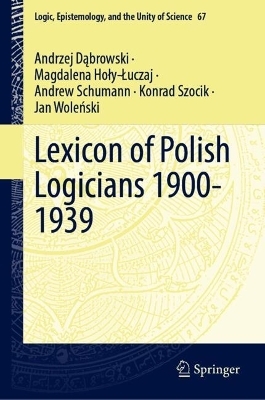
Lexicon of Polish Logicians 1900-1939
Springer International Publishing (Verlag)
978-3-032-16052-2 (ISBN)
- Noch nicht erschienen - erscheint am 14.02.2026
- Versandkostenfrei
- Auch auf Rechnung
- Artikel merken
This book offers world-unique knowledge about outstanding Polish logicians of the first half of the 20th century. The book shows the achievements of Polish logicians, their influence on the development of science, interactions with philosophers and scientists from other countries, as well as cultural and social consequences. Containing over 140 entries accompanied by photographs of over half the discussed logicians, the volume is a comprehensive list of the period.
Topics in the book include many-valued logic, Lesniewski's system, set theory and its foundations, semantic theory of truth, natural deduction, intuitionistic logic, and methodology in philosophy of science. The book is intended for both beginners and advanced researchers of logic, both students and logicians, philosophers, historians of ideas and historians of science.
Andrzej Dabrowski is an Assistant Professor at the University of the National Education Commission, Krakow (Poland). His philosophical interests focus primarily on selected problems in epistemology and logic, as well as the broadly understood philosophy of mind, psychology, and cognitive science. In his research, he pays particular attention to the issues of intentionality and emotion, exploring questions such as how emotions influence cognition and knowledge. He is the author of Intencjonalnosc i semantyka [Intentionality and Semantics] (Universitas, Kraków 2013) and Zródla, natura i funkcje emocji. Studium teorii impulsji Leona Petrazyckiego w kontekscie wspólczesnych badan [Sources, Nature and Functions of Emotions. A Study of Leon Petrazycki s Theory of Impulses in the Context of Contemporary Research] (WUW, Warsaw 2019).
Magdalena Holy-Luczaj is an Assistant Professor at the Institute of Philosophy at the University of Wroclaw (Poland). With a background in continental philosophy, she works at the intersection of environmental philosophy and philosophy of technology. Her research explores how technical artifacts fit within environmental ethics, aiming to balance the interests of natural beings and human dependence on technology. She is also interested in the history of philosophy, particularly in its Polish context. Her articles have appeared in Environmental Values, Environmental Ethics, Philosophy of Technology, Ethics and the Environment, and other academic journals. She has twice been a Fulbright Scholar at the University of New Mexico in Albuquerque (2013/14) and at the University of Georgia in Athens (2021/22).
Andrew Schumann is a Professor of the Department of Cognitive Science and Mathematical Modelling at the University of Information Technology and Management in Rzeszow (Poland). His interests lie in logic and artificial intelligence, particularly in exploring how formal reasoning can be applied to biological systems. He has participated in the project Physarum Chip: Growing Computers from Slime Mould supported by the Seventh Framework Programme (FP7-ICT-2011-8). The main objectives are to design and fabricate a distributed biomorphic computing device built and operated by slime mould Physarum polycephalum. He published several books, including: Archaeology of Logic (Taylor & Francis Group, CRC Press, 2023), Behaviourism in Studying Swarms: Logical Models of Sensing and Motoring (Springer International Publishing AG, 2019), Talmudic Logic (College Publications, 2012), and others. He has also edited many books, including the following: Swarm Intelligence: From Social Bacteria to Humans (Taylor & Francis Group, CRC Press, 2020), Judgements and Truth. Essays in Honour of Jan Wolenski (College Publications, 2020), Pragmatic Studies in Judaism (Gorgias Press, 2013); Logic in Central and Eastern Europe: History, Science, and Discourse (University Press of America, 2012); Logic in Orthodox Christian Thinking (Ontos Verlag / De Gruyter, 2012); Logic in Religious Discourse (Ontos Verlag / De Gruyter, 2010); Judaic Logic (Gorgias Press, 2008). His works also appeared in Synthese, Logica Universalis, The Journal of Indian Philosophy, Argumentation, etc.
Konrad Szocik is a philosopher, bioethicist, and professor at the University of Information Technology and Management in Rzeszow. From 2021 to 2022, he was a visiting fellow at the Yale Interdisciplinary Center for Bioethics. His research interests include philosophy, the ethics and bioethics of space exploration, human enhancement, feminism, selected issues at the intersection of futures studies and technology, as well as climate change, population ethics, procreative ethics, and the philosophy of antinatalism. His most recent monographs include Feminist Bioethics in Space (2024) and The Bioethics of Space Exploration (2023), publ
Introduction.- Chapter 1. Kazimierz Ajdukiewicz.- Chapter 2. Stefan Banach.- Chapter 3. Wladyslaw Bieganski.- Chapter 4. Józef (Innocenty) Maria Bochenski.- Chapter 5. Benedykt Bornstein.- Chapter 6. Leon Chwistek.- Chapter 7. Tadeusz Czezowski.- Chapter 8. Izydora Dambska.- Chapter 9. Samuel Dickstein.- Chapter 10. Jan Drewnowski.- Chapter 11. Samuel Eilenberg.- Chapter 12. Ludwik Fleck.- Chapter 13. Daniela Gromska.- Chapter 14. Boleslaw Gawecki.- Chapter 15. Henryk Greniewski.- Chapter 16. Jan Herzberg (or Hercberg).- Chapter 17. Wladyslaw Hetper.- Chapter 18. Henryk Hiz.- Chapter 19. Janina Hosiason-Lindenbaum.- Chapter 20. Roman Ingarden.- Chapter 21. Zygmunt Janiszewski.- Chapter 22. Stanislaw Jaskowski.- Chapter 23. Zbigniew Jordan.- Chapter 24. Stanislaw Kaczorowski.- Chapter 25. Jan Kalicki.- Chapter 26. Bronislaw Knaster.- Chapter 27. Maria Kokoszynska-Lutmanowa.- Chapter 28. Antoni Korcik.- Chapter 29. Alfred Korzybski.- Chapter 30. Janina Kotarbinska.- Chapter 31. Tadeusz Kotarbinski.- Chapter 32. Adam Krokiewicz.- Chapter 33. Zygmunt Kruszewski.- Chapter 34. Jerzy Kuczynski.- Chapter 35. Kazimierz Kuratowski.- Chapter 36. Jerzy Kurylowicz.- Chapter 37. Czeslaw Lejewski.- Chapter 38. Stanislaw Lesniewski.- Chapter 39. Adolf Lindenbaum.- Chapter 40. Jan Lukasiewicz.- Chapter 41. Seweryna Luszczewska-Romahnowa.- Chapter 42. Edward Marczewski.- Chapter 43. Stanislaw Mazur.- Chapter 44. Stefan Mazurkiewicz.- Chapter 45. Henryk Mehlberg.- Chapter 46. Joachim Metallmann.- Chapter 47. Konstanty Michalski.- Chapter 48. Andrzej Mostowski.- Chapter 49. Maria Ossowska.- Chapter 50. Stanislaw Ossowski.- Chapter 51. Antoni Panski.- Chapter 52. Józef Pepis.- Chapter 53. Chaïm Perelman.- Chapter 54. Leon Petrazycki.- Chapter 55. Edward Poznanski.- Chapter 56. Mojzesz Presburger.- Chapter 57. Jan Salamucha.- Chapter 58. Stanislaw Schayer.- Chapter 59. Zygmunt Schmierer.- Chapter 60. Waclaw Sierpinski.- Chapter 61. Jan Sleszynski.- Chapter 62. Jerzy Slupecki.- Chapter 63. Franciszek Smolka.- Chapter 64. Marian Smoluchowski.- Chapter 65. Boleslaw Sobocinski.- Chapter 66. Jerzy Splawa-Neyman.- Chapter 67. Edward Stamm.- Chapter 68. Hugo Steinhaus.- Chapter 69. Wladyslaw Szumowski.- Chapter 70. Alfred Tarski.- Chapter 71.Tatarkiewicz, Wladyslaw.- Chapter 72. Kazimierz Twardowski.- Chapter 73. Stanislaw Ulam.- Chapter 74. Mordechaj (Mordchaj) Wajsberg.- Chapter 75. Adam Wiegner.- Chapter 76. Witold Wilkosz.- Chapter 77. Aleksander Wundheiler.- Chapter 78. Stanislaw Zaremba.- Chapter 79. Zygmunt Zawirski.- Chapter 80. Florian Znaniecki.- Chapter 81. Eustachy ylinski.
| Erscheint lt. Verlag | 14.2.2026 |
|---|---|
| Reihe/Serie | Logic, Epistemology, and the Unity of Science |
| Zusatzinfo | XX, 230 p. 80 illus. |
| Verlagsort | Cham |
| Sprache | englisch |
| Maße | 155 x 235 mm |
| Themenwelt | Geisteswissenschaften ► Philosophie ► Allgemeines / Lexika |
| Geisteswissenschaften ► Philosophie ► Logik | |
| Schlagworte | Chwistek's systems • history of logic in poland • Intuitionistic Logic • Lesniewski's system • Leśniewski's system • Logic • Lvov-Warsaw School • Many-valued Logic • Natural deduction • Poland • Polish logicians • Polish logicians and philosophers • Semantic Theory of Truth • Set theory and its foundations |
| ISBN-10 | 3-032-16052-9 / 3032160529 |
| ISBN-13 | 978-3-032-16052-2 / 9783032160522 |
| Zustand | Neuware |
| Informationen gemäß Produktsicherheitsverordnung (GPSR) | |
| Haben Sie eine Frage zum Produkt? |
aus dem Bereich