


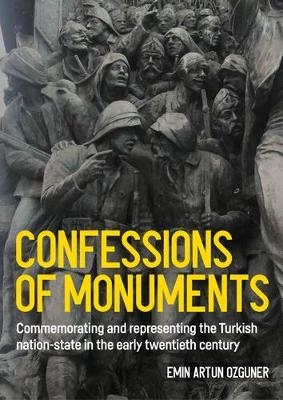
Confessions of Monuments
Commemorating and Representing the Turkish Nation-State in the Early Twentieth Century
Seiten
2026
Manchester University Press (Verlag)
978-1-5261-7623-3 (ISBN)
Manchester University Press (Verlag)
978-1-5261-7623-3 (ISBN)
- Noch nicht erschienen (ca. Juni 2026)
- Versandkostenfrei
- Auch auf Rechnung
- Artikel merken
This book examines the role of artefacts and design practice in representing and commemorating a new political community of Turks within the cultural transformation from empire to nation-state between 1908-50s. It offers an expanded understanding of nation-building within global, public as well as top-down official agencies. -- .
Following the dissolution of the Ottoman Empire in the early 1920s, an emerging nation state built a particular relationship with the Ottoman past. In its simultaneous disavowal and inheritance of it, this was the new Republic of Turkey, founded in 1923. Nation-states are areas of ideological contestation. However, they are equally visible and tangible. This is thanks to the making of a new world of artefacts in build or print that represent and commemorate them in many, often contradicting ways through design practices. This book offers a thorough account of this new Turkish material world through the trajectories of commemoration; from public monuments, print media, and festive illumination to temporary and permanent architecture from the onset of the 1908 Young Turk revolution to the demise of Turkey’s founding single-party regime in the late 1950s. If objects are silent actors of history, their confessions await. -- .
Following the dissolution of the Ottoman Empire in the early 1920s, an emerging nation state built a particular relationship with the Ottoman past. In its simultaneous disavowal and inheritance of it, this was the new Republic of Turkey, founded in 1923. Nation-states are areas of ideological contestation. However, they are equally visible and tangible. This is thanks to the making of a new world of artefacts in build or print that represent and commemorate them in many, often contradicting ways through design practices. This book offers a thorough account of this new Turkish material world through the trajectories of commemoration; from public monuments, print media, and festive illumination to temporary and permanent architecture from the onset of the 1908 Young Turk revolution to the demise of Turkey’s founding single-party regime in the late 1950s. If objects are silent actors of history, their confessions await. -- .
Artun Ozguner is a Senior Lecturer in Contextual and Theoretical Studies at the University for the Creative Arts -- .
Introduction
1 Re-imagining the empire in ink and stone
2 Building the nation in bronze: the republican network of monuments
3 Picturing the nation in paint and light
4 Modern by Tradition: monuments in the Inönü era
5 The Republic Looks Back: relics in bone and bronze
Conclusion: a tale of two monuments
Select bibliography -- .
| Erscheint lt. Verlag | 23.6.2026 |
|---|---|
| Reihe/Serie | Studies in Design and Material Culture |
| Zusatzinfo | 32 colour plates 63 black & white illustrations |
| Verlagsort | Manchester |
| Sprache | englisch |
| Maße | 170 x 240 mm |
| Themenwelt | Kunst / Musik / Theater |
| Geisteswissenschaften ► Geschichte ► Hilfswissenschaften | |
| Technik ► Architektur | |
| ISBN-10 | 1-5261-7623-8 / 1526176238 |
| ISBN-13 | 978-1-5261-7623-3 / 9781526176233 |
| Zustand | Neuware |
| Informationen gemäß Produktsicherheitsverordnung (GPSR) | |
| Haben Sie eine Frage zum Produkt? |
Mehr entdecken
aus dem Bereich

aus dem Bereich
die Geburt der Grafiksammlung des Kunstmuseums Stuttgart im …
Buch | Hardcover (2024)
VDG Weimar - Verlag und Datenbank für Geisteswissenschaften
CHF 36,90
kulturelles Erbe und Identität in historischen und jüdischen Museen …
Buch | Hardcover (2025)
De Gruyter Oldenbourg (Verlag)
CHF 41,90
kartografische Wissenskulturen um 1448
Buch | Hardcover (2024)
De Gruyter (Verlag)
CHF 139,90


