


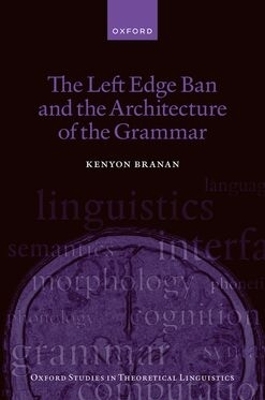
The Left Edge Ban and the Architecture of the Grammar
Seiten
2026
Oxford University Press (Verlag)
978-0-19-288236-3 (ISBN)
Oxford University Press (Verlag)
978-0-19-288236-3 (ISBN)
- Noch nicht erschienen (ca. Mai 2026)
- Versandkostenfrei
- Auch auf Rechnung
- Artikel merken
This book proposes and motivates a ban on words and sentences of a particular form, and shows that there are differences between how this ban is satisfied at the word level and at the sentence level. The strategies that each language employs are shown to account for a wide range of apparently disparate linguistic facts.
This book proposes and motivates a ban on words and sentences of a particular form, and shows that there are differences between how this ban is satisfied at the word level and at the sentence level. One striking finding is that syntactic operations may serve as a means of avoiding violation of the ban, which might not be expected on a strictly feed-forward grammatical architecture. A theoretically interesting consequence of this is that the syntax must be able to see at least some information that the phonology can access, motivating an architecture of the grammar that is different from what is commonly assumed.
Empirically, this ban can account for a variety of apparently disparate linguistic facts including, but not limited to: cross-linguistic skews in attested stress patterns, morphophonological differences between prefixes and suffixes, restrictions on certain disharmonic word orders and cases where this restriction is apparently lifted, and a requirement that heavy elements undergo obligatory extraposition from a variety of fronted constituents. Each of these cases can be understood as the consequence of the grammar of a particular language employing a limited set of strategies to ensure that the proposed ban is satisfied.
This book proposes and motivates a ban on words and sentences of a particular form, and shows that there are differences between how this ban is satisfied at the word level and at the sentence level. One striking finding is that syntactic operations may serve as a means of avoiding violation of the ban, which might not be expected on a strictly feed-forward grammatical architecture. A theoretically interesting consequence of this is that the syntax must be able to see at least some information that the phonology can access, motivating an architecture of the grammar that is different from what is commonly assumed.
Empirically, this ban can account for a variety of apparently disparate linguistic facts including, but not limited to: cross-linguistic skews in attested stress patterns, morphophonological differences between prefixes and suffixes, restrictions on certain disharmonic word orders and cases where this restriction is apparently lifted, and a requirement that heavy elements undergo obligatory extraposition from a variety of fronted constituents. Each of these cases can be understood as the consequence of the grammar of a particular language employing a limited set of strategies to ensure that the proposed ban is satisfied.
Kenyon Branan is a research associate affiliated with the Georg-August-Universität Göttingen. After completing his PhD at MIT, he held positions at the National University of Singapore and the Leibniz-Zentrum Allgemeine Sprachwissenschaft. His research explores syntax and the interactions between syntax and the interfaces.
| Erscheint lt. Verlag | 31.5.2026 |
|---|---|
| Reihe/Serie | Oxford Studies in Theoretical Linguistics ; 89 |
| Verlagsort | Oxford |
| Sprache | englisch |
| Maße | 156 x 234 mm |
| Themenwelt | Geisteswissenschaften ► Sprach- / Literaturwissenschaft ► Sprachwissenschaft |
| ISBN-10 | 0-19-288236-8 / 0192882368 |
| ISBN-13 | 978-0-19-288236-3 / 9780192882363 |
| Zustand | Neuware |
| Informationen gemäß Produktsicherheitsverordnung (GPSR) | |
| Haben Sie eine Frage zum Produkt? |
Mehr entdecken
aus dem Bereich


aus dem Bereich
Eine Wiederentdeckung
Buch | Softcover (2025)
Piper (Verlag)
CHF 19,55
Das umfassende Standardwerk auf der Grundlage der aktuellen amtlichen …
Buch | Hardcover (2024)
Duden (Cornelsen Verlag)
CHF 48,95


