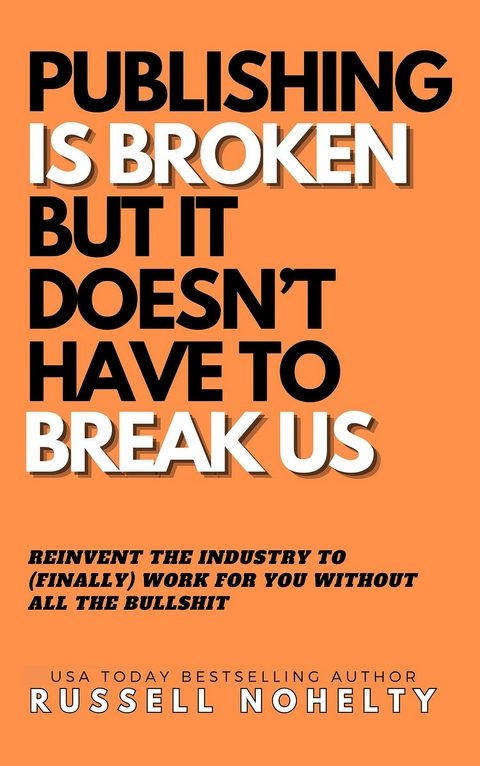
Publishing is Broken, but it Doesn't Have to Break Us (eBook)
364 Seiten
Wannabe Press (Verlag)
978-0-00-101779-5 (ISBN)
Publishing is broken, but it doesn't have to break you. In this candid, no-holds-barred guide, USA Today bestselling author and small-press publisher Russell Nohelty reveals why the traditional publishing model is stacked against most writers, and how to make the industry work for you.
Drawing on decades of experience and dozens of successful book launches, Nohelty offers a blueprint for building your creative career without selling your soul or burning yourself out. You'll learn how to break free from tired industry myths, connect directly with the readers who love your work, jettison traditional gatekeepers, construct a sustainable creative life. and leverage simple tools and strategies that actually pay off without all the needless hustle.
Whether you're a first-time writer or a seasoned pro, this book offers real-world strategies for breaking free of the status quo. Packed with straight talk, practical insights, and actionable advice, Publishing Is Broken Publishing, But It Doesn't Have to Break Us doesn't pretend there's a one-size-fits-all answer. Instead, it hands you the keys to design a publishing path that fits your goals, your schedule, and your sanity. If you're ready to build a thriving, bullshit-free writing career, this book will show you the way forward.
Yes, some authors can just write the next book and release a new book every month for months, or sometimes even years...
...but they almost always burn out.
My friend says you have to push hard for three years to break through, and I think that's about the limit somebody can push their body to write that much before it rebels on them.
I think most people start burning out at six months at this pace and they keep it up for two years, maybe three if they are really stubborn.
If they don't burn out, then they either transition to co-writing, transition to running a publishing company, or transition to building their brand in other mediums.
There are so many well-intentioned and helpful humans in this industry. You can basically walk up to any author, and they will spill every secret they have to you at any time.
The industry is in the best shape it's ever been...
...and everyone is still broke.
On top of that, everyone is burned out from writing and writing and writing and writing without ever getting anywhere they feel "safe" taking their foot off the gas.
“Write the next book” is still being pushed as the dominant narrative to find success in publishing, and we don’t think it’s doing authors any favors.
Yes, it’s obviously important to have a critical mass of writing to break through and build a successful career. What does a critical mass mean, though? Is it three books? Five? Ten? Twenty? Fifty?
At what point does it become a burden instead of a blessing? Following that advice is causing people to write dozens of books for years and years while still riding the struggle bus the whole time.
If that's really the best practice to find success, then show me the receipts.
● If that's true, then why isn't it working for so many people?
● If that's true, then why is everyone at their wit's end?
● If that's true, then why do I get texts from my successful friends damn near weekly at this point telling me they don't think they're gonna make it the end of the year?
Of course, writing books is how we make money. I’m not saying you don’t have to write books as an author. That would be like telling a baker to stop baking bread.
You can’t have success as an author without books, but I’m not convinced writing the next book is the best marketing action for all authors at all time, just like I don’t think baking bread is the best marketing action for somebody who can’t drive foot traffic into their bakery storefront.
Sir Terry Pratchett wrote over 50 books in his career and has sold 100 million books in the process. Stephen King has published 65 novels in his career. Anne Rice published 37 novels. Jane Austen wrote 6 novels. Melissa Albert has also written 6 books.
Meanwhile, I’ve written over 40 novels and have seen almost none of the success of these people. I have a pretty decent career going, but there has to be something beyond “write the next book” that’s driving these people forward. I can tell you I’m nowhere near 100 million copies sold, and I’m working just as hard as Sir Terry.
Systemic issues facing authors
● So, what’s happening here? Unfortunately, it’s not as easy as pointing a finger. There are systemic issues that no single author can fix by themselves, or even collectively, without a lot of help. They include, but are not limited to:
● Capitalism, but not in the way you think: I have plenty of vitriol to throw at capitalism, but the biggest problem for authors is capitalism works consistently, but not intuitively. People think 1+1=2, but really 1+potato=cheese sandwich. It's nonsense, but it is consistent nonsense. Once you understand how to connect the right nonsense to the right outcome, you can build predictable money.
● Price elasticity: Books have a very narrow band in which they can operate. They can basically be $0-$10 as an ebook or $10-$30 in print. This is what Monica called The Novelist's Dilemma. This is why we need a bunch of books before we can hope to break even on books, because we have to price low. On top of that, readers have been trained to devalue the price of a book. The hardest thing to do in business is sell on volume, and the whole industry does that, because books are so cheap there's no other choice.
● The Power Law curve: When you chart an industry like tech, there are companies worth trillions of dollars, which means there are a bunch of companies that are worth hundreds of billions, even more worth billions, and tons worth millions. Meanwhile, an indie author might push 8 figures, which means when you chart that power law curve back, there are fewer people at every stage, and the majority are making a pittance.
● Trying to shoehorn everyone into a very few business models: In the past few posts I've made, it's proven out that people still think if you do the right thing for the right length of time in the right genre then you'll still probably not make it and I just...don't agree with that. Being exposed to many other types of business this year it's clear there are hundreds of business models that might work for an author, but they are only ever exposed to but a very few.
● The whole industry mainly knows how to do one thing: That thing is change the price of their book. They don't use any other psychological trigger except “put book out, raise price, and lower price.”
● Only going after the 1/5: Amazon teaches us to focus on the cheap, quick wins. If somebody isn't ready to buy now now now, then they have always been seen as being worthless to authors. However, being a sales manager I know that if you show something to 5 people 1 will say no, 1 will say yes, and the other 3 will be on the fence. What separates a decent salesperson from a great one is the ability to convert 2-4 out of 5, instead of just that 1. You can literally double your sales if you just convert 1 out of 5 people without doing any other work.
● Authors think about collaborations all wrong, or at least not expansively enough: They are very good about finding collaborations with people who are the exact same as them, but they are terrible at the thing that really moves the needle once you get more success, which is finding people dimilar (different but complementary) than the medium you currently use. Have you ever approached a local business who does something different than you do, but has a complementary audience, to see if they wanted to offer your books in a bundle with their stuff? I hear a few authors doing it here or there, but nobody ever talks or thinks about how to make this happen outside of book bundles.
● We are still taught that we are annoying our readers when we sell to them: I can't believe people still say this to me consistently, but if somebody joins your list to hear about your books, you aren't annoying them by sharing your books with them. That is such a wild thing to say, and yet 95% of the authors I know still think this. They "don't want to bother their readers" and everyone just kind of agrees with that advice.
● We have to compete against every product that has ever been made: In very few industries are the business owners up against a 400-year-old dead person for somebody's money and attention. Maybe a winery has to compete against the past sometimes, but then at least that older wine is way more expensive which prices people out of the market for it. Even film and radio only go back a hundred years, but books have been published for thousands of years, and you can read them all for a pittance. No musical artist will ever have to go up against Mozart, only a cheap facsimile of Mozart as told through a modern orchestra.
● We think "x is the answer": It doesn’t matter what x is, as long as it’s something authors haven’t tried yet, or haven’t tried in a while. This happens all the time. Direct sales is not the answer for comic book people...they already do direct sales. Fiction apps are not the answer for genre authors because they pay shit outside of romance. Community isn't the answer to anything. Community is a nice, blobby, nebulous word that is so squishy that it can mean anything. There is really a suite of answers that could help, but we have to get better at trying stuff that hasn't been done before.
● The publishing industry is elitist: Yeah, we are inclusive on some level, but we are super cliquey, and we don't believe everyone can or should be an author. We definitely don't believe everyone can succeed as an author. This is an industry started by elites and run by elites. For eons the only way you could prove you were really an "author" was by not needing the money, but what that really proved was you were an aristocrat, which is what they really wanted to do. Why have we carried this through to 2024?
● Authors don't want to run businesses: Not only don't they want to do it, they will actively sabotage themselves and the industry at every turn to "make art." Meanwhile, they wrote a book with their name on it and think they don't want attention. Why did you write the book then? Just admit you want to run a business, make money, and that it's okay to want to be seen. It is impossible to teach authors because they are gleefully ignorant of the things that they need to do, and they complain about it.
● We actively suppress information on new things that don't fit our mental...
| Erscheint lt. Verlag | 20.11.2025 |
|---|---|
| Sprache | englisch |
| Themenwelt | Geisteswissenschaften ► Sprach- / Literaturwissenschaft |
| ISBN-10 | 0-00-101779-9 / 0001017799 |
| ISBN-13 | 978-0-00-101779-5 / 9780001017795 |
| Informationen gemäß Produktsicherheitsverordnung (GPSR) | |
| Haben Sie eine Frage zum Produkt? |
 EPUB (Adobe DRM)
Größe: 339 KB
Kopierschutz: Adobe-DRM
Adobe-DRM ist ein Kopierschutz, der das eBook vor Mißbrauch schützen soll. Dabei wird das eBook bereits beim Download auf Ihre persönliche Adobe-ID autorisiert. Lesen können Sie das eBook dann nur auf den Geräten, welche ebenfalls auf Ihre Adobe-ID registriert sind.
Details zum Adobe-DRM
Dateiformat: EPUB (Electronic Publication)
EPUB ist ein offener Standard für eBooks und eignet sich besonders zur Darstellung von Belletristik und Sachbüchern. Der Fließtext wird dynamisch an die Display- und Schriftgröße angepasst. Auch für mobile Lesegeräte ist EPUB daher gut geeignet.
Systemvoraussetzungen:
PC/Mac: Mit einem PC oder Mac können Sie dieses eBook lesen. Sie benötigen eine
eReader: Dieses eBook kann mit (fast) allen eBook-Readern gelesen werden. Mit dem amazon-Kindle ist es aber nicht kompatibel.
Smartphone/Tablet: Egal ob Apple oder Android, dieses eBook können Sie lesen. Sie benötigen eine
Geräteliste und zusätzliche Hinweise
Buying eBooks from abroad
For tax law reasons we can sell eBooks just within Germany and Switzerland. Regrettably we cannot fulfill eBook-orders from other countries.
aus dem Bereich