


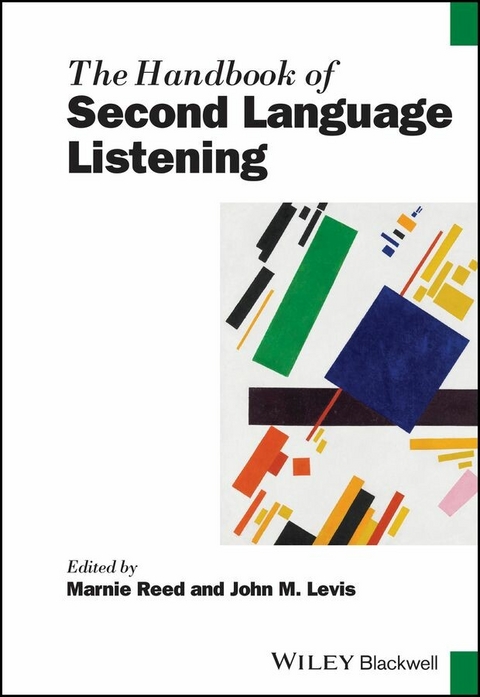
Essential insights and strategies for teaching and researching second language listening comprehension skills
The Handbook of Second Language Listening provides comprehensive and authoritative coverage of the processes, challenges, and pedagogy of second language (L2) listening. Designed for researchers, teacher educators, and classroom practitioners, this volume presents a systematic examination of how L2 learners perceive and interpret spoken language across diverse contexts and discusses how instruction can better support the listening process.
The Handbook addresses a broad range of topics essential to understanding and teaching L2 listening, including perceptual foundations, the influence of prosody, speech perception, listening assessment, and metacognitive strategy use. Chapters by leading scholars and emerging voices in applied linguistics bridge theory and practice by offering evidence-based insights into listener variability, instructional design, and the interface between listening and pronunciation. This book brings attention to topic areas often overlooked, such as decolonial theory in listening research and the impact of orthography on perception. Equipping educators and scholars with the tools needed to understand L2 listening as both a cognitive process and a teachable skill, the Handbook of Second Language Listening:
- Integrates current findings from phonetics, psycholinguistics, and applied linguistics
- Connects theoretical models of perception and processing with classroom-based applications
- Addresses foundational and emerging topics, from phonetic decoding comprehension of spoken academic discourse
- Includes dedicated sections on technology-enhanced assessment and instruction
- Covers key pedagogical challenges such as listening in noise, processing of prosody, and strategy instruction
- Provides practical frameworks for evaluating and designing L2 listening tasks
The Handbook of Second Language Listening is ideal for graduate-level courses in TESOL and Applied Linguistics, including Second Language Acquisition, Listening Pedagogy, and Language Assessment, which are core to MA TESOL and Linguistics programs. It is also a critical reference for researchers, teacher educators, curriculum designers, and language assessment specialists.
MARNIE REED is Professor Emerita of TESOL and Applied Linguistics at Boston University. She is co-author of Phonetics in Language Teaching and co-editor of Listening in the Classroom. With John M. Levis, she co-edited The Handbook of English Pronunciation for Wiley Blackwell in 2015.
JOHN M. LEVIS is Distinguished Professor of Applied Linguistics and Technology at Iowa State University. He is the founding editor of the Journal of Second Language Pronunciation and author of Intelligibility, Oral Communication and the Teaching of Pronunciation. Levis has co-edited several seminal volumes including Second Language Pronunciation: Bridging the Gap Between Research and Teaching (Wiley Blackwell, 2022), and is recognized internationally for his research on second language pronunciation and oral communication.
Essential insights and strategies for teaching and researching second language listening comprehension skills The Handbook of Second Language Listening provides comprehensive and authoritative coverage of the processes, challenges, and pedagogy of second language (L2) listening. Designed for researchers, teacher educators, and classroom practitioners, this volume presents a systematic examination of how L2 learners perceive and interpret spoken language across diverse contexts and discusses how instruction can better support the listening process. The Handbook addresses a broad range of topics essential to understanding and teaching L2 listening, including perceptual foundations, the influence of prosody, speech perception, listening assessment, and metacognitive strategy use. Chapters by leading scholars and emerging voices in applied linguistics bridge theory and practice by offering evidence-based insights into listener variability, instructional design, and the interface between listening and pronunciation. This book brings attention to topic areas often overlooked, such as decolonial theory in listening research and the impact of orthography on perception. Equipping educators and scholars with the tools needed to understand L2 listening as both a cognitive process and a teachable skill, the Handbook of Second Language Listening: Integrates current findings from phonetics, psycholinguistics, and applied linguistics Connects theoretical models of perception and processing with classroom-based applications Addresses foundational and emerging topics, from phonetic decoding comprehension of spoken academic discourse Includes dedicated sections on technology-enhanced assessment and instruction Covers key pedagogical challenges such as listening in noise, processing of prosody, and strategy instruction Provides practical frameworks for evaluating and designing L2 listening tasks The Handbook of Second Language Listening is ideal for graduate-level courses in TESOL and Applied Linguistics, including Second Language Acquisition, Listening Pedagogy, and Language Assessment, which are core to MA TESOL and Linguistics programs. It is also a critical reference for researchers, teacher educators, curriculum designers, and language assessment specialists.
Notes on Contributors
Dylan Ashton is a public school teacher in the state of Pennsylvania, USA, specializing in French and English as a Second Language. With additional teaching experience at the University of Pittsburgh’s English Language Institute, he now also serves as an Adjunct Professor of Education at Muhlenberg College. Dylan’s teaching journey includes a Fulbright teaching assistantship in Paris, where he taught English in collaboration with the Franco-American Commission. He holds a master’s degree in applied linguistics from the University of Pittsburgh.
Alexis K. Black is an Assistant Professor at the School of Audiology and Speech Sciences at the University of British Columbia, Canada. She received her Ph.D. in Linguistics and Cognitive Science from the University of British Columbia and completed a postdoctoral fellowship in neurolinguistics with Dr. Richard Aslin at Haskins Laboratories and Yale University. Dr. Black’s expertise includes infant speech perception, phonological acquisition, phonetics, and neurolinguistics. Her research focuses on learning mechanisms that support early language learning.
Mirjam Broersma is a Professor of Second Language Acquisition at Radboud University, The Netherlands. With her students and collaborators, she investigates how people acquire and use multiple languages. Her research addresses second language acquisition and early bilingualism, in children and adults, using a psycholinguistic experimental approach. She currently leads a large-scale investigation of the effects of psychological trauma on second language acquisition in refugees. Some of her research themes are: second language acquisition in refugees; birth language memories in international adoptees; sound perception and production, word recognition, segmentation of continuous speech, and vocal emotion recognition in non-native listening; and code-switching.
Mónica S. Cárdenas-Claros is a Full Professor at the Instituto de Literatura y Ciencias del Lenguaje (Literature and Language Science Institute) at Pontificia Universidad Católica de Valparaíso in Chile (Pontifical Catholic University of Valparaíso, Chile). Mónica is the author of a number of articles on computer-based L2 listening, technology integration in language classrooms, and the development of research competencies of pre-service teachers.
Nathaniel Carney is a Professor of English and Director of the English Education Research Center at Kobe College, Japan. He is also an adjunct faculty member in the Graduate College of Education at Temple University. He has published in the areas of second language (L2) listening and L2 pedagogy, with interests in second language acquisition, CALL, and teacher education.
Robert Cavaluzzi is a linguist with training in psycholinguistics as well as phonetics and phonology. He holds a master’s degree in Cognitive Neuroscience of Language from the University of the Basque Country and a bachelor’s in Spanish Language and Literature from the State University of New York at New Paltz. Robert taught English in Spain and subsequently in South Korea as a Fulbright grantee. His research interests include investigating technology’s impact on language instruction and evaluating the role of orthography on foreign language acquisition.
Gayatri Choudhary recently graduated with a Bachelor of Arts in Psychology (2024) from the University of British Columbia (UBC), Canada. During her undergraduate studies, she worked with Dr. Alexis Black on infant speech and language acquisition, Dr. Susan Birch on social-emotional development in children, and Dr. Kiley Hamlin on infants’ understanding of morality.
Reza Dalman (Ph.D., Northern Arizona University) is an Assistant Professor of TESOL/Linguistics in the English Department at Winona State University, USA. Reza’s research focuses on second language (L2) speech and intelligibility, speech perception and production, and oral assessment and testing. He has published the findings of his research in various TESOL- and second language acquisition–related journals, including TESOL Quarterly, Language Teaching Research, International Journal of Listening, Australian Review of Applied Linguistics, Advances in Language and Literary Studies, and Asia TEFL, inter alia.
Phung Dao is an Assistant Professor in Second Language Education at the Faculty of Education, University of Cambridge, UK, where he teaches MPhil/MEd courses in Research in Second Language Education (RSLE) and supervises Ph.D. students. His research interests focus on instructed second language acquisition (ISLA), technology for language teaching and learning, peer interaction, learner engagement, task-based language teaching (TBLT), L2 pedagogy, and L2 teacher education. His publications appear in flagship L2 journals such as Modern Language Journal, TESOL Quarterly, Studies in Second Language Acquisition, Language Teaching, Computer Assisted Language Learning, Language Teaching Research, System, among others.
Isabelle Darcy is a psycholinguist working on second language acquisition of phonological systems. She is a professor of second language studies at Indiana University (USA) and at Université Grenoble-Alpes (France). She previously worked at the University of Potsdam and at the University of Tübingen (Germany), after obtaining a Ph.D. in Linguistics and Cognitive Science from the Johannes Gutenberg University of Mainz (Germany) and from the EHESS (France). Her research interests include speech processing in first and later-learned languages across the lifespan, the development of mental lexicons, cognitive individual differences, and pronunciation instruction.
Mark R. Emerick is an Assistant Professor at Vassar College in New York, USA, where he explores the intersections of language, power, and pedagogy in his work. Mark’s research interests extend from his experiences as an ESL teacher, focusing on language in education policy, teacher language ideologies, and equity and access for multilingual learners of English in U.S. schools. Mark has published in a variety of academic journals, including System, Anthropology and Education Quarterly, TESOL Quarterly, Language Policy, and the International Multilingual Research Journal. He is currently serving as an associate editor of New York State TESOL Journal.
Suzanne Flynn is a Professor of Linguistics and Language Acquisition at the Massachusetts Institute of Technology, USA. Her research focuses on multiple language learning in children and adults, as well as on the neural representation of the multilingual brain. More recently, her work has focused on issues related to language impairment and autism. She has published extensively in journals and has authored and co-edited many books. She is a leading researcher in the fields of bilingualism and multilingualism.
Christine C. M. Goh is President’s Chair Professor in Education (Linguistics and Language Education) in the English Language and Literature Department at the National Institute of Education, Nanyang Technological University Singapore. She has vast experience as an English language teacher at school and tertiary levels, a language learning researcher, and a language teacher educator. She is passionate about bilingual language education, particularly in second language oracy (listening, speaking, and thinking) development, learner metacognition, and teacher cognition, and has published and spoken extensively on these topics in the past 30 years.
Suzanne Graham is a Professor of Language and Education at the Institute of Education, University of Reading, UK. Since the early 2000s, she has published widely in the field of second language listening, with a particular focus on listening strategies, the teaching of listening, vocabulary learning through listening, and the relationship between self-efficacy and listening comprehension. Her most recent research has explored teachers’ knowledge of and practice in relation to listening instruction, as well as the relationship between teacher listening self-efficacy and learners’ listening proficiency.
Alice Henderson is a Professor at Université Grenoble – Alpes, France, where she teaches English for Specific Purposes to science and technology students. She taught English phonetics and phonology for 24 years and has been involved in training teachers in France, Norway, Poland, and Spain. In 2009, she initiated the international bi-annual conference English Pronunciation: Issues & Practices. Her research interests include English pronunciation teaching and learning, the perception of foreign-accented speech, and English Medium Instruction (EMI). Much of her research has focused on speakers, but she is also intrigued by listeners’ roles, from an intercultural and sociolinguistic perspective.
Thalia Hernandez-DePaoli is a student at the School of Audiology and Speech Sciences program at the University of British Columbia (UBC), Canada, pursuing her master’s degree in audiology. She is working on her thesis with Dr. Alexis Black, investigating neural representations of word learning in infants using electroencephalography.
Solène Inceoglu is a Senior Lecturer in the School of Literature, Languages and Linguistics at the Australian National University. She holds a Ph.D. in Second Language Studies from Michigan State University. Her research focuses on second language speech perception and production, the role of technology in pronunciation learning and teaching, and individual...
| Erscheint lt. Verlag | 18.11.2025 |
|---|---|
| Reihe/Serie | Blackwell Handbooks in Linguistics |
| Sprache | englisch |
| Themenwelt | Geisteswissenschaften ► Sprach- / Literaturwissenschaft ► Sprachwissenschaft |
| Schlagworte | academic listening • L2 applied linguistics • L2 comprehension • L2 curriculum • L2 education training • L2 language acquisition • L2 language pedagogy • L2 listening assessment • L2 listening instruction • L2 speech perception • second language listening |
| ISBN-13 | 9781394312351 / 9781394312351 |
| Informationen gemäß Produktsicherheitsverordnung (GPSR) | |
| Haben Sie eine Frage zum Produkt? |
 EPUB (Adobe DRM)
Kopierschutz: Adobe-DRM
Adobe-DRM ist ein Kopierschutz, der das eBook vor Mißbrauch schützen soll. Dabei wird das eBook bereits beim Download auf Ihre persönliche Adobe-ID autorisiert. Lesen können Sie das eBook dann nur auf den Geräten, welche ebenfalls auf Ihre Adobe-ID registriert sind.
Details zum Adobe-DRM
Dateiformat: EPUB (Electronic Publication)
EPUB ist ein offener Standard für eBooks und eignet sich besonders zur Darstellung von Belletristik und Sachbüchern. Der Fließtext wird dynamisch an die Display- und Schriftgröße angepasst. Auch für mobile Lesegeräte ist EPUB daher gut geeignet.
Systemvoraussetzungen:
PC/Mac: Mit einem PC oder Mac können Sie dieses eBook lesen. Sie benötigen eine
eReader: Dieses eBook kann mit (fast) allen eBook-Readern gelesen werden. Mit dem amazon-Kindle ist es aber nicht kompatibel.
Smartphone/Tablet: Egal ob Apple oder Android, dieses eBook können Sie lesen. Sie benötigen eine
Geräteliste und zusätzliche Hinweise
Buying eBooks from abroad
For tax law reasons we can sell eBooks just within Germany and Switzerland. Regrettably we cannot fulfill eBook-orders from other countries.
aus dem Bereich


