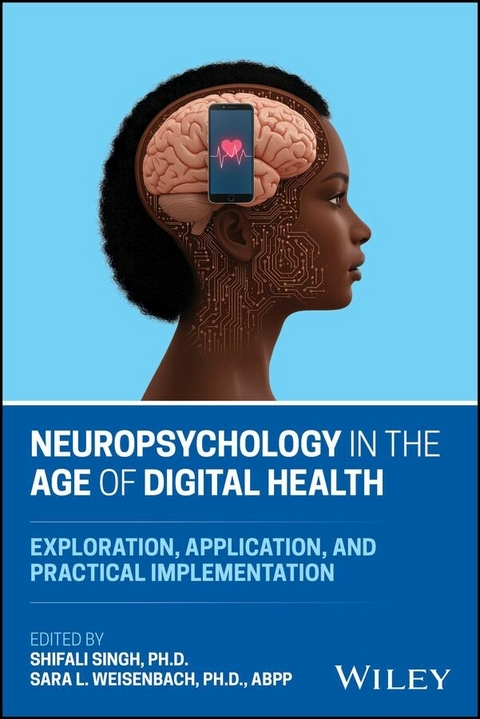
Neuropsychology in the Age of Digital Health (eBook)
557 Seiten
Wiley (Verlag)
978-1-394-29541-8 (ISBN)
A groundbreaking and accurate guide to the latest digital technology relevant to neuropsychology clinicians, researchers, and trainees
Neuropsychology in the Age of Digital Health: Exploration, Application, and Practical Implementation, delivers a practical, up-to-date guide to the implementation of digital health tools in clinical and training settings.
This includes authoritative and accurate discussions of the incorporation of digital screening tools and comprehensive assessment methods into neuropsychology practice environments, while also discussing the use of digital cognitive health tools in disease management and how those tools can be used as part of stepped-care models and population health management.
Readers will find:
- Practical advice for integrating new digital tech into clinical and educational settings, with original data gleaned from a survey of current clinical neuropsychology trainees
- Effective strategies for addressing the most pertinent ethical challenges that arise from the use of digital technology in this field
- Examinations of exploratory tools that are useful in research settings and that have potential applications in clinical work
Neuropsychology in the Age of Digital Health is an essential resource for undergraduate and graduate students with an interest in clinical and research neuropsychology, practicing clinical and research neuropsychologists, and students of graduate-level cognitive assessment courses.
Dr. SHIFALI SINGH, Ph.D., is an Assistant Professor, Clinical Neuropsychologist, and the Director of Digital Neuropsychology and Brain Health at McLean Hospital and Harvard Medical School. Her research aims to modernize neuropsychological evaluations using novel digital technologies. Dr. Singh additionally owns a private practice, Cambridge Neuropsychology, and works as an associate at a venture capital fund, where she invests in digital health companies. She currently teaches courses at Harvard College related to technology and mental health. Dr. Singh holds leadership positions in APA and SCN, serving as Past-President of Division 12 Section 10, Board Member of the CPT Advisory Board, and the founder of the ANST Neuro-technology Initiative.
Dr. SARA L. WEISENBACH, Ph.D., ABPP is an Associate Professor of Psychology in the Department of Psychiatry at Harvard Medical School, the chief of Neuropsychology at McLean Hospital, a board-certified clinical neuropsychologist, and a clinical translational researcher. Throughout her career she has sought to improve quality of life for individuals with cognitive and psychiatric concerns through delivery of top-notch patient care, cutting-edge research, education, and mentorship, and service to the fields of neuropsychology and geriatric psychiatry. She is a nationally recognized expert in cognitive and emotional health in older adults and a past president of the Society for Clinical Neuropsychology of the American Psychological Association.
A groundbreaking and accurate guide to the latest digital technology relevant to neuropsychology clinicians, researchers, and trainees Neuropsychology in the Age of Digital Health: Exploration, Application, and Practical Implementation, delivers a practical, up-to-date guide to the implementation of digital health tools in clinical and training settings. This includes authoritative and accurate discussions of the incorporation of digital screening tools and comprehensive assessment methods into neuropsychology practice environments, while also discussing the use of digital cognitive health tools in disease management and how those tools can be used as part of stepped-care models and population health management. Readers will find: Practical advice for integrating new digital tech into clinical and educational settings, with original data gleaned from a survey of current clinical neuropsychology trainees Effective strategies for addressing the most pertinent ethical challenges that arise from the use of digital technology in this field Examinations of exploratory tools that are useful in research settings and that have potential applications in clinical work Neuropsychology in the Age of Digital Health is an essential resource for undergraduate and graduate students with an interest in clinical and research neuropsychology, practicing clinical and research neuropsychologists, and students of graduate-level cognitive assessment courses.
About the Authors
Adaeze Njoku earned her bachelor’s degrees in Psychology and Biology, with a concentration in Neuroscience from Rowan University. As an undergraduate, she conducted research in their Schizophrenia Spectrum Lab examining the relationship between psychosis-risk and psychosocial factors. After graduating in 2024, she became a research coordinator at the Rutgers Neuropsychology Lab, where she coordinated studies on cognitive function and fatigue in individuals with multiple sclerosis and post-COVID syndrome. She is currently focused on furthering her career in clinical research as she prepares for graduate training.
Dr. Ana Trueba-Yepez, PhD, is an assistant in psychology in the Division of Geriatric Psychiatry at McLean Hospital and an instructor in psychiatry at Harvard Medical School. She focuses on cognitive behavior therapy (CBT) and integration of mindfulness into treatment. Dr. Trueba-Yepez received her undergraduate degree in neuroscience at Trinity University. She went on to complete an MA in clinical psychology, followed by a PhD in the same field, both of which were conferred by Southern Methodist University.
Averi Giudicessi, MA, is a doctoral student in the Clinical Psychology program at Boston University (BU), where she is co-mentored by Dr. Yakeel Quiroz and Dr. Alice Cronin-Golomb. She earned her bachelor’s degree in Psychology from Fordham University and an MS in Neuropsychology from Benemérita Universidad Autónoma de Puebla. Her research focuses on sex differences in aging and how reproductive factors unique to women may contribute to increased risk for Alzheimer’s disease (AD) and dementia. As part of this work, she is also interested in the development and implementation of digital neuropsychological assessment tools to improve access to cognitive screening and research participation, particularly among underrepresented and remote populations. She has contributed to the validation of remote cognitive assessment measures and has worked with digital testing platforms in both English and Spanish. Her work is supported by an NINDS F31 fellowship focused on investigating the sex-specific effects on white matter integrity and brain function in individuals with autosomal dominant AD and vascular dementia.
Prof. Bettina S. Husebo, MD, PhD, specialized in anesthesia, intensive care, palliative care, and nursing home medicine, and is working at the Department of Global Public Health and Primary Care, University of Bergen, Norway. She is an ERC Consolidator Grant holder for the 5-D project (Decoding Death and Dying in people with Dementia by Digital thanotyping, 2024–2028) and PI of the Care Node at the FKB Center, Neuro-SysMed, Department of Neurology, Haukeland University Hospital. Husebø is the head of the Center for Elderly and Nursing Home Medicine (SEFAS) (supported by the Norwegian Government) and the head of the Trond Mohn Research Center for Complex Conditions and Ageing (CC.AGE, 2024–2028). She is a postgraduate of SQIL (Safety, Quality, Informatics, Leadership), Harvard Medical School, and is experienced in leading large research groups: SEFAS has 28 employees (PhD candidates, post-doctors, researchers, and administration). Husebo’s experience from 25 research projects (11 ongoing) is developed in collaboration with industry partners, municipalities, and an expansive international research network. Her clinical research is focused on method development and randomized controlled intervention trials, including nursing home patients and home-dwelling people with dementia, highlighting the assessment and treatment of pain, neuropsychiatric and behavioral disturbances, medication reviews, and end-of-life care. One of her latest publications is the Lancet Commission on The Value of Death, highlighting the considerable care gaps at the end of life. Her recent work involves a transdisciplinary approach to ethics, technology, smart living, and artificial intelligence, also in healthy older adults and people with Parkinson’s Disease.
Brianna Clark recently graduated with a Bachelor of Arts in Psychology from Rutgers University and is currently Master’s student in Applied Psychology at the Rutgers Graduate School of Applied and Professional Psychology. As an undergraduate, Brianna worked in two labs as a research assistant, focusing on perceptions of interracial interactions in virtual reality and neuropsychological assessment of people with neurodegenerative diseases. Her research interests include technology used in health assessments of older adults and vigilance in intergroup interactions. Brianna seeks to further explore her research interests through her Master’s thesis, which evaluates White women’s vigilance after witnessing the behavior of an ingroup member in a media clip depicting an intergroup interaction. She plans to continue her studies by pursuing a PhD in Clinical Psychology with a specialization in neuropsychology.
Christopher Gonzalez Corona, MS, is a PhD candidate in clinical psychology, specializing in neuropsychology at Rosalind Franklin University of Medicine and Science. Christopher’s research focuses on the cultural and contextual factors that shape experiences of subjective cognitive decline (SCD), with particular emphasis on social determinants of health (SDOH) in the preclinical stages of Alzheimer’s disease. His broader interests include mobile task development, digital assessment tools, the growing role of tele-neuropsychology in increasing access to care, neuroimaging markers, cardiovascular health, and memory, especially as they relate to health disparities in English- and Spanish-speaking non-Hispanic Black and Latino/Hispanic populations. Ultimately, Christopher hopes to unravel the complexities of cognitive aging while advancing research and clinical practices that center on the experiences of marginalized communities. His long-term goal is to improve the quality of life for individuals affected by cognitive decline and to reduce disparities across the continuum of brain health. Christopher fosters collaboration and raises awareness of the unique challenges faced by underrepresented communities in accessing and receiving culturally responsive neuropsychological care.
Daniel G. Saldana, PhD, studied at the Graduate Center, CUNY, Queens College. He finished his doctoral training at the UCLA Semel Institute, Hispanic Neuropsychiatric Center of Excellence (HNCE), where he completed a multicultural neuropsychology internship. At this site, he went on to finish his fellowship training as chief fellow of his training program. Dr. Saldana is a current instructor of psychology at the Massachusetts General Hospital (MGH) in the Department of Psychiatry at Harvard Medical School (HMS). He joined the MGH Multicultural Assessment and Research Center (MARC) in October 2023 as a bilingual (English and Spanish) clinician and served as Associate Director. He is currently an attending neuropsychologist at the Psychological Assessment Center (PAC), where he is passionate about the learning and advancement of his practicum students and post-doctoral fellows. As part of his research work, he is part of the Multicultural Alzheimer’s Prevention Program (MAPP) and works across various research studies, including the Boston Latino Aging Study (BLAST). He also collaborates with the US Consortium of Aging, Dementia & Latino Studies (CADLAS), focusing on normative research. As part of his doctoral dissertation, he conducted a study integrating remote neuropsychological assessment and mobile-based breathing techniques. He previously published on the benefits of cognitive training as administered via remote methods (i.e., phone). He continues to be interested in the intersection between neuropsychology and technology. In his spare time, Dr. Saldana enjoys chess, reading science fiction, and playing volleyball.
Dr. Elena Tsoy is an Assistant Professor of Neurology at the University of California, San Francisco Memory and Aging Center and the Global Brain Health Institute. She is a bilingual clinical neuropsychologist with a research program aimed at advancing dementia care nationally and globally and laying the foundation for accurate, timely, and accessible diagnostic and therapeutic practices for all older adults. Dr. Tsoy is a lead developer of the UCSF Tablet-based Cognitive Assessment Tool “TabCAT” software platform, which delivers reliable and sensitive measures of cognitive functioning across populations and clinical settings. She leads multiple research projects funded by the US National Institutes of Health, Alzheimer’s Association, and Global Brain Health Institute, including studies on scalable clinical and biological biomarkers of Alzheimer’s disease, social determinants of dementia diagnostic disparities, and design and validation of dementia clinical tools in low- and middle-income countries.
Gerald H. Angoff, MD, MBA, is a former Assistant Clinical Professor of Pediatrics at Dartmouth-Hitchcock Medical Center in New Hampshire and has served as a consultant in medical information technology. At Dartmouth-Hitchcock, he performed a dual role in patient care and medical informatics. He specialized in pediatric and adult congenital heart disease and was co-director of the Adult Congenital Heart Program. He has guided training, implementation and optimization of electronic medical records, focusing on efficiency, outcomes and quality improvement. He has served as a consultant for the implementation of electronic medical records at community health centers in Greater Boston. Dr. Angoff is a Certified Physician Executive, a Six Sigma Green Belt and has an MBA with a...
| Erscheint lt. Verlag | 17.11.2025 |
|---|---|
| Sprache | englisch |
| Themenwelt | Geisteswissenschaften ► Psychologie ► Test in der Psychologie |
| Schlagworte | cognitive assessment tech • cognitive assessment tools • digital cognitive assessment technology • digital cognitive assessment tools • neuropsychology assessment tools • neuropsychology digital tools • Neuropsychology technology • neuropsychology tools |
| ISBN-10 | 1-394-29541-3 / 1394295413 |
| ISBN-13 | 978-1-394-29541-8 / 9781394295418 |
| Informationen gemäß Produktsicherheitsverordnung (GPSR) | |
| Haben Sie eine Frage zum Produkt? |
 EPUB (Adobe DRM)
Kopierschutz: Adobe-DRM
Adobe-DRM ist ein Kopierschutz, der das eBook vor Mißbrauch schützen soll. Dabei wird das eBook bereits beim Download auf Ihre persönliche Adobe-ID autorisiert. Lesen können Sie das eBook dann nur auf den Geräten, welche ebenfalls auf Ihre Adobe-ID registriert sind.
Details zum Adobe-DRM
Dateiformat: EPUB (Electronic Publication)
EPUB ist ein offener Standard für eBooks und eignet sich besonders zur Darstellung von Belletristik und Sachbüchern. Der Fließtext wird dynamisch an die Display- und Schriftgröße angepasst. Auch für mobile Lesegeräte ist EPUB daher gut geeignet.
Systemvoraussetzungen:
PC/Mac: Mit einem PC oder Mac können Sie dieses eBook lesen. Sie benötigen eine
eReader: Dieses eBook kann mit (fast) allen eBook-Readern gelesen werden. Mit dem amazon-Kindle ist es aber nicht kompatibel.
Smartphone/Tablet: Egal ob Apple oder Android, dieses eBook können Sie lesen. Sie benötigen eine
Geräteliste und zusätzliche Hinweise
Buying eBooks from abroad
For tax law reasons we can sell eBooks just within Germany and Switzerland. Regrettably we cannot fulfill eBook-orders from other countries.
aus dem Bereich