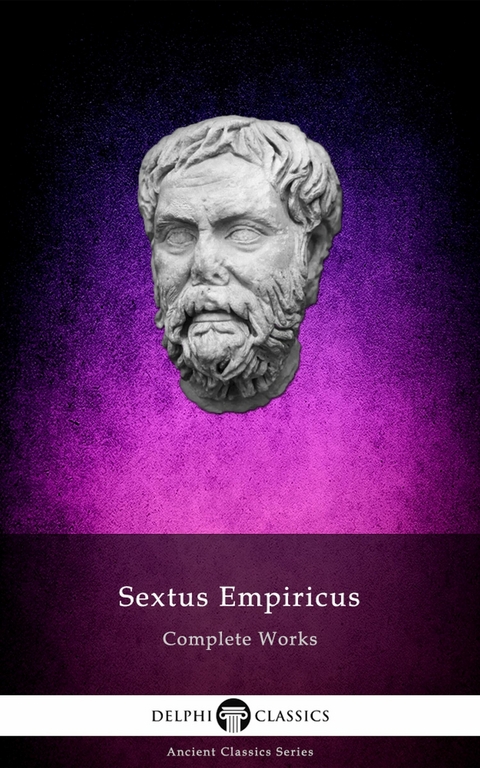
Delphi Complete Works of Sextus Empiricus Illustrated (eBook)
2294 Seiten
Publishdrive (Verlag)
978-1-80170-285-0 (ISBN)
A Greek philosopher of the mid-late second century AD, Sextus Empiricus produced the only extant comprehensive account of Greek Skepticism. As a major exponent of Pyrrhonistic 'suspension of judgment,' Sextus attacked syllogistic proofs in every area of speculative knowledge. His work would have a long-lasting impact on the development of philosophical thought throughout Europe into the Enlightenment. Delphi's Ancient Classics series provides eReaders with the wisdom of the Classical world, offering both English translations and the original Greek texts. This eBook presents Sextus' complete extant works, with illustrations, informative introductions and the usual Delphi bonus material. (Version 1)
* Beautifully illustrated with images relating to Sextus' life and works
* Features the complete extant works of Sextus, in both English translation and the original Greek
* Concise introduction to the text
* R. G. Bury's translation, previously appearing in the Loeb Classical Library edition
* Excellent formatting of the texts
* Easily locate the sections you want to read with individual contents tables
* Provides a special dual English and Greek text of 'Outlines of Pyrrhonism', allowing readers to compare the sections paragraph by paragraph - ideal for classical students
* Features three bonus biographies - discover Sextus' ancient world
CONTENTS:
The Translations
Outlines of Pyrrhonism
Against the Professors
Against the Logicians
Against the Physicists
Against the Ethicists
The Greek Texts
List of Greek Texts
The Dual Text
Outlines of Pyrrhonism (Greek and English Text)
The Biographies
Life of Pyrrho by Diogenes Laertius
Life of Timon by Diogenes Laertius
Introduction to Sextus Empiricus (1936) by R. G. Bury
A Greek philosopher of the mid-late second century AD, Sextus Empiricus produced the only extant comprehensive account of Greek Skepticism. As a major exponent of Pyrrhonistic "e;suspension of judgment,"e; Sextus attacked syllogistic proofs in every area of speculative knowledge. His work would have a long-lasting impact on the development of philosophical thought throughout Europe into the Enlightenment. Delphi's Ancient Classics series provides eReaders with the wisdom of the Classical world, offering both English translations and the original Greek texts. This eBook presents Sextus' complete extant works, with illustrations, informative introductions and the usual Delphi bonus material. (Version 1)* Beautifully illustrated with images relating to Sextus life and works* Features the complete extant works of Sextus, in both English translation and the original Greek* Concise introduction to the text* R. G. Bury s translation, previously appearing in the Loeb Classical Library edition * Excellent formatting of the texts* Easily locate the sections you want to read with individual contents tables* Provides a special dual English and Greek text of Outlines of Pyrrhonism , allowing readers to compare the sections paragraph by paragraph ideal for classical students* Features three bonus biographies discover Sextus ancient worldCONTENTS:The TranslationsOutlines of PyrrhonismAgainst the ProfessorsAgainst the LogiciansAgainst the PhysicistsAgainst the EthicistsThe Greek TextsList of Greek TextsThe Dual TextOutlines of Pyrrhonism (Greek and English Text)The BiographiesLife of Pyrrho by Diogenes LaertiusLife of Timon by Diogenes LaertiusIntroduction to Sextus Empiricus (1936) by R. G. Bury
CHAPTER V.
OF THE CRITERION “BY WHOM, “ OR AGENT
NOW “MAN” (IF he is “the agent”) seems to me, so far as regards the statements made by the Dogmatists, to be not only non-apprehensible but also inconceivable. At least we hear the Platonic Socrates expressly confessing that he does not know whether he is a man or something else. And when they wish to establish the concept of “Man” they disagree in the first place, and in the second place they speak unintelligibly.
Thus Democritus declares that “Man is that which we all know. “ Then, so far as his opinion goes, we shall not know Man, since we also know a dog, and consequently Dog too will be Man. And some men we do not know, therefore they will not be men. Or rather, if we are to judge by this concept, no one will be a man; for since Democritus says that Man must be known by all, and all men know no one man, no one, according to him, will be a man.
And it is evident from the relevance of this criticism that we are not now arguing sophistically. For this thinker proceeds to say that “Only the atoms and the void truly exist, “ and these he says “form the substrate not only of animals but of all compound substances, “ so that, so far as depends on these, we shall not form a concept of the particular essence of “Man, “ seeing that they are common to all things. But besides these there is no existing substrate; so that we shall possess no means whereby we shall be able to distinguish Man from the other animals and form a precise conception of him.
Again, Epicurus says that Man is “This sort of a shape combined with vitality. “ According to him, then, since Man is shown by pointing out, he that is not pointed out is not a man, and if anyone points out a female, the male will not be Man, while if he points out a male the female will not be Man. And we shall also draw the same inferences from the difference in the circumstances which we learn from the Fourth Mode of Suspension.
Others used to assert that “Man is a rational mortal animal, receptive of intelligence and science. “ Now since it is shown by the First Mode of Suspension that no animal is irrational but all are receptive of intelligence and science, so far as their statements go, we shall be unable to perceive what they mean.
And the attributes contained in this definition are used either in an “actual, “ or full, or in a potential sense; if in a full sense, he that has not already acquired complete science and is not rationally perfect and in the very act of dying — for this is to be mortal in the full sense of the word — is not a man. And if the sense is to be potential, then he will not be a man who possesses reason in perfection or who has acquired intelligence and science; but this conclusion is even more absurd than the former.
In this way, then, the concept of Man is shown to be one which it is impossible to frame.
For when Plato declares that “Man is a featherless two-footed animal with broad nails, receptive of political science, “ not even he himself claims to affirm this positively; for if Man is one of the class of things which, as he puts it, come into being but never possess absolute being, and if it is impossible, in his view, to make a positive declaration about things which never really exist, then even Plato will not claim to be taken as putting forward this definition positively, but rather as making, in his usual way, a probable statement.
But even if we should grant, by way of concession, that Man can be conceived, yet he will be found to be non-apprehensible. For he is compounded of soul and body, and neither body nor soul perchance is apprehended; so that Man is not apprehended.
Now that body is not apprehended is easily shown thus: the attributes of an object are different from the object whereof they are attributes. So when colour or any similar quality is perceived by us, what we perceive is probably the attributes of the body but not the body itself. Certainly the body, they say, exists in three dimensions; we ought therefore to apprehend its length and breadth and depth in order to apprehend the body. For if we perceived depth we should also discern silver pieces under their coating of gold. Therefore we do not apprehend the body either.
But, not to dwell on the controversy about the body, Man is also found to be non-apprehensible owing to the fact that his soul is non-apprehensible. That it is non-apprehensible is plain from this: of those who have treated of the soul — so that we may avoid dwelling on the long and endless controversy — some have asserted, as did Dicaearchus the Messenian, that the soul has no existence, others that it has existence, and others have suspended judgement.
If, then, the Dogmatists shall maintain that this dispute is incapable of decision, they will be admitting thereby the non-apprehensibility of the soul, while if they say it is capable of decision, let them tell us by what means they will decide it. For they cannot say “by sense-perception, “ since the soul is said by them to be an object of intelligence; and if they shall say “by the intellect, “ we will say that inasmuch as the intellect is the least evident part of the soul — as is shown by those who agree about the real existence of the soul, though differing about the intellect,
— if they propose to apprehend the soul and to decide the dispute about it by means of the intellect, they will be proposing to decide and establish the less questionable matter by the more questionable, which is absurd. Thus, neither by the intellect will the dispute about the soul be decided; therefore there is no means to decide it. And this being so, it is non-apprehensible; and, in consequence, Man too will not be apprehended.
But even supposing we grant that Man is apprehended, it would not, probably, be possible to show that objects ought to be judged by him. For he who asserts that objects ought to be judged by Man will be asserting this either without proof or with proof. Not with proof; for the proof must be true and tested, and therefore tested by some standard. Since, then, we are unable to make an agreed statement as to the standard by which the proof itself can be tested (for we are still inquiring about the criterion “By whom”), we shall be unable to pronounce judgement on the proof, and therefore also to prove the criterion, which is the subject of discussion.
And if it shall be asserted without proof that objects ought to be judged by Man, the assertion will be disbelieved, so that we shall be unable to affirm positively that the criterion “By whom” (or Agent) is Man. Moreover, who is to be the judge that the criterion of the Agent is Man? For if they assert this without a judgement (or criterion) they will surely not be believed.
Yet if they say that a man is to be the judge, that will be assuming the point at issue; while if they make another animal the judge, in what way do they come to adopt that animal for the purpose of judging whether Man is the criterion? If they do so without a judgement, it will not be believed, and if with a judgement, it in turn needs to be judged by something. If, then, it is judged by itself, the same absurdity remains (for the object of inquiry will be judged by the object of inquiry); and if by Man, circular reasoning is introduced; and if by some judge other than these two, we shall once again in his case demand the criterion “By whom, “ and so on ad infinitum. Consequently we shall not be in a position to declare that objects ought to be judged by Man.
But let it be granted and established that objects ought to be judged by Man. Then, since there exists great difference amongst men, let the Dogmatists first agree together that this is the particular man to whom we must attend, and then, and only then, let them bid us also to yield him our assent. But if they are going to dispute about this “long as the waters flow on and the tall trees cease not to burgeon” (to quote the familiar saying), how can they urge us to assent rashly to anyone?
For if they declare that we must believe the Sage, we shall ask them “What Sage?” Is it the Sage of Epicurus or of the Stoics, the Cyrenaic Sage or the Cynic? For they will be unable to return a unanimous answer.
And if anyone shall demand that we should desist from our inquiry about the Sage and simply believe the man who is more sagacious than all others, then, in the first place, they will dispute as to who is more sagacious than the rest, and in the next place, even if it be granted that it can be unanimously agreed who the man is who is more sagacious than those of the present and the past, even so this man will not deserve credence.
For inasmuch as sagacity is liable to a great, indeed almost incalculable, advance or decline in intensity, we assert that it is possible for another man to arise who is more sagacious than this man who, we say, is more sagacious than those of the past and present. So, then, just as we are requested to believe the man who is now said to be wiser than those of the present and the past because of his sagacity, so it is still more proper to believe his successor in the future who will be more sagacious than he. And when that successor has arisen, then it is right to expect that yet another will arise more sagacious than he, and so on ad infinitum.
Nor is it evident whether all these men will agree with one another or contradict one another. And consequently, even when one of them is acknowledged to be more sagacious than those of the past and present, seeing that we are unable to affirm positively that no man will be more...
| Erscheint lt. Verlag | 11.11.2025 |
|---|---|
| Reihe/Serie | Delphi Ancient Classics |
| Sprache | englisch |
| Themenwelt | Geisteswissenschaften ► Philosophie ► Geschichte der Philosophie |
| Schlagworte | bury • Loeb • Mathematicians • professors • Pyrrhonism • Seneca • skeptic |
| ISBN-10 | 1-80170-285-3 / 1801702853 |
| ISBN-13 | 978-1-80170-285-0 / 9781801702850 |
| Informationen gemäß Produktsicherheitsverordnung (GPSR) | |
| Haben Sie eine Frage zum Produkt? |
 EPUB (Ohne DRM)
Digital Rights Management: ohne DRM
Dieses eBook enthält kein DRM oder Kopierschutz. Eine Weitergabe an Dritte ist jedoch rechtlich nicht zulässig, weil Sie beim Kauf nur die Rechte an der persönlichen Nutzung erwerben.
Dateiformat: EPUB (Electronic Publication)
EPUB ist ein offener Standard für eBooks und eignet sich besonders zur Darstellung von Belletristik und Sachbüchern. Der Fließtext wird dynamisch an die Display- und Schriftgröße angepasst. Auch für mobile Lesegeräte ist EPUB daher gut geeignet.
Systemvoraussetzungen:
PC/Mac: Mit einem PC oder Mac können Sie dieses eBook lesen. Sie benötigen dafür die kostenlose Software Adobe Digital Editions.
eReader: Dieses eBook kann mit (fast) allen eBook-Readern gelesen werden. Mit dem amazon-Kindle ist es aber nicht kompatibel.
Smartphone/Tablet: Egal ob Apple oder Android, dieses eBook können Sie lesen. Sie benötigen dafür eine kostenlose App.
Geräteliste und zusätzliche Hinweise
Buying eBooks from abroad
For tax law reasons we can sell eBooks just within Germany and Switzerland. Regrettably we cannot fulfill eBook-orders from other countries.
aus dem Bereich