


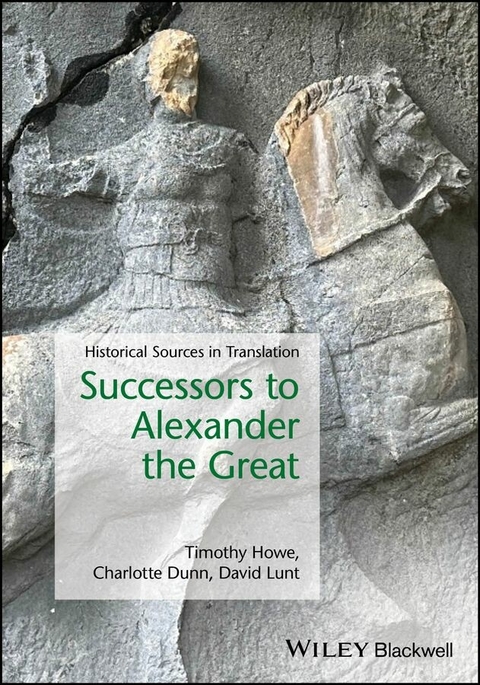
Successors to Alexander the Great (eBook)
677 Seiten
Wiley-Blackwell (Verlag)
978-1-119-68831-0 (ISBN)
A comprehensive collection of translated sources on the wars and world of Alexander's successors
Successors to Alexander the Great brings together-for the first time in a single collection-the essential translated sources for the tumultuous period following the death of Alexander the Great in 323 BCE. Spanning Greek, Latin, Persian Babylonian, Egyptian, and epigraphic materials, this volume provides direct access to a wide range of documents that illuminate the world and the wars of the Diadochi and the complex efforts to reassemble, rule, and redefine the fragments of Alexander's empire.
Organized thematically and geographically, this book allows readers to explore the Successors' ambitions, alliances, propaganda, and political innovation across a sprawling and multi-ethnic landscape. Contextual commentary throughout helps readers navigate the fragmentary nature of source evidence, the biases of ancient authors, and the evolving concepts of legitimacy and kingship. With its thematic structure and source diversity, the book offers an ideal foundation for historical, literary, and historiographical inquiry into the Hellenistic world.
The first unified, carefully curated, deeply contextualized collection of primary sources on the post-Alexander Hellenistic world, Successors to Alexander the Great:
- Features Greek, Latin, Persian, Babylonian, Egyptian, and epigraphic material spanning multiple traditions and viewpoints
- Includes bibliographies with each chapter for ease of reference and deeper research engagement
- Highlights the complexity of succession politics, propaganda, and kingship after Alexander's death
- Illuminates lesser-known figures and regions often excluded from traditional Hellenistic narratives
- Promotes critical thinking and historiographical awareness through exposure to conflicting ancient perspectives
- Supports interdisciplinary teaching on identity, authority, and empire-building in the ancient world
Presenting a single, coherent, and accessible narrative, Successors to Alexander the Great is ideal for upper-level undergraduate and graduate courses on Alexander the Great, the Hellenistic world, and ancient Greek history. It supports degree programs in Classics, History, Ancient Studies, Middle Eastern Studies, and related disciplines, and serves as a vital reference for scholars, educators, and researchers.
Timothy Howe is a Professor of History, Archaeology, and Ancient Studies at St. Olaf College. He has published extensively on Alexander the Great, ancient Mediterranean trade, and terrorism. He is the Senior Editor of The Ancient History Bulletin and co-directs archaeological excavations at Antiochia ad Cragum in Turkey.
Charlotte Dunn is a Senior Lecturer in Classics at the University of Tasmania. Her research focuses on the Hellenistic world, especially the careers and self-representation of the Diadochi. She has published widely on topics like royal identity and coinage in the post-Alexander era and coauthored Demetrius the Besieger, the first full-length study of the Hellenistic king.
David Lunt is a Professor of History at Southern Utah University. His research explores sport and cultural identity in the ancient world, particularly in relation to Greek athletics and festivals. He has written a book about the Crown Games of ancient Greece, and has published research treating Alexander's relationship to athletics. He serves on the editorial boards for the Journal of Sport History, the International Journal of the History of Sport, and the Journal of Olympic Studies.
A comprehensive collection of translated sources on the wars and world of Alexander's successors Successors to Alexander the Great brings together for the first time in a single collection the essential translated sources for the tumultuous period following the death of Alexander the Great in 323 BCE. Spanning Greek, Latin, Persian Babylonian, Egyptian, and epigraphic materials, this volume provides direct access to a wide range of documents that illuminate the world and the wars of the Diadochi and the complex efforts to reassemble, rule, and redefine the fragments of Alexander's empire. Organized thematically and geographically, this book allows readers to explore the Successors' ambitions, alliances, propaganda, and political innovation across a sprawling and multi-ethnic landscape. Contextual commentary throughout helps readers navigate the fragmentary nature of source evidence, the biases of ancient authors, and the evolving concepts of legitimacy and kingship. With its thematic structure and source diversity, the book offers an ideal foundation for historical, literary, and historiographical inquiry into the Hellenistic world. The first unified, carefully curated, deeply contextualized collection of primary sources on the post-Alexander Hellenistic world, Successors to Alexander the Great: Features Greek, Latin, Persian, Babylonian, Egyptian, and epigraphic material spanning multiple traditions and viewpoints Includes bibliographies with each chapter for ease of reference and deeper research engagement Highlights the complexity of succession politics, propaganda, and kingship after Alexander's death Illuminates lesser-known figures and regions often excluded from traditional Hellenistic narratives Promotes critical thinking and historiographical awareness through exposure to conflicting ancient perspectives Supports interdisciplinary teaching on identity, authority, and empire-building in the ancient world Presenting a single, coherent, and accessible narrative, Successors to Alexander the Great is ideal for upper-level undergraduate and graduate courses on Alexander the Great, the Hellenistic world, and ancient Greek history. It supports degree programs in Classics, History, Ancient Studies, Middle Eastern Studies, and related disciplines, and serves as a vital reference for scholars, educators, and researchers.
Introduction
I shall attempt in the books that follow to detail, as best I can, the history of the Successors.
—Diodorus 17.118.4
The Death of the King
Alexander the Great (356–323) led his army from Macedonia to, seemingly, the ends of the earth. During his reign, Alexander had exposed himself to every danger, shared every hardship with his soldiers, and was laid low by multiple injuries and bouts of illness over the course of a decade of fierce campaigning. Nonetheless, the Macedonians were unprepared for the sudden shock of Alexander's death, when the great conqueror drew his last breath in Babylon at the age of just 32.1 Alexander's army inherited a succession crisis on an unprecedented scale, the course of which would be decided on the battlefield, and would leave a powerful impact on what came to be known as the Hellenistic Age. This volume focuses on the source material for this power struggle and the actions of the Successors themselves (also commonly referred to as the Diadochi). These Successors were the ambitious men and women who played a role in the turbulent politics that unfolded over decades, as Alexander's empire was portioned, fought over, and eventually reformed into a number of new kingdoms. It is a fascinating age, full of political intrigue, spectacular military operations, and incredible new innovations which influenced the ancient world down until the period of Roman conquest. The ancient evidence for the Successors and the events of these years poses a number of challenges, the reasons for which will be discussed in more detail below.
A Succession Crisis
Instead of a capable heir, Alexander left behind an unborn child, still in utero at the time of his death. And this was not the only challenge to the transition of power, as Alexander also had no clear second in command, and there was no one person at Babylon who was particularly elevated above the others who could take charge unchallenged.2 This was probably deliberate planning by Alexander, as he had divided the important offices and positions of command between his men, ensuring that there was no concentration of power on one single individual. This of course protected and benefited Alexander during his lifetime but was disastrous following his death. This lack of foresight is perhaps curious as Alexander had been counselled to avoid this exact situation—advised to marry much earlier for example, by his senior generals, Parmenion and Antipater (Diodorus 17.16.2) in order to establish dynastic continuity as soon as possible. Alexander had rejected this advice, which could have been for any number of reasons: he may have feared to favour one elite Macedonian family over another, or been concerned about leaving a child behind in Macedonia to grow up without his influence. He may have always intended to marry once there was a political advantage to do so in relation to his campaign, which is indeed what eventually happened, but this occurred so much later in his reign that time ran out to secure the accession of his son. In 323 BCE, the Macedonians had no way to know if Alexander's child would make it to term, or would be male (the Macedonians would not have considered a female ruler), and there was the further complication that not all of the Macedonians wanted to accept the rule of the child of his wife Rhoxane, who was a Bactrian woman.3 This reluctance can probably be attributed to xenophobia, as Alexander's attempts at blending elements of Persian customs into his court had been criticised or even outright rejected. But probably the more immediate concern was the obvious fact that whoever was appointed regent would be the de facto ruler for at least 13 years, while they waited for the son of Alexander to reach an age where he could conceivably take control of his father's empire. Thirteen years was a long time without a king, and the prospect must have been anxiety inducing for many. For others, it was a clear, shining opportunity for personal gain.
For the future Alexander IV, still at six to eight months gestation, this was an unpromising situation. And there were also other potential contenders for power, which added complexity to the discussions. Rhoxane's shaky position is evidenced by her complicity in swiftly murdering her rival, Achaemenid princess Stateira, another wife of Alexander's and the first of many royal victims of the succession crisis.4 Such a brutal action probably speaks to Rhoxane's vulnerability and acknowledgement that Stateira (and any children from her) could take precedence for the throne due to her higher status. Alexander also had another son, Herakles son of Barsine, but this Herakles remains a rather obscure figure and was apparently low down on the list of preferred future kings. Some, like the famous scholar W. W. Tarn even went as far as arguing that this child might not have existed at all, though this theory is now largely dismissed. It is fair to note, however, that the sources do not suggest that Alexander had much of a relationship with Herakles.5 And importantly, at the time of deciding the succession in 323 Herakles was just a young child himself, perhaps as young as four, and so the same issue of a dominating regent and puppet kingship would have prevailed.
The escalating crisis was further compounded by the fact that Macedonian kingship itself did not have much of a systematic succession process. The system, such as it was, appears to have favoured those with strong ties to the powerful Macedonian elite, and those who were experienced enough to hold onto their throne, often through brutal tactics. The Macedonians themselves were very attached to the Argead clan, the ancestral royal house that Alexander had belonged to. All successful contenders for the throne had been Argeads, and all had made use of important family connections to secure their rule, often having to fight rivals to gain their positions. This powerful, emotional connection to the Argeads will be seen again in the actions and politics of the Successors, who made use of any Argead connection they might conceivably claim. Cassander, for example, would go on to marry Thessalonike, the daughter of Philip II, and name his firstborn son Philip as well, all part of his plan to secure Macedonia. Children like Alexander IV and Herakles could technically claim an Argead connection, but without strong ties to Macedonia or powerful supporters to genuinely advocate for them, these two unfortunate sons of Alexander stood little chance of ever being seriously considered for his throne. Both survived into their teens, but were eliminated as soon as they looked to stand any chance at claiming their father's throne.
The one adult Argead male who was available as a contender was a brother of Alexander, a man named Arrhidaios, son of Philip II and Philine of Larisa. He had not been considered for the Macedonian throne over Alexander at the time of Philip's own death, and in addition, Arrhidaios had some type of condition, possibly a mental and/or physical disability, which seems to have prevented him from being able to operate independently.6 It is telling that we hear little about him in the sources until after his famous brother's death. Even his survival into Alexander's reign suggests he was not perceived to be any sort of threat to Alexander. Arrhidaios certainly does not appear to have coveted the kingship in 323 and did not advocate for himself to be named king. But in the chaos that erupted as the generals and the army met to discuss the succession, Arrhidaios was put forth as a candidate, preferred because he was an adult, and an Argead, and due to his connection with Philip II who was for the most part fondly remembered. Arrhidaios was supported by the infantry in particular, who disagreed strongly with Alexander's unborn son being named as his heir. He was proclaimed king by these soldiers, and Arrhidaios became Philip III Arrhidaios.
When the dust settled (and the alleged mutineers had been executed),7 and Alexander IV was born, an uneasy joint kingship was agreed upon under the guardianship of Perdikkas. The fears that those who controlled the kings would seek to use them to gain power and influence over events immediately came to pass. Alexander's vast empire was unwieldy, and he had not yet had time to establish appropriate mechanisms with which to govern such an expanse, a situation which only contributed to the challenge of managing matters. Those of Alexander's generals and friends who were awarded satrapies to govern set about shoring up their control of these regions and building their power bases, forming alliances with one another, and manoeuvring into advantageous positions from which to grow the territories they governed. Many displayed royal ambitions for themselves from an early point, and certainly individuals like Perdikkas were accused of having designs on the crown. Others, namely the royal members of Alexander's family, like his sisters Kleopatra and Kynnane, and his mother Olympias, also joined the fray. Olympias in particular tried to support her grandson, while Kynnane orchestrated the marriage of her daughter Adea Eurydike to Philip III Arrhidaios, which ultimately cost Adea her life. As the next decades of the power struggle unfolded, the unfortunate kings Alexander IV and Philip III Arrhidaios would be murdered, Alexander on the orders of Cassander, Arrhidaios on the authority of Olympias. Indeed, most of the remaining members of the Argead clan met a bloody fate one way or another, at the hands of their rivals, as did many of the most...
| Erscheint lt. Verlag | 14.11.2025 |
|---|---|
| Reihe/Serie | Blackwell Sourcebooks in Ancient History |
| Sprache | englisch |
| Themenwelt | Geisteswissenschaften ► Sprach- / Literaturwissenschaft ► Anglistik / Amerikanistik |
| Geisteswissenschaften ► Sprach- / Literaturwissenschaft ► Latein / Altgriechisch | |
| Geisteswissenschaften ► Sprach- / Literaturwissenschaft ► Literaturwissenschaft | |
| Schlagworte | Alexander Babylonian sources • Alexander Egyptian sources • Alexander Hellenistic epigraphy • Alexander successor kingdoms • Alexander the Great • Alexander the Great translated sources • Diadochi • Hellenistic History • post-Alexander political history |
| ISBN-10 | 1-119-68831-0 / 1119688310 |
| ISBN-13 | 978-1-119-68831-0 / 9781119688310 |
| Informationen gemäß Produktsicherheitsverordnung (GPSR) | |
| Haben Sie eine Frage zum Produkt? |
 EPUB (Adobe DRM)
Kopierschutz: Adobe-DRM
Adobe-DRM ist ein Kopierschutz, der das eBook vor Mißbrauch schützen soll. Dabei wird das eBook bereits beim Download auf Ihre persönliche Adobe-ID autorisiert. Lesen können Sie das eBook dann nur auf den Geräten, welche ebenfalls auf Ihre Adobe-ID registriert sind.
Details zum Adobe-DRM
Dateiformat: EPUB (Electronic Publication)
EPUB ist ein offener Standard für eBooks und eignet sich besonders zur Darstellung von Belletristik und Sachbüchern. Der Fließtext wird dynamisch an die Display- und Schriftgröße angepasst. Auch für mobile Lesegeräte ist EPUB daher gut geeignet.
Systemvoraussetzungen:
PC/Mac: Mit einem PC oder Mac können Sie dieses eBook lesen. Sie benötigen eine
eReader: Dieses eBook kann mit (fast) allen eBook-Readern gelesen werden. Mit dem amazon-Kindle ist es aber nicht kompatibel.
Smartphone/Tablet: Egal ob Apple oder Android, dieses eBook können Sie lesen. Sie benötigen eine
Geräteliste und zusätzliche Hinweise
Buying eBooks from abroad
For tax law reasons we can sell eBooks just within Germany and Switzerland. Regrettably we cannot fulfill eBook-orders from other countries.
aus dem Bereich


