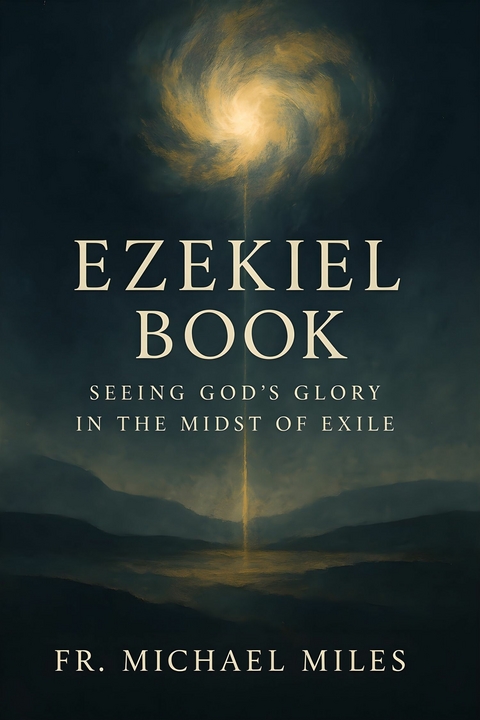
Ezekiel Book (eBook)
146 Seiten
Publishdrive (Verlag)
978-0-00-110249-1 (ISBN)
Do you ever feel like you're living in exile-far from where you thought God would have you by now?
Do you look at the chaos in your life, your church, or the world and quietly ask, 'Where is God's glory in all of this?'
Have you tried reading the book of Ezekiel, only to close your Bible confused by wheels, creatures, and strange visions that don't seem to connect to your everyday struggles?
If you answered YES to at least one of these questions, you NEED to keep reading...
Discover God's Glory in the Middle of Your Personal Exile
Many followers of Jesus feel spiritually displaced. Broken dreams, unanswered prayers, cultural hostility, and church disappointment can leave you wondering if God has moved on and left you behind. Ezekiel was written into that kind of world-exiles ripped from their homes, asking if God's presence had abandoned them forever.
Yet tucked inside this 'strangest' of prophetic books is a blazing message of hope: God's glory goes into exile with His people-and meets them there.
But for most believers, Ezekiel feels too overwhelming, too visionary, or too distant to understand... so they skip it and miss one of the most powerful portraits of God in all of Scripture.
You don't have to skip it anymore.
Presenting: Ezekiel Book: Seeing God's Glory in the Midst of Exile
This book walks you carefully and clearly through Ezekiel so you can see how God's glory breaks into the darkest seasons of His people's story-and yours. Written for everyday Christians, not just scholars, it helps you move from confusion to clarity, from fear to confidence, and from spiritual numbness to renewed awe.
Inside, you'll discover:
The story behind the visions - how exile, temple, and glory all fit together so Ezekiel finally makes sense.
Simple explanations of complex imagery - wheels, cherubim, dry bones, the new temple, and more-without drowning you in academic jargon.
A God who comes close in hard places - how the God of Ezekiel still enters loss, disappointment, and cultural collapse with piercing holiness and tender mercy.
Practical connections to your life today - prompts to help you respond in repentance, worship, obedience, and resilient hope right where you are.
Glimpses of Jesus in Ezekiel's message - how the themes of shepherd, new heart, Spirit, and restored temple point forward to Christ.
Imagine this...
Imagine opening to Ezekiel and actually looking forward to reading it. Instead of skimming strange visions, you see how each chapter reveals a God who refuses to abandon His people-even when they're the ones who walked away.
Picture yourself recognizing your own 'exile places': the job that didn't work out, the prayer that seemed unanswered, the church hurt that still stings... and then seeing, right there, signs of God's stubborn, radiant glory.
Whether you're a small group leader, a pastor, or simply a believer who feels like life has not gone the way you expected, Ezekiel Book: Seeing God's Glory in the Midst of Exile will help you:
Rebuild confidence that God has not forgotten you
Learn to recognize His presence in uncomfortable, in-between seasons
Grow a deeper reverence for His holiness and a deeper trust in His love
Find fresh motivation to stay faithful-even in a culture far from home
Don't leave one of the Bible's most hope-filled books closed on your shelf.
Let Ezekiel mentor you in exile and show you the God whose glory shines especially in the dark.
Your journey to seeing God's glory in the midst of exile can start today.
Introduction: Why Ezekiel, Why Now
Most readers approach the Book of Ezekiel with a kind of quiet hesitation, as though they were standing at the entrance of a dense forest whose paths are unclear. The visions seem too strange, the language too severe, the judgments too heavy to feel comforting or familiar. Many believers openly admit that Ezekiel is the book they skip when reading through Scripture. Others confess that it feels like an ancient puzzle meant for scholars, not ordinary people trying to navigate the pressures of modern life. Yet this instinctive distance from Ezekiel comes not because the book is irrelevant, but because its relevance strikes closer to home than we realize. The prophet speaks from a world shaken apart, and his words are aimed at people who have lost the anchoring structures of their lives. When read with openness rather than fear, Ezekiel becomes one of the most honest and compassionate guides for anyone who has ever felt adrift.
Ezekiel was called into ministry during Israel’s exile—a moment of national dislocation so deep that it fractured the identity of an entire people. Families had been uprooted. Rituals that once grounded their days had vanished. The temple, which had served as the heart of their worship and the symbol of God’s nearness, lay in ruins. The promises they grew up hearing suddenly felt suspended in midair, as though they no longer applied to the world they were living in. Nothing in their lives resembled what they once thought “normal” meant. Scholars describe exile as the defining tragedy of Israel’s story, not only because it was politically catastrophic, but because it created an emotional and spiritual disorientation unlike anything they had ever known. Everything familiar had collapsed, and no one knew what to trust.
It is into this atmosphere of confusion that Ezekiel steps, not as a distant theologian, but as a fellow sufferer. He himself was among the exiles. He knew the shock of waking up in a place that did not feel like home. He knew the silence of God that often accompanies seasons of upheaval. He knew what it was like to watch dreams crumble, and to wonder whether they would ever be restored. Ezekiel does not preach from the safety of a distant pulpit; he speaks from the rubble of shared loss. This is precisely why his book has the power to speak so directly into the lives of people today. Even though most of us will never experience the political exile that marked Israel’s story, almost everyone eventually encounters a form of personal exile—an internal dislocation that feels just as real.
For some, exile arrives quietly through the slow erosion of confidence, purpose, or joy. A job is lost, a relationship unravels, a long-held plan no longer works, and suddenly the familiar map of life no longer makes sense. You can be physically at home yet feel spiritually far from any place that feels safe. For others, exile takes the form of cultural or moral bewilderment. The world shifts so rapidly that it becomes difficult to recognize the values, rhythms, or assumptions that once formed the backdrop of everyday life. What once seemed stable now feels uncertain. Even faith, which may have been solid for many years, can feel strangely fragile during these seasons, as though God’s presence is clouded by a heavy silence. Still others experience exile through grief, betrayal, illness, or disappointment—those moments when life feels suspended between what was and what will never be again.
Ezekiel understands the weight of such seasons, because his entire ministry begins at the moment when life collapses around him. This is why he is not an intimidating prophet to avoid, but a companion whose honesty makes space for our own unspoken questions. The vivid imagery in his visions, far from being irrelevant, mirrors the intensity of our inner worlds when we face upheaval. When life is stable, we prefer tidy metaphors and gentle reassurances. But when everything collapses, the language of fire, wind, wheels, and upheaval suddenly makes sense. Ezekiel does not use imagery to confuse the reader; he uses it to express what ordinary words cannot capture. His visions are like the language of dreams: dramatic, unsettling, and revealing, pulling the reader into a deeper understanding of the spiritual landscape beneath the surface of crisis.
Yet Ezekiel does more than describe the chaos of exile; he reveals that God is not absent from it. One of the most striking features of the book is that God’s glory appears not in Jerusalem, the sacred center Israel had lost, but in Babylon, the land of their captors. This alone overturns one of the most painful assumptions people carry during seasons of hardship—the belief that God is distant or withholding because life has become difficult. Ezekiel’s first vision follows the exiles into their foreign land, demonstrating that God’s presence is not tied to familiar geography. If His glory can appear by the Kebar River, it can appear in whatever unfamiliar place you find yourself now. This revelation does not remove the pain of exile, but it does reframe it. The story is not about God abandoning His people; it is about God meeting them where they least expected Him.
Modern readers often assume Ezekiel is a book primarily about judgment. Certainly, Ezekiel is unflinching in its assessment of Israel’s failures, but judgment is never the endpoint. Ezekiel’s message is aimed at healing a fractured people by restoring their vision of who God is and who they are called to be. When everything familiar has been stripped away, clarity becomes a gift. Ezekiel’s confrontations are not a form of divine cruelty; they are the mercy that clears the ground for renewal. Anyone who has walked through the collapse of a dream knows that clarity often comes only after painful truth is acknowledged. Ezekiel speaks this truth not to crush, but to rebuild.
This is precisely why Ezekiel resonates so deeply with the emotional landscape of modern life. We live in a time marked by uncertainty, rapid change, and constant pressure. Many people quietly carry a sense of displacement even without moving from their homes. They navigate psychological or spiritual exile without language for it. Ezekiel provides that language. He names the disorientation, the numbness, the anger, and the longing that accompany seasons of upheaval. And he does so while offering a vision of God that refuses to be confined to any single place, culture, or circumstance. Ezekiel’s God is not confined by the ruins of the past; He moves, restores, transforms, and renews.
The relevance of Ezekiel becomes even more profound when we consider that exile does not always end quickly. Many people imagine that spiritual difficulty should resolve within weeks or months, and they grow discouraged when the darkness lasts longer than expected. Ezekiel’s ministry reminds us that God’s work within seasons of exile is often slow, deliberate, and deeply transformative. The exiles did not return immediately, but in the waiting, God reshaped their identity. He stripped away illusions, healed what had been wounded, and prepared them for a life rooted more deeply in His presence than ever before. The same pattern appears in the personal journeys of countless believers today. Ezekiel teaches us that exile is not a detour; it is a place where God reshapes the heart.
If you have ever felt lost, overwhelmed, disoriented, or spiritually exhausted, Ezekiel has something to say to you. His book is not an ancient relic but a mirror held up to the soul, reflecting the ache of losing what once felt certain and the unexpected hope that rises in places we never intended to dwell. To read Ezekiel is to discover that exile, painful as it is, becomes a space where God’s glory breaks through the cracks of our broken expectations. It is an invitation to look again, to listen again, to believe that the God who seemed silent may actually be nearer than you imagined.
This is why Ezekiel matters now. His prophetic voice reaches across centuries to remind us that dislocation is not the end of the story. The God who met Israel beside a foreign river is the same God who meets you in the unsettled places of your life. In that sense, Ezekiel is not merely a book about ancient Israel; it is a book about you.
One of the most surprising gifts of the Book of Ezekiel is that it refuses to confine God to the places where we feel most secure. Long before readers encounter a single judgment or symbol, Ezekiel confronts them with a truth they may never have considered: God’s glory is not restricted to sanctuaries, traditions, or sacred landmarks. It appears in unexpected terrain—sometimes even in the places we would prefer to avoid. This is not a poetic exaggeration but the core claim of Ezekiel’s opening vision. The prophet sees God not in Jerusalem, not in the holy precincts of the temple, but in Babylon, the very heart of exile. That moment is not a narrative detail; it is the theological foundation of the entire book. If God can show His glory there, then there is no place so disordered, painful, or unfamiliar that He cannot fill with His presence.
When Ezekiel first sees the glory of God by the Kebar River, the exiles around him have no reason to expect anything holy to break into their shattered lives. Their world has been reduced to survival and memory. They have been torn from the routines that once gave structure to their faith. Their rituals cannot be performed. Their sense of belonging has been fractured. Life seems to have narrowed into a long corridor of unanswered questions. They do not ask where God is; they assume they already know the answer. They believe He has remained in the ruins of Jerusalem, or that He has withdrawn entirely in disappointment or judgment. This is the...
| Erscheint lt. Verlag | 13.11.2025 |
|---|---|
| Sprache | englisch |
| Themenwelt | Geisteswissenschaften ► Religion / Theologie ► Christentum |
| ISBN-10 | 0-00-110249-4 / 0001102494 |
| ISBN-13 | 978-0-00-110249-1 / 9780001102491 |
| Informationen gemäß Produktsicherheitsverordnung (GPSR) | |
| Haben Sie eine Frage zum Produkt? |
 EPUB (Adobe DRM)
Größe: 1,4 MB
Kopierschutz: Adobe-DRM
Adobe-DRM ist ein Kopierschutz, der das eBook vor Mißbrauch schützen soll. Dabei wird das eBook bereits beim Download auf Ihre persönliche Adobe-ID autorisiert. Lesen können Sie das eBook dann nur auf den Geräten, welche ebenfalls auf Ihre Adobe-ID registriert sind.
Details zum Adobe-DRM
Dateiformat: EPUB (Electronic Publication)
EPUB ist ein offener Standard für eBooks und eignet sich besonders zur Darstellung von Belletristik und Sachbüchern. Der Fließtext wird dynamisch an die Display- und Schriftgröße angepasst. Auch für mobile Lesegeräte ist EPUB daher gut geeignet.
Systemvoraussetzungen:
PC/Mac: Mit einem PC oder Mac können Sie dieses eBook lesen. Sie benötigen eine
eReader: Dieses eBook kann mit (fast) allen eBook-Readern gelesen werden. Mit dem amazon-Kindle ist es aber nicht kompatibel.
Smartphone/Tablet: Egal ob Apple oder Android, dieses eBook können Sie lesen. Sie benötigen eine
Geräteliste und zusätzliche Hinweise
Buying eBooks from abroad
For tax law reasons we can sell eBooks just within Germany and Switzerland. Regrettably we cannot fulfill eBook-orders from other countries.
aus dem Bereich