


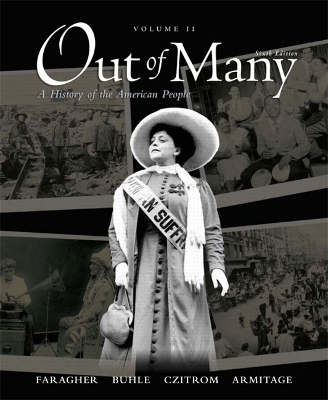
Out of Many, Volume 2
Pearson (Verlag)
978-0-13-614957-6 (ISBN)
- Titel erscheint in neuer Auflage
- Artikel merken
Instead of looking at the country as a homogenous whole, the authors break down the country into more meaningful and manageable building blocks: the individual, the community, the state, and the region. Showing these interplays between the individuals and groups and the groups and the regions, each chapter of the text will help students understand the textured and varied history that has produced the increasing complexity of America.
John Mack Faragher John Mack Faragher is Arthur Unobskey Professor of American History and director of the Howard R. Lamar Center for the Study of Frontiers and Borders at Yale University. Born in Arizona and raised in southern California, he received his B.A. at the University of California, Riverside, and his Ph.D. at Yale University. He is the author of Women and Men on the Overland Trail (1979), Sugar Creek: Life on the Illinois Prairie (1986), Daniel Boone: The Life and Legend of an American Pioneer (1992), The American West: A New Interpretive History (2000), and A Great and Noble Scheme: The Tragic Story of the Expulsion of the French Acadians from their American Homeland (2005). Mari Jo Buhle Mari Jo Buhle is William R. Kenan Jr. University Professor and Professor of American Civilization and History at Brown University, specializing in American women’s history. She received her B.A. from the University of Illinois, Urbana—Champaign, and her Ph.D. from the University of Wisconsin, Madison. She is the author of Women and American Socialism, 1870—1920 (1981) and Feminism and Its Discontents: A Century of Struggle with Psychoanalysis (1998). She is also coeditor of Encyclopedia of the American Left, second edition (1998). Professor Buhle held a fellowship (1991—1996) from the John D. and Catherine T. MacArthur Foundation. Daniel Czitrom Daniel Czitrom is Professor of History at Mount Holyoke College. Born and raised in New York City, he received his B.A. from the State University of New York at Binghamton and his M.A. and Ph.D. from the University of Wisconsin, Madison. He is the author of Media and the American Mind: From Morse to McLuhan (1982), which won the First Books Award of the American Historical Association and has been translated into Spanish and Chinese. He is co-author of Rediscovering Jacob Riis: Exposure Journalism and Photography in Turn of the Century New York (2007). He has served as a historical consultant and featured on-camera commentator for several documentary film projects, including the PBS productions New York: A Documentary Film; American Photography: A Century of Images; and The Great Transatlantic Cable. He currently serves on the Executive Board of the Organization of American Historians. Susan H. Armitage Susan H. Armitage is Claudius O. and Mary R. Johnson Distinguished Professor of History at Washington State University. She earned her Ph.D. from the London School of Economics and Political Science. Among her many publications on western women’s history are three coedited books, The Women’s West (1987), So Much To Be Done: Women on the Mining and Ranching Frontier (1991), and Writing the Range: Race, Class, and Culture in the Women’s West (1997). She currently serves as an editor of a series of books on women and American history for the University of Illinois Press.
New“Seeing History” features in each chapter offer in-depth analysis of an image or series of images from a particular historical period. These visually engaging features help students to understand how various individuals and events have been depicted throughout American history and underscore the important role images and illustrations play in understanding and interpreting the past.
New“Communities in Conflict” features in each chapter reveal how conflicts amongst individuals and groups have changed the course of history. These sections present a primary source passage from each side of a specific event or issue, helping students to see how controversy and discussion have shaped America.
A New Primary Source: Documents in U.S. History CD-ROM is bound to each new copy of the book. This versatile resource offers 400 primary source documents in accessible PDF format and over 350 images and maps. It also provides a number of features that help students work with documents, including headnotes, focus questions, highlighting and note-taking tools, and a glossary of terms for certain documents.
Chapter-by-chapter changes
Chapter 17 Reconstruction
· Seeing History: Changing Images of Reconstruction
· Communities in Conflict: The Ku Klux Klan in Alabama
· Expanded discussion of Southern Republicans in reconstruction era, emphasizing regional differences within the South
· Improved treatment of how sharecropping and tenant farming transformed Southern agriculture and environment
· Expanded material on Ku Klux Klan use of terror
· Clarified discussion of Slaughterhouse cases in Supreme Court and how they in effect denied the original intent of the
Fourteenth Amendment
· New material on Radical Republican conceptions of free labor and equality of opportunity
Chapter 18 CONQUEST AND SURVIVAL: THE TRANS-MISSISSIPPI WEST
· Seeing History: The Legendary Cowboy: Nat Love, Deadwood Dick
· Communities in Conflict: The Carlisle Indian Industrial School
Chapter 19 Production and Consumption in the Gilded AGe
· Seeing History: The Standard Oil Company
· Communities in Conflict: Haymarket Square, Chicago, May 4, 1886
Chapter 20 Democracy and Empire
· Seeing History: The White Man’s Burden
· Communities in Conflict: Two Sides of Anti-Imperialism
Chapter 21 Urban America and the Progressive Era
· Seeing History: Photographing Poverty in the Slums of New York
· Communities in Conflict: Debating Prohibition in Progressive-Era Ohio
· New section on “Progressive Politics in States and Cities,” with expanded coverage of political progressives beyond such
well-known national figures as Theodore Roosevelt and Woodrow Wilson
· A more global perspective on both Progressive reforms and Progressive era immigration to the U.S.
· Improved treatment of the origins of the Federal Reserve and modern banking system
· New section on “Challenges to Progressivism” and revised section on “Women’s Movements and Black Activism” to
demonstrate how organized workers, women, and African Americans presented distinct challenges to mainstream
Progressive reform
Chapter 22 A Global Power: The United States in the Era of the Great WAr
· Seeing History: Selling War
· Communities in Conflict: The War at Home in Wisconsin
· New American Communities Intro: “The American Expeditionary Force in France,” focusing on creation of a new
community in the American military during WW I and its experience as the first massive deployment of U.S. troops
abroad
· New sub-section on “The Russian Revolution, the Fourteen Points, and Allied Victory,” integrating the events in Russia
with Wilson’s plan for postwar peace
· New sub-section on “Public Health and the Influenza Pandemic, with expanded coverage of the global influenza
pandemic
· Reorganized section on “An Uneasy Peace,” including new sub-section on “Peacemaking and the Specter of Bolshevism,”
strengthening a global perspective for understanding the impact of the Russian Revolution, the end of the war, and the
aftermath
23 The Twenties
· Seeing History: Creating Celebrity
· Communities in Conflict: The Scopes Trial in Dayton, Tennessee
· Reorganized order of A-heads to place more emphasis on close connections between postwar economy, the state, and
business practices
· New sub-section on “Global Commerce and U.S. Foreign Policy”
· Improved sub-section on “Welfare Capitalism” with more explicit discussion of anti-union practices
· Strengthened sub-section on “Immigration Restriction” by showing how creation of the new racial category of “Asian”
codified racial exclusion in immigration and naturalization law
· In “Alienated Intellectuals” sub-section, added more material on the Sacco and Vanzetti case and how it reflected nativist
feeling of the era
24 The Great Depression and the New Deal
· Seeing History: Documenting Hard Times in Black and White and Color
· Communities in Conflict: Californians Face the Influx of “Dust Bowl” Migrants
· In “Hard Times” section, improved treatment of the underlying causes of the Great Depression and added new sub-
section on “A Global Crisis and the Election of 1932”
· In sub-section on “The Hundred Days,” added new coverage on creation of the FDIC and FHA
· In section on “Left Turn and the Second New Deal,” included new material on the Supreme Court invalidation of the NIRA
and AAA as important spur to FDR’s determination to make the 1936 election a popular mandate on the New Deal
· In section on “The New Deal in the South and West,” strengthened environmental themes in the subsections, “An
Environmental Disaster: The Dust Bowl” and “Modernizing Southern Farming and Landholding”
· Re-organized section on “Depression Era Culture,” including new sub-section on “Raising Spirits: Film, Radio, and the
Swing Era”
Chapter 25 World War II
· Seeing History: Norman Rockwell’s “Rosie, the Riveter”
· Communities in Conflict: On Deploying the Atomic Bomb
Chapter 26 The Cold War
· Seeing History: The Hollywood Film Invasion, U.S.A
· Communities in Conflict: Congress and the Red Scare
Chapter 27 America at Midcentury
· Seeing History: Televising a National Tragedy
· Communities in Conflict: Integrating Levittown, Pennsylvania
· Reorganized first two sections and sharpened focus on the Cold War and prosperity as two key themes defining the era
(“Under the Cold War’s Shadow” and “The Affluent Society”)
· Expanded sub-section on “Subsidizing Prosperity” to underline how federal legislation and tax policy played a key role in
creating the postwar boom
Chapter 28 The Civil Rights Movement
· Seeing History: Civil Rights on the World Stage
· Communities in Conflict: Confrontation in Birmingham
· Overall, added more material on the views and actions of moderate white Southerners, and the Movement’s conscious
efforts to exploit the differences among them
· Improved sub-section “The Segregated South” by adding material on the tension between maintaining segregation and
the
· Improved treatment of “Crisis in Little Rock” sub-section by including more on the economic implications of tension
between maintaining segregation and the desire to diversify and grow the Southern economy
· Strengthened section on “Civil Rights Beyond Black and White” with more material on tensions between Mexican
Americans and Mexican immigrants
Chapter 29 War Abroad, War at Home
· Seeing History: Kim Phuc, Fleeing a Napalm Attack near Trang Bang
· Communities in Conflict: The Prospects for Peace in Vietnam, April 1965
Chapter 30 The Conservative Ascendancy
· Seeing History: The Presidential Inauguration of Ronald Reagan
· Communities in Conflict: Three Mile Island, Pennsylvania
Chapter 31 The United States in a Global Age
· Seeing History: The 9/11 Attacks
· Communities in Conflict: Illegal Immigrants and the Border Fence
· Reorganized and tightened treatment of the “Clinton Presidency”
· New final section on “The Bush Presidency and the War on Terror”
· New sub section covering “Hurricane Katrina” and its impact
· Updated coverage of the Iraq War to include developments since 2004
| Erscheint lt. Verlag | 21.2.2008 |
|---|---|
| Sprache | englisch |
| Maße | 229 x 273 mm |
| Gewicht | 1365 g |
| Themenwelt | Geisteswissenschaften ► Geschichte ► Regional- / Ländergeschichte |
| ISBN-10 | 0-13-614957-X / 013614957X |
| ISBN-13 | 978-0-13-614957-6 / 9780136149576 |
| Zustand | Neuware |
| Informationen gemäß Produktsicherheitsverordnung (GPSR) | |
| Haben Sie eine Frage zum Produkt? |
aus dem Bereich


