


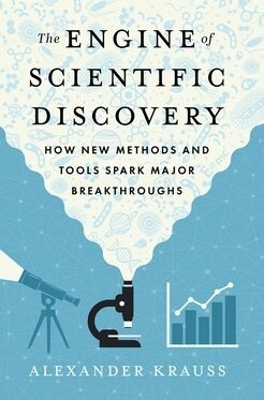
The Engine of Scientific Discovery
How New Methods and Tools Spark Major Breakthroughs
Seiten
2026
Oxford University Press Inc (Verlag)
978-0-19-782979-0 (ISBN)
Oxford University Press Inc (Verlag)
978-0-19-782979-0 (ISBN)
- Noch nicht erschienen (ca. Mai 2026)
- Versandkostenfrei
- Auch auf Rechnung
- Artikel merken
Many believe that discoveries arise by chance or serendipity. The Engine of Scientific Discovery illustrates, for the first time, how we can actively speed up the pace of new breakthroughs by developing better methods and tools of discovery.
How do we spark new scientific discoveries? How can we accelerate new breakthroughs in science? These are some of the biggest unsolved questions in science.
Many believe that discoveries arise by chance or serendipity. The Engine of Scientific Discovery illustrates, for the first time, how we can actively speed up the pace of new breakthroughs by developing better methods and tools of discovery which enable us to see and think in entirely new ways. New tools are the lenses through which we discover what we often did not even know existed: improved microscopes uncovered microorganisms and viruses, x-ray methods exposed the structure of DNA, particle accelerators detected subatomic particles, and advanced telescopes revealed galaxies.
This book explores science's biggest discoveries--spanning all Nobel Prize discoveries and over 200 other major discoveries. The findings are striking: science's over 750 major discoveries have been triggered by first developing a new method or instrument that made the breakthrough possible. In fact, most discoveries are now uncovered within just a few years after designing the needed tool. This pattern reveals how our transformative new tools are The Engine of Scientific Discovery--a fundamental principle of scientific progress overlooked until now.
By shifting our attention to inventing new tools as the key to advancing new breakthroughs, we can spark a methodological revolution in science. Instead of waiting for breakthroughs, we can actively design and build new tools of discoveries. What if the next great breakthroughs depend not just on asking better questions, but developing better tools to ask and answer them--on entirely new ways of discovering? A new theory of discovery emerges, offering a roadmap for accelerating progress across science.
How do we spark new scientific discoveries? How can we accelerate new breakthroughs in science? These are some of the biggest unsolved questions in science.
Many believe that discoveries arise by chance or serendipity. The Engine of Scientific Discovery illustrates, for the first time, how we can actively speed up the pace of new breakthroughs by developing better methods and tools of discovery which enable us to see and think in entirely new ways. New tools are the lenses through which we discover what we often did not even know existed: improved microscopes uncovered microorganisms and viruses, x-ray methods exposed the structure of DNA, particle accelerators detected subatomic particles, and advanced telescopes revealed galaxies.
This book explores science's biggest discoveries--spanning all Nobel Prize discoveries and over 200 other major discoveries. The findings are striking: science's over 750 major discoveries have been triggered by first developing a new method or instrument that made the breakthrough possible. In fact, most discoveries are now uncovered within just a few years after designing the needed tool. This pattern reveals how our transformative new tools are The Engine of Scientific Discovery--a fundamental principle of scientific progress overlooked until now.
By shifting our attention to inventing new tools as the key to advancing new breakthroughs, we can spark a methodological revolution in science. Instead of waiting for breakthroughs, we can actively design and build new tools of discoveries. What if the next great breakthroughs depend not just on asking better questions, but developing better tools to ask and answer them--on entirely new ways of discovering? A new theory of discovery emerges, offering a roadmap for accelerating progress across science.
Alexander Krauss is a Research Associate at the London School of Economics and Affiliated Professor at the Barcelona School of Economics and Spanish National Research Council. After his PhD, he worked with governments and the World Bank for five years, before teaching at University College London. He is the author of Science of Science (OUP 2024). His research interests span the science of science, metascience, innovation, and the economics of science.
| Erscheint lt. Verlag | 2.5.2026 |
|---|---|
| Verlagsort | New York |
| Sprache | englisch |
| Maße | 156 x 235 mm |
| Themenwelt | Geschichte ► Teilgebiete der Geschichte ► Technikgeschichte |
| Naturwissenschaften ► Physik / Astronomie | |
| ISBN-10 | 0-19-782979-1 / 0197829791 |
| ISBN-13 | 978-0-19-782979-0 / 9780197829790 |
| Zustand | Neuware |
| Informationen gemäß Produktsicherheitsverordnung (GPSR) | |
| Haben Sie eine Frage zum Produkt? |
Mehr entdecken
aus dem Bereich



aus dem Bereich
eine Geschichte der Fehlbarkeit von Mensch und Technologie
Buch | Hardcover (2025)
C.H.Beck (Verlag)
CHF 44,75
Buch | Softcover (2024)
Lehmanns Media (Verlag)
CHF 27,90
von Gutenberg bis zum Smartphone
Buch | Hardcover (2025)
Klett-Cotta (Verlag)
CHF 33,55


