


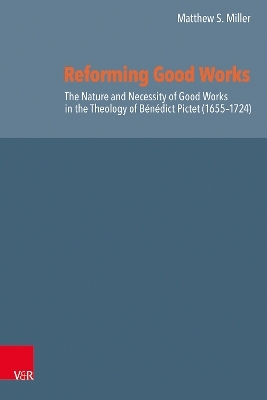
Reforming Good Works in Geneva
Bénédict Pictet’s Doctrine of Good Works and His Place in Late Reformed Orthodoxy
2026
|
1. Edition
Vandenhoeck & Ruprecht (Verlag)
9783525502563 (ISBN)
Vandenhoeck & Ruprecht (Verlag)
9783525502563 (ISBN)
- Noch nicht erschienen (ca. Mai 2026)
- Versandkostenfrei
- Auch auf Rechnung
- Artikel merken
A sweeping reinterpretation of Pictet’s theology
In this groundbreaking study, Miller shows how Bénédict Pictet – the heir to Francis Turretin’s chair of theology in Geneva, who ministered in the twilight years of Geneva’s Reformation – sought to press the necessity of good works to its limit without compromising the Reformed doctrine of justification. Miller explores the historical and intellectual roots of this aim by tracing the development of the doctrine of good works in Pictet’s major Genevan predecessors (Calvin, Beza, Diodati, Turretin), considering the rapid social and theological changes occurring in Geneva at the turn of the eighteenth century, and examining evidence for the influence of the Dutch “Further Reformation” on Pictet’s overall theological program. Along the way, Miller identifies and corrects a significant scholarly misreading of Pictet’s corpus – in particular, a misidentification of which was Pictet’s “major theological text”. The result is a sweeping reinterpretation of Pictet’s theology and its place within the early modern Reformed tradition.
In this groundbreaking study, Miller shows how Bénédict Pictet – the heir to Francis Turretin’s chair of theology in Geneva, who ministered in the twilight years of Geneva’s Reformation – sought to press the necessity of good works to its limit without compromising the Reformed doctrine of justification. Miller explores the historical and intellectual roots of this aim by tracing the development of the doctrine of good works in Pictet’s major Genevan predecessors (Calvin, Beza, Diodati, Turretin), considering the rapid social and theological changes occurring in Geneva at the turn of the eighteenth century, and examining evidence for the influence of the Dutch “Further Reformation” on Pictet’s overall theological program. Along the way, Miller identifies and corrects a significant scholarly misreading of Pictet’s corpus – in particular, a misidentification of which was Pictet’s “major theological text”. The result is a sweeping reinterpretation of Pictet’s theology and its place within the early modern Reformed tradition.
Matthew Scott Miller (PhD, University of Bristol) is a Senior Fellow for Applied Theology with the C.S. Lewis Institute in Washington D.C. and an ordained Presbyterian minister with the Associate Reformed Presbyterian Church. He is also the translator of the works of French Reformed theologian, Pierre Courthial (1914–2009).
Herman J. Selderhuis ist Professor für Kirchengeschichte an der Theologischen Universität Apeldoorn, Direktor von Refo500, Wissenschaftlicher Kurator der Johannes a Lasco Bibliothek sowie Präsident des Internationalen Calvinkongresses.
| Erscheint lt. Verlag | 11.5.2026 |
|---|---|
| Reihe/Serie | Reformed Historical Theology ; Volume 085, Part |
| Mitarbeit |
Herausgeber (Serie): Herman J. Selderhuis |
| Verlagsort | Göttingen |
| Sprache | englisch |
| Themenwelt | Geisteswissenschaften ► Religion / Theologie ► Christentum |
| Schlagworte | Dutch Further Reformation • Enlightened Orthodoxy • Genevan Theology • Reformed Orthodoxy • Systematische Theologie |
| ISBN-13 | 9783525502563 / 9783525502563 |
| Zustand | Neuware |
| Informationen gemäß Produktsicherheitsverordnung (GPSR) | |
| Haben Sie eine Frage zum Produkt? |
Mehr entdecken
aus dem Bereich


aus dem Bereich


