


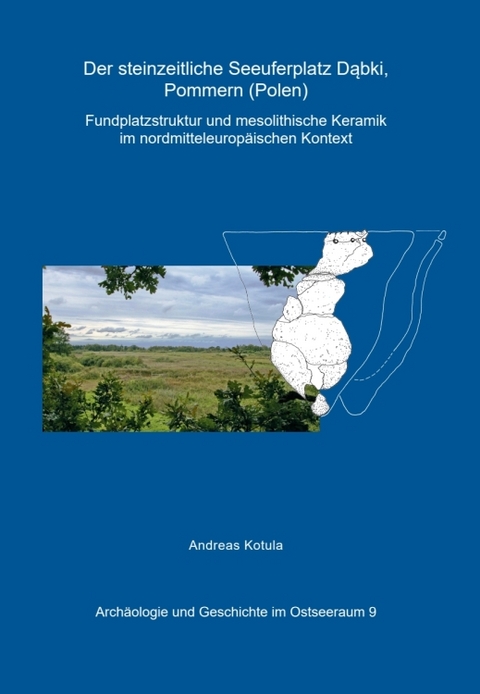
Der steinzeitliche Seeuferplatz Dąbki, Pommern (Polen)
Fundplatzstruktur und mesolithische Keramik im nordmitteleuropäischen Kontext
Seiten
2025
|
1., Aufl.
VML Vlg Marie Leidorf (Verlag)
978-3-89646-469-9 (ISBN)
VML Vlg Marie Leidorf (Verlag)
978-3-89646-469-9 (ISBN)
Anknüpfend an AGO 8 werden hier die Jäger-Sammler-Keramik von Dąbki 9 und ihre Parallelen untersucht. Der Fundplatz besitzt Feuchtbodenerhaltung [z. B. Einbaum, Paddel] und mindestens 10 Feuerstellen mit Keramik, Speiseresten, Tierknochen [v.a. Biber] und Silices. Er liegt am Ufer eines ehemaligen, heute vermoorten Sees unweit der polnischen Ostseeküste, etwa mittig zwischen Stettin und Danzig. Dąbki ist von großer Wichtigkeit für die Frage der Neolithisierung und des Aufkommens von Keramik im Westbaltikum. Die Funde vor Ort bestehen aus mind. 52 Stück mineralisch gemagerter Spitzbodenware, mind. 29 ovalen Schalen [Lampen], nachfolgender Trichterbecherkeramik sowie größeren Mengen neolithischer Fremdkeramik. Spitzbodenware kam ab 5000 v.Chr. im Westen in der Swifterbant-Kultur vor, Importe von Linearbandkeramik gab es im frühen 5. Jahrtausend. Die Produktion lokaler Dąbki-Keramik begann frühestens um 4850/4700. Ertebølle-Keramik setzte um 4600 ein, und Lampen hielten um 4500 aus der Narva-Kultur von Osten her Einzug. Dąbki war dabei ein eng eingebundener und innovativer Teil innerhalb der gut vernetzten Küstengemeinschaften.
Following up AGO 8, this volume examines the hunter-gatherer pottery from Dąbki 9 and its parallels. The site features water-logged conditions [e. g. a preserved dugout canoe and paddle] and at least 10 hearths with pottery, food crusts, animal bones [especially beaver] and flint tools. It is located on the shore of a former lake, now a marsh, not far from the Polish Baltic coast, roughly halfway between Szczecin and Gdańsk. Dąbki is of great importance for the question of Neolithisation and the emergence of pottery in the Western Baltic region. The finds from the site consist of at least 52 pieces of mineral-tempered pointed-bottom wares, at least 29 oval bowls [lamps], subsequent funnel-beaker pottery and larger amounts of foreign Neolithic pottery. Pointed-bottom vessels appeared in the west in the Swifterbant Culture from 5000 B.C. onwards, imports of Linear Pottery occurred in the early 5th millennium B.C.. The production of local Dąbki pottery began around 4850/4700 B.C. at the earliest. Ertebølle pottery appeared around 4600 B.C., and lamps from the Narva Culture in the east arrived c. 4500 B.C.. Dąbki was a closely integrated and innovative part of the well-connected coastal communities. Following up AGO 8, this volume examines the hunter-gatherer pottery from Dąbki 9 and its parallels. The site features water-logged conditions [e. g. a preserved dugout canoe and paddle] and at least 10 hearths with pottery, food crusts, animal bones [especially beaver] and flint tools. It is located on the shore of a former lake, now a marsh, not far from the Polish Baltic coast, roughly halfway between Szczecin and Gdańsk. Dąbki is of great importance for the question of Neolithisation and the emergence of pottery in the Western Baltic region. The finds from the site consist of at least 52 pieces of mineral-tempered pointed-bottom wares, at least 29 oval bowls [lamps], subsequent funnel-beaker pottery and larger amounts of foreign Neolithic pottery. Pointed-bottom vessels appeared in the west in the Swifterbant Culture from 5000 B.C. onwards, imports of Linear Pottery occurred in the early 5th millennium B.C.. The production of local Dąbki pottery began around 4850/4700 B.C. at the earliest. Ertebølle pottery appeared around 4600 B.C., and lamps from the Narva Culture in the east arrived c. 4500 B.C.. Dąbki was a closely integrated and innovative part of the well-connected coastal communities.
Following up AGO 8, this volume examines the hunter-gatherer pottery from Dąbki 9 and its parallels. The site features water-logged conditions [e. g. a preserved dugout canoe and paddle] and at least 10 hearths with pottery, food crusts, animal bones [especially beaver] and flint tools. It is located on the shore of a former lake, now a marsh, not far from the Polish Baltic coast, roughly halfway between Szczecin and Gdańsk. Dąbki is of great importance for the question of Neolithisation and the emergence of pottery in the Western Baltic region. The finds from the site consist of at least 52 pieces of mineral-tempered pointed-bottom wares, at least 29 oval bowls [lamps], subsequent funnel-beaker pottery and larger amounts of foreign Neolithic pottery. Pointed-bottom vessels appeared in the west in the Swifterbant Culture from 5000 B.C. onwards, imports of Linear Pottery occurred in the early 5th millennium B.C.. The production of local Dąbki pottery began around 4850/4700 B.C. at the earliest. Ertebølle pottery appeared around 4600 B.C., and lamps from the Narva Culture in the east arrived c. 4500 B.C.. Dąbki was a closely integrated and innovative part of the well-connected coastal communities. Following up AGO 8, this volume examines the hunter-gatherer pottery from Dąbki 9 and its parallels. The site features water-logged conditions [e. g. a preserved dugout canoe and paddle] and at least 10 hearths with pottery, food crusts, animal bones [especially beaver] and flint tools. It is located on the shore of a former lake, now a marsh, not far from the Polish Baltic coast, roughly halfway between Szczecin and Gdańsk. Dąbki is of great importance for the question of Neolithisation and the emergence of pottery in the Western Baltic region. The finds from the site consist of at least 52 pieces of mineral-tempered pointed-bottom wares, at least 29 oval bowls [lamps], subsequent funnel-beaker pottery and larger amounts of foreign Neolithic pottery. Pointed-bottom vessels appeared in the west in the Swifterbant Culture from 5000 B.C. onwards, imports of Linear Pottery occurred in the early 5th millennium B.C.. The production of local Dąbki pottery began around 4850/4700 B.C. at the earliest. Ertebølle pottery appeared around 4600 B.C., and lamps from the Narva Culture in the east arrived c. 4500 B.C.. Dąbki was a closely integrated and innovative part of the well-connected coastal communities.
| Erscheinungsdatum | 06.11.2025 |
|---|---|
| Reihe/Serie | Archäologie und Geschichte im Ostseeraum ; 9 |
| Verlagsort | Rahden/Westf. |
| Sprache | deutsch |
| Maße | 210 x 297 mm |
| Gewicht | 14901490 g |
| Themenwelt | Geisteswissenschaften ► Archäologie |
| Geschichte ► Allgemeine Geschichte ► Vor- und Frühgeschichte | |
| Schlagworte | Seeufersiedlung • Siedlungsarchäologie • Tierknochen |
| ISBN-10 | 3-89646-469-8 / 3896464698 |
| ISBN-13 | 978-3-89646-469-9 / 9783896464699 |
| Zustand | Neuware |
| Informationen gemäß Produktsicherheitsverordnung (GPSR) | |
| Haben Sie eine Frage zum Produkt? |
Mehr entdecken
aus dem Bereich


aus dem Bereich
auf den Spuren der frühen Zivilisationen
Buch | Hardcover (2023)
C.H.Beck (Verlag)
CHF 27,95
Konzepte – Methoden – Theorien
Buch | Softcover (2024)
UTB (Verlag)
CHF 55,85


