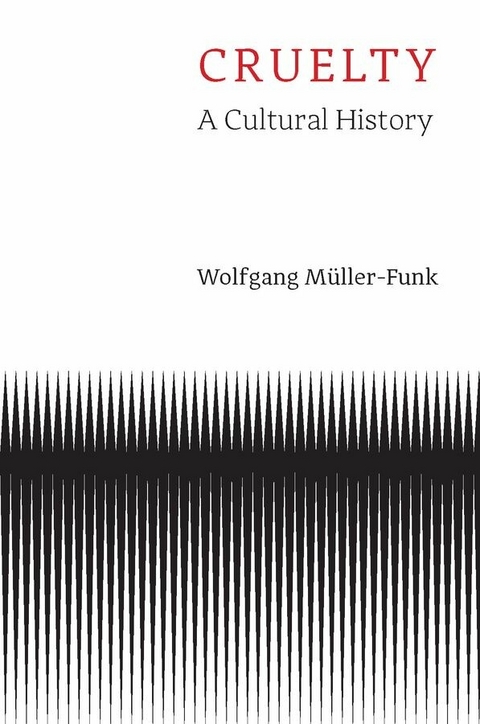
Cruelty (eBook)
375 Seiten
Polity (Verlag)
978-1-5095-6396-8 (ISBN)
In a humane world, cruelty should not exist, and yet it has been a feature of our societies since time immemorial. From individual acts of cruelty to systematic torture and mass murder, cruelty has been humanity's constant companion, attesting to a darker side of human nature. Cruelty involves the use of violence but it is more than this, since it is organized and calculated; its intention is to inflict pain and suffering on others, even to destroy the other. Cruelty is perhaps the ultimate form of violence in which the extermination of the other is staged as a threat in order to make others compliant or instil in them the fear of death.
In this wide-ranging cultural history, Wolfgang Müller-Funk examines the ways in which different thinkers and authors - from Herodotus to Nietzsche, from Seneca to Musil and Koestler - have conceptualized and tried to make sense of a phenomenon we would prefer to ignore. He seeks to unveil the conditions under which an economy of cruelty emerges, in which violence is calculated and becomes a quasi-natural matter of course. The economy of cruelty involves the efficient use of means to pursue irrational goals. It also involves discourses and narrative patterns that legitimize organized violence and neutralize emotions, such as empathy and compassion, that would restrain or obstruct the pursuit of cruelty.
This disturbing inquiry into the nature of cruelty and its role in human culture will be of interest to students and scholars throughout the humanities and to a wide general readership.
Wolfgang Müller-Funk is Professor of Cultural Studies at the University of Vienna.
2
The Economy of Cruelty (Robert Musil)
The Subjective Dimension of Cruelty (Stendhal)
Robert Musil’s novel The Confusions of Young Törless offers a particularly vivid example of the discursive history of cruelty. However, approaching this early masterpiece requires taking a detour via a number of authors who preceded Musil. The starting point is Stendhal’s novel The Red and the Black, set during the period of restoration between 1815 and 1830. In a scene in a salon, the hero of the story, the social parvenu Julien, quarrels with the Italian Count Altamira about the French revolutionary Georges Danton. However, the real subjects of the conversation are self-assertion, the pride of the male sex, social status and, not least, cruelty. This context makes sense for the reader, since Julien wants to see Mathilde, a girl from a well-to-do family who has clearly fallen in love with him, suffer. He therefore resolutely ignores all her advances. He knows that the rejection pains her, and he too is pained by having to suppress his own desire. The woman’s seemingly hopeless infatuation marks a shift in the socially unequal relationship: ‘He did not deign to look up at Mathilde. She, with her big eyes extraordinarily wide open and fixed upon him, looked like his slave.’1 The act of dissimulation in this case applies to a social inferior who ultimately needs this woman for his social advancement.
This description makes it clear that a certain cruel impulse can even play a part in seemingly innocent situations, and cannot necessarily be judged by its concrete consequences, which in turn makes the phenomenon of targeted violence far more ubiquitous than it would initially appear. Staged and apportioned acts of violence by dictators are only the tip of the iceberg of a powerful human impulse. The pinprick that Mathilde receives from Julien remains invisible and goes almost unnoticed. But this makes it all the more suitable for studying the anatomy of a cruelty whose aim is to evoke an unequal power situation.
In Hegel’s Phenomenology of Spirit, the opposition of mastery and slavery is presented as a battle for self-consciousness between two originally equivalent consciousnesses. To achieve the former requires recognition by an Other, though admittedly this recognition is doubly unequal and crooked in the end: the one who has become a slave is denied the status of an equal self-consciousness, while the victor, in a surprising reversal, becomes dependent on the work of the slave and their accompanying material relation to the world.2
The situation in Stendhal is fundamentally different from that in Hegel. The novel deals with the inversion of an asymmetry, but in Hegel this is the result of a battle between two self-consciousnesses. The defeated Other is henceforth compelled to acknowledge his subalternity, and hence the Other’s superiority. The fact that he evens out this imbalance – the master proves to be dependent on the slave’s work – is an inversion that is also significant in Stendhal’s novel.
In The Red and the Black, Julien initially enjoys a splendid confidence that a socially superior woman is hopelessly in love with him; he lets her dangle like a fish. That is why he delays the reciprocation of this silent declaration of love, which defines the social and political trajectory of the story – after all, the furtive Bonapartist wants to become a member of the ruling class. Out of pure calculation, he does not return her feelings; he certainly could if he wanted to, and doing so would make sense emotionally, but the rejection reaffirms and restores his previously injured narcissism.
The scene in the salon demonstrates vividly how closely connected cruelty and recognition are. Social inferiority is experienced as a lack of recognition, which evokes the desire for male satisfaction. The aim of the pinprick against the woman is disdain, an injury caused by not recognizing her existence, since the man is pretending not to notice her, as if she were not even there.3
In the conversation scene, Altamira, the aristocrat who has been sentenced to death in his native country, laments that nowadays there are no longer any genuinely cruel people, the type who relish their aggressive impulses like gourmets: ‘There are no genuine passions left in the nineteenth century: that’s why people are so bored in France. They commit acts of the utmost cruelty, but without any cruelty at all.’4 In this artful dialogue scene, in which the young Mathilde is a mere listener, Julien agrees with Altamira and even goes a step further than him with the following words: ‘when you commit crimes, you should at least do it with enjoyment: that’s the only good thing about them, and the only slight justification there is for them’.5 On the one hand, then, the young man, coolly calculating his social advancement and using Mathilde to that end, formulates the programme of a cruelty that is modern in its cynical tone and underlying lust for power. It is only authenticated by the sensation of pleasure, and therefore includes the experience of the ‘real’. On the other hand, this view is itself romantic, for it dismisses rational calculation in a cruel act – which Julien himself performs in the scene vis-à-vis Mathilde – and only permits that cruel act in so far as it arises from a subjective, thoroughly individual, useless and ‘authentic’ desire.
With reference to Stendhal, Henning Ritter speaks of a ‘cult of passion’ and a ‘flight from the time in which he was condemned to live, and against whose passionlessness he protested’. Ritter interprets this stance he attributes to Stendhal as a protest against the businesslike spirit of capitalism, which ‘even when committing the cruellest acts […] does not want to get its hands dirty’.6 Ritter thus indirectly addresses the collectively committed cruel act that would culminate in the Shoah, the industrially implemented extermination of European Jews. The question remains of whether these two forms of cruelty – on the one hand passionless and coolly calculated, on the other affectively charged – are not two dark sides of modern occidental culture that have repeatedly intersected in certain historical situations. Hidden and suppressed affects certainly played a part for the thinkers of the so-called Conservative Revolution, who mostly argued for cold calculation (see Chapter 3). This process is described metaphorically in Wilhelm Hauff’s fairy tale about a stone heart. By analogy with the diabolical pact in Goethe’s Faust, in which a man sells his soul, Hauff describes a symbolic heart transplant. The Mephistopheles of this story, ‘Dutch Michael’, advertises the transplant to the unsuspecting Peter with the following words:
‘You see,’ said Dutch Michael, ‘all these have cast aside life’s woes and worries; not one of these hearts now beats careworn with anxiety, and the former owners are glad to be rid of the restless guest.’
‘But what do they now have in their breast instead?’ asked Peter, who felt faint from all he had seen.
‘This,’ replied Michael. He reached into a drawer and took out – a stone heart.7
What is presented here, in an uncanny literary setting, as a symbolic exchange and heart transplant, can be described as a cultural training programme the purpose of which is to practise distance, hardness and insensitivity. Various authors, such as Emilio Lussu (One Year on the High Plateau, 1938) in a critical manner, or Carlo Emilio Gadda (Diary of War and Imprisonment, 1955) and Ernst Jünger (Storm of Steel, 1920) affirmatively, circle around the idea of coldness that can be grasped in Hauff’s metaphor. What all of these texts have in common is that the contempt for death and pain becomes heroically charged; many such authors would appear later among the followers of the movement that carried out the extermination of the Jews without batting an eyelid.
According to Károly (Karl) Mannheim, the crystallization point at which cool calculation and hot passion come together is a hallmark of ideologies. These distinguish themselves by the fact that they are similar to yet different from utopias, which strive for a future state of being that transcends ordinary being in a certain sense. Utopias generate a surplus. It is this transgression which brings into play that cold passion on which ideology feeds.8
This pleasurable cruelty tends to exclude traditional revenge, which stems less from the idea of spontaneous aggression than from a pre-capitalist, paternalistically regulated exchange economy: the murder seemingly pays the debt incurred through the preceding murder.9 Taking revenge becomes a pedantic duty that preserves or restores the symbolic law of the father. What is initially amazing about the exchange in Stendhal’s novel is that for both Julien and his aristocratic interlocutor there is an alliance between subjective and objective cruelty, meaning that the cruel act would somehow be decadent if it lacked any subjective enjoyment. By contrast, one can show that the ‘cult of passion’ in which affects are ennobled as ‘authentic’ is a more recent historical phenomenon. The two conversational partners in Stendhal’s novel require...
| Erscheint lt. Verlag | 3.11.2025 |
|---|---|
| Übersetzer | Wieland Hoban |
| Sprache | englisch |
| Themenwelt | Geisteswissenschaften ► Geschichte ► Allgemeines / Lexika |
| Schlagworte | abuse of power • crudelitas • cruelty • cruelty after Freud • cruelty as part of human nature • cultural history of cruelty • despots • discourse and narrative patterns of cruelty • discursive history of cruelty • economy of cruelty • Elias Canetti • emotional abuse • have people always been cruel? • history of emotions • inflicting pain • intentional unkindness • Jean Amery • Marquis de Sade • Mass murder • Nazi torture • Nietzsche • Psychoanalysis • Rationality • Robert Musil • rulers and leadership • Sadism • sexuality and calculated cruelty • systematic torture • Torture • tyrants • unhappiness • what is cruelty? • why are people cruel? • why are people cruel to others? • will we ever eliminate cruelty from human society |
| ISBN-10 | 1-5095-6396-2 / 1509563962 |
| ISBN-13 | 978-1-5095-6396-8 / 9781509563968 |
| Informationen gemäß Produktsicherheitsverordnung (GPSR) | |
| Haben Sie eine Frage zum Produkt? |
 EPUB (Adobe DRM)
Kopierschutz: Adobe-DRM
Adobe-DRM ist ein Kopierschutz, der das eBook vor Mißbrauch schützen soll. Dabei wird das eBook bereits beim Download auf Ihre persönliche Adobe-ID autorisiert. Lesen können Sie das eBook dann nur auf den Geräten, welche ebenfalls auf Ihre Adobe-ID registriert sind.
Details zum Adobe-DRM
Dateiformat: EPUB (Electronic Publication)
EPUB ist ein offener Standard für eBooks und eignet sich besonders zur Darstellung von Belletristik und Sachbüchern. Der Fließtext wird dynamisch an die Display- und Schriftgröße angepasst. Auch für mobile Lesegeräte ist EPUB daher gut geeignet.
Systemvoraussetzungen:
PC/Mac: Mit einem PC oder Mac können Sie dieses eBook lesen. Sie benötigen eine
eReader: Dieses eBook kann mit (fast) allen eBook-Readern gelesen werden. Mit dem amazon-Kindle ist es aber nicht kompatibel.
Smartphone/Tablet: Egal ob Apple oder Android, dieses eBook können Sie lesen. Sie benötigen eine
Geräteliste und zusätzliche Hinweise
Buying eBooks from abroad
For tax law reasons we can sell eBooks just within Germany and Switzerland. Regrettably we cannot fulfill eBook-orders from other countries.
aus dem Bereich