Zum Hauptinhalt springen
Nicht aus der Schweiz? Besuchen Sie lehmanns.de

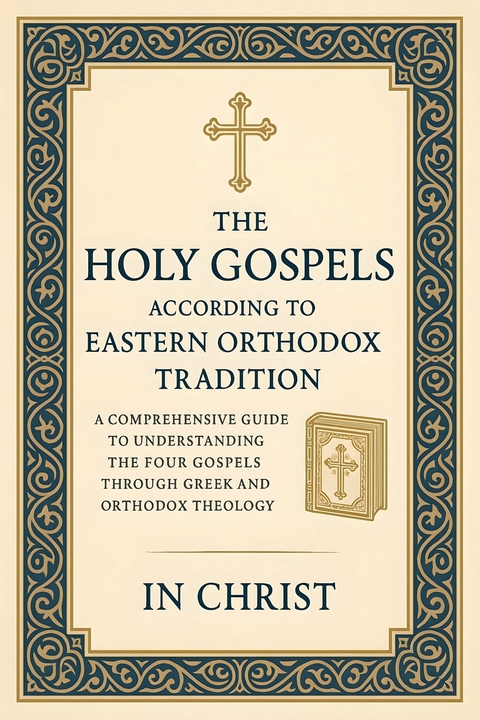
The Holy Gospels According to Eastern Orthodox Tradition (eBook)

A Comprehensive Guide to Understanding the Four Gospels through Greek and Orthodox Theology

(Autor)

eBook Download: EPUB
2025
114 Seiten
Publishdrive (Verlag)
979-8-90148-160-8 (ISBN)
Lese- und Medienproben

The Holy Gospels According to  Eastern Orthodox Tradition - In Christ
Systemvoraussetzungen
8,49 inkl. MwSt
(CHF 8,25)
Der eBook-Verkauf erfolgt durch die Lehmanns Media GmbH (Berlin) zum Preis in Euro inkl. MwSt.
  • Download sofort lieferbar
  • Zahlungsarten anzeigen

Discover the Profound Depths of the Holy Gospels Through Ancient Orthodox Wisdom


Unlock the transformative power of the four Gospels as understood by Eastern Orthodox Christianity for nearly two millennia.


'The Holy Gospels According to Eastern Orthodox Tradition' offers readers an unprecedented journey into the heart of Orthodox biblical interpretation, patristic theology, and spiritual practice.


Why This Book Will Transform Your Understanding:


This comprehensive guide bridges ancient wisdom with contemporary spiritual hunger, providing both scholarly depth and practical application. Whether you're a theology student, Orthodox Christian seeking deeper faith, or spiritual seeker exploring traditional Christianity, this book offers invaluable insights into Gospel interpretation through the lens of Greek Orthodox tradition.


What You'll Discover Inside:


Foundational Orthodox Theology - Master the essential principles of Eastern Orthodox Christianity, including the nature of Holy Tradition, biblical interpretation methods, and Trinitarian doctrine that shapes Gospel understanding


Complete Gospel Analysis - Explore each of the four Gospels (Matthew, Mark, Luke, John) through Orthodox patristic commentaries, liturgical context, and theological interpretation


Central Orthodox Themes - Dive deep into the Incarnation, theosis (deification), the role of the Theotokos (Mother of God), and the cosmic significance of Christ's Passion, Death, and Resurrection


Sacramental Life - Understand how the Gospels reveal and establish the seven Orthodox sacraments, connecting biblical narrative to liturgical practice


Liturgical Context - Experience how Orthodox worship brings the Gospels to life through iconography, hymnography, and the liturgical calendar


Practical Spirituality - Access authentic Orthodox prayers based on Gospel texts, including the Jesus Prayer, Beatitude prayers, and Marian devotions


Patristic Wisdom - Learn from the Church Fathers like John Chrysostom, Cyril of Alexandria, and other Orthodox theologians who shaped Gospel interpretation


Perfect For: 


Orthodox Christians seeking deeper scriptural understanding 


Theology students and biblical scholars 


Spiritual directors and clergy 


Anyone interested in Eastern Christianity and patristic theology 


Readers exploring traditional Christian spirituality and mysticism 


Those seeking authentic Gospel-based prayer and devotional practices


Author Expertise:


Written by 'In Christ,' this work represents centuries of Orthodox theological tradition, combining scholarly rigour with spiritual insight. The book draws from extensive patristic sources, liturgical texts, and Orthodox spiritual tradition to provide an authentic interpretation.


Transform Your Spiritual Journey:


This isn't just another Bible commentary; it's a gateway to experiencing the Gospels as living, transformative texts that continue to shape Orthodox Christian life.


Explore how ancient wisdom resonates with contemporary spiritual needs, offering hope, healing, and the promise of theosis-becoming partakers of the divine nature.


Join millions of Orthodox Christians worldwide who find in the Gospels not just historical accounts, but the very words of life that continue to transform hearts and minds.


Bonus Materials Include:


Glossary of Orthodox theological terms 


Recommended patristic commentaries 


Orthodox liturgical calendar with Gospel readings 


Traditional prayers and hymns based on Gospel texts


Chapter 2: The Nature of Holy Tradition

Understanding Holy Tradition vs. Human Traditions

The concept of Holy Tradition stands at the very heart of Orthodox Christianity and provides the essential framework for understanding how the Orthodox Church approaches the Holy Scriptures, including the four Gospels. To comprehend Orthodox biblical interpretation, one must first grasp the Orthodox understanding of Tradition—not as a collection of human customs or ecclesiastical regulations, but as the very life of the Church itself as it has been preserved and transmitted through the centuries under the guidance of the Holy Spirit.
The Orthodox Church makes a crucial distinction between Holy Tradition (with a capital "T") and human traditions (with a lowercase "t"). This distinction is not merely semantic but reflects a fundamental theological principle about the nature of divine revelation and its preservation within the Church. Holy Tradition encompasses everything that pertains to the Kingdom of God and is done by the grace of the Holy Spirit, while human traditions are temporal and temporary customs that, while potentially helpful, do not possess eternal significance.
Holy Tradition is understood as the ongoing life of God's People, beginning with the Old Testament community of Israel and finding its fulfilment in the Christian Church. The Orthodox Church teaches that this tradition is not static but living and dynamic, continuing to grow and develop as the Church lives by the inspiration of the Holy Spirit. This growth, however, is not innovation in the sense of adding new doctrines, but rather the deepening understanding and application of the apostolic faith that was "once for all delivered to the saints" (Jude 3).
The word "tradition" itself derives from the Latin traditio, which translates the Greek paradosis, meaning "that which is handed down" or "delivered." In the New Testament, the apostle Paul uses this term to describe both the Gospel message itself and the manner of its transmission. In 1 Corinthians 15:3, Paul writes, "For I delivered (paredoka) to you as of first importance what I also received (parelabon): that Christ died for our sins in accordance with the scriptures." This passage illustrates the Orthodox understanding of tradition as the faithful transmission of divine revelation from one generation to the next.
The Orthodox Church recognizes that not everything practiced within the Church belongs to Holy Tradition. Some practices are merely human customs that have developed for practical or cultural reasons. These human traditions may be beneficial and worthy of respect, but they do not possess the same authority as Holy Tradition. Examples might include specific architectural styles for churches, particular forms of ecclesiastical dress, or local customs that vary from one Orthodox community to another. The Church has the authority to modify or abandon such human traditions when circumstances warrant, but Holy Tradition remains unchangeable because it represents the divine life itself.
The criterion for distinguishing between Holy Tradition and human traditions lies in their relationship to the Kingdom of God and their inspiration by the Holy Spirit. Holy Tradition encompasses those elements of Church life that are essential for salvation and spiritual growth, that reveal divine truth, and that connect the faithful with the apostolic community. Human traditions, while potentially valuable, are not necessary for salvation and do not carry the same spiritual authority.
This understanding of tradition has profound implications for how Orthodox Christians approach change and development within the Church. While the Church may adapt its human traditions to meet changing circumstances, it cannot and will not alter Holy Tradition without ceasing to be the Church. This principle provides both stability and flexibility—stability in maintaining the essential apostolic faith, and flexibility in adapting non-essential practices to serve the spiritual needs of the faithful in different times and places.

The Relationship between Scripture and Tradition
One of the most distinctive aspects of Orthodox Christianity is its understanding of the relationship between Scripture and Tradition. Unlike Protestant Christianity, which often emphasizes sola scriptura (Scripture alone), or Roman Catholicism, which treats Scripture and Tradition as two separate sources of revelation, Orthodox Christianity views Scripture as an integral part of Holy Tradition rather than as something separate from or opposed to it.
The Orthodox Church teaches that the Bible itself is a product of Holy Tradition. The Scriptures were written within the Church, by members of the Church, for the Church, under the inspiration of the Holy Spirit working within the community of faith. The process of recognizing which books belonged to the biblical canon was itself a function of Holy Tradition, as the Church discerned which writings authentically preserved and transmitted the apostolic faith. The Bible did not create the Church; rather, the Church, guided by the Holy Spirit, recognized and preserved the biblical writings as authoritative expressions of the faith.
This understanding means that Scripture cannot be properly interpreted apart from the living Tradition of the Church. The Orthodox Church maintains that the same Holy Spirit who inspired the biblical authors continues to guide the Church in understanding and interpreting the Scriptures. This does not mean that the Church adds to Scripture or treats later developments as equal to biblical revelation, but rather that the Church provides the proper context and framework for understanding what Scripture means.
The Orthodox approach to Scripture and Tradition can be illustrated through the analogy of a river and its banks. Scripture is like the flowing water of the river—the dynamic, life-giving word of God. Tradition is like the banks of the river—the stable framework that guides and channels the flow of Scripture, ensuring that it reaches its proper destination. Without the banks, the river would become a destructive flood; without the flowing water, the banks would be merely empty channels. Scripture and Tradition work together to preserve and transmit the life-giving word of God.
This relationship has practical implications for biblical interpretation. Orthodox Christians do not approach the Bible as isolated individuals seeking to discover its meaning through private study alone. While personal reading and meditation on Scripture are encouraged and valued, the primary context for encountering Scripture is within the liturgical and communal life of the Church. The Gospels are proclaimed in the Divine Liturgy, interpreted through patristic homilies, celebrated in feast days, and lived out in the sacramental life of the Church.
The Orthodox Church also recognizes that Scripture contains different levels of meaning that require the guidance of Tradition to understand fully. Following the patristic tradition, Orthodox interpretation acknowledges literal, moral, allegorical, and anagogical (mystical) meanings within the biblical text. This multi-layered approach to interpretation requires the wisdom and experience of the Church's tradition to navigate properly. Individual readers, no matter how sincere or learned, may miss important dimensions of meaning that become apparent only within the broader context of Church tradition.
The relationship between Scripture and Tradition also explains why Orthodox Christianity places such emphasis on the writings of the Church Fathers. These patristic authors are not viewed as infallible or as adding new revelations to Scripture, but rather as faithful interpreters who help subsequent generations understand how the apostolic Church understood and applied the biblical message. Their writings serve as guides and checks against novel interpretations that might distort the authentic meaning of Scripture.

The Seven Elements of Holy Tradition
The Orthodox Church identifies seven primary elements that constitute Holy Tradition, each playing a crucial role in preserving and transmitting the apostolic faith. These elements are not separate or independent sources of revelation but rather different aspects of the single, unified tradition that flows from the apostolic community. Understanding these elements is essential for grasping how Orthodox Christians approach the Gospels and biblical interpretation more generally.

1. The Bible
The Bible holds the first and most important place among the elements of Holy Tradition. This includes both the Old Testament, which prepared the way for Christ, and the New Testament, which records the apostolic witness to Christ's life, death, and resurrection. The Gospels occupy a central position within the New Testament as the primary witnesses to the earthly ministry of Jesus Christ. The Orthodox Church uses the Septuagint (Greek translation of the Old Testament) as its standard Old Testament text, recognizing its authority and the theological insights preserved in its translation.
The Orthodox approach to the Bible emphasizes its role as the written heart of Holy Tradition. The biblical writings are not viewed as exhaustive records of everything Christ said and did (as John 21:25 acknowledges), but rather as the inspired and authoritative core around which the rest of tradition develops. The Gospels, in particular, are understood not merely as historical biographies but as theological proclamations designed to evoke faith and guide spiritual transformation.
2. The Church's Liturgical Life and...

Erscheint lt. Verlag 1.11.2025
Reihe/Serie Daily Prayers
Sprache englisch
Themenwelt Religion / Theologie Christentum Bibelausgaben / Bibelkommentare
Schlagworte Byzantine Christianity Tradition • Church Fathers Gospel Interpretation • Eastern Orthodox Christianity • Gospel Commentary Patristic • Greek Orthodox Biblical Studies • Orthodox Spiritual Life Prayer • Orthodox Theology Theosis
ISBN-13 979-8-90148-160-8 / 9798901481608
Informationen gemäß Produktsicherheitsverordnung (GPSR)
Haben Sie eine Frage zum Produkt?
EPUBEPUB (Ohne DRM)

Digital Rights Management: ohne DRM
Dieses eBook enthält kein DRM oder Kopier­schutz. Eine Weiter­gabe an Dritte ist jedoch rechtlich nicht zulässig, weil Sie beim Kauf nur die Rechte an der persön­lichen Nutzung erwerben.

Dateiformat: EPUB (Electronic Publication)
EPUB ist ein offener Standard für eBooks und eignet sich besonders zur Darstellung von Belle­tristik und Sach­büchern. Der Fließ­text wird dynamisch an die Display- und Schrift­größe ange­passt. Auch für mobile Lese­geräte ist EPUB daher gut geeignet.

Systemvoraussetzungen:
PC/Mac: Mit einem PC oder Mac können Sie dieses eBook lesen. Sie benötigen dafür die kostenlose Software Adobe Digital Editions.
eReader: Dieses eBook kann mit (fast) allen eBook-Readern gelesen werden. Mit dem amazon-Kindle ist es aber nicht kompatibel.
Smartphone/Tablet: Egal ob Apple oder Android, dieses eBook können Sie lesen. Sie benötigen dafür eine kostenlose App.
Geräteliste und zusätzliche Hinweise

Buying eBooks from abroad
For tax law reasons we can sell eBooks just within Germany and Switzerland. Regrettably we cannot fulfill eBook-orders from other countries.

Mehr entdecken
aus dem Bereich
Offenbarungen und Visionen eines biblischen Propheten im äthiopischen …

von John S. Salomon

eBook Download (2024)
tredition (Verlag)
CHF 19,50