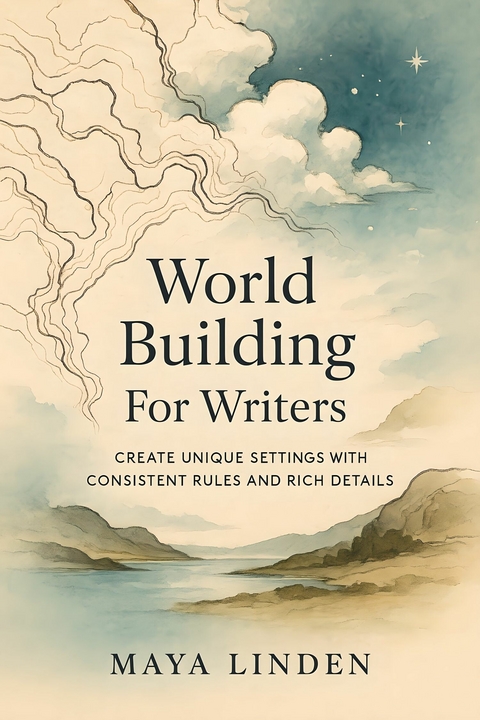
World Building For Writers (eBook)
131 Seiten
Publishdrive (Verlag)
978-0-00-109483-3 (ISBN)
Do your story worlds feel thin, inconsistent, or hard to keep straight as you draft?
Are you struggling to invent settings that feel original-without drowning readers in info-dumps?
Do you want a reliable system to design magic/tech, cultures, maps, histories, and rules that actually hold up under pressure?
If you answered YES to at least one of these questions, you MUST KEEP READING...
Unlock the Craft of Building Worlds Readers Can Live In
Too many promising stories collapse under shaky rules and cardboard settings. Maybe your power system breaks in chapter twelve. Maybe your map contradicts your plot. Maybe every city sounds the same, and your 'unique' culture feels like a reskinned cliché. It's frustrating-and it can stall a draft for months.
But don't despair-you're not alone in this...
Presenting: World Building For Writers: Create Unique Settings with Consistent Rules and Rich Details
Chapter 1 — World DNA: Invariants, Boundaries, and the Rule Audit
Before a writer sketches a map or names a single city, the deeper architecture of the world must be understood. Beneath every mountain range, under every empire, and even behind the metaphysical scaffolding of your magic or technology, lies the world’s DNA—its invariants, its dials, and its tunables. These are not aesthetic choices; they are structural constants that define what is possible, probable, and forbidden within your setting. Like the laws of physics in our own universe, they govern every act of creation, every transgression, and every hope your characters pursue. Without them, your world collapses into a stage prop—fragile, arbitrary, and inert. With them, it breathes with an inner logic that readers can feel even when they can’t articulate it.
1.1 Invariants, Dials, and Tunables
To design a coherent world, you must first separate your creative decisions into three categories—invariants, dials, and tunables. Each plays a specific role in maintaining balance and believability. The distinction among them might seem theoretical, but once you start applying it to your story’s mechanics, you’ll see how it liberates imagination rather than limiting it. Most failed world-building stems from confusing one for another—treating an invariant as flexible, or a dial as absolute, until the world’s internal physics crumble under contradiction.
Invariants are the non-negotiables, the deep laws of your fictional universe. They define what reality itself permits. These rules must never be broken, not even by accident, or you risk rupturing the trust between your story and its reader. “No faster-than-light travel” is an invariant in a hard science fiction novel; “magic costs lifespan” is one in a grimdark fantasy. Such principles are not decorative—they impose moral and physical shape. They are the bones beneath the skin of your story.
When you define an invariant, you are defining a moral universe. For example, if you decide that magic always extracts a physical price, every spell becomes an ethical decision. Healing a child may shorten the healer’s own life; resurrecting a loved one could destroy a kingdom’s balance. Readers may not consciously track this rule, but they will feel the gravity of consequence behind every act. Likewise, if you declare that faster-than-light travel is impossible, exploration becomes an act of endurance rather than convenience. Empires shrink; isolation defines psychology. Characters must grapple with distance not as a plot obstacle but as a spiritual condition.
Choosing invariants is therefore a declaration of values. You’re saying: “This is what this world believes in. This is what cannot be undone.” Even in stories with gods, the gods themselves obey invariants. They may manipulate them, interpret them, or punish mortals who challenge them, but the rules themselves remain firm. Every convincing fictional world has these hidden constants. Tolkien’s Middle-earth has mortality as its central invariant—death is unchangeable, and even divine beings are bound by it. In Dune, ecology is the invariant—every social, religious, and political structure exists because of planetary scarcity. Whether your world’s bedrock is thermodynamics or karma, define it clearly and early.
Once your invariants are set, you can move to dials—the adjustable ranges within those fixed laws. Dials are what give your world its variability, tone, and sense of living change. They are the parameters that can shift, sometimes wildly, without breaking the system. Gravity might fluctuate by ten percent from region to region; literacy rates might vary from five to ninety percent; political stability could swing with each decade. Dials allow you to model inequality, transformation, and decay. They are the levers by which you evolve history.
A dial is not random; it is meaningful variation within a lawful frame. By specifying your dials, you decide where tension accumulates. A world with variable magic density, for example, creates zones of privilege and desperation. Some regions become cultural capitals of enchantment; others turn to industry or faith to compensate. A slight alteration in oxygen levels could explain the development of giant fauna in one hemisphere and delicate, short-lived species in another. Dial shifts invite adaptation—and adaptation breeds story.
Writers often overlook the narrative power of dials because they seem technical, but they are the key to dynamism. Consider literacy: in a world where only five percent of the population can read, knowledge itself becomes currency. Control of writing means control of memory, history, and truth. A rebellion led by a printer becomes not just political but existential—a fight over who has the right to remember. Raise literacy to ninety percent, and the same world becomes one of ideological chaos, where propaganda replaces ignorance and every citizen becomes an editor of reality. The rule is the same; the dial changes the story’s temperature.
The third layer, tunables, operates closer to the narrative surface. These are world parameters tied directly to plot beats—settings that can be adjusted mid-story to heighten drama or reveal consequence. Tunables can shift because of character action, natural disaster, or divine intervention, but always in accordance with your established invariants and dials. Think of them as responsive systems. If the invariant says “magic costs lifespan,” a tunable might define how much life each spell drains, and that value could increase as corruption spreads or as magical pollution builds. If your world forbids faster-than-light travel, a tunable could determine how close an experimental engine comes before catastrophic failure.
Tunables are where plot and physics intersect. They’re the knobs that the story itself turns. A drought lasting three months might, through political neglect or mystical imbalance, stretch into six—pushing your society into famine and war. A social taboo might begin to weaken as generations change, creating a slow revolution of manners. Each adjustment reconfigures relationships and institutions without discarding the rules that make the world coherent.
Every time you define or alter a tunable, you must ask: who benefits, who suffers, and what new conflicts emerge? A rule without consequence is not a rule—it’s trivia. Narrative power resides in friction. If magic suddenly becomes cheaper, who loses status? If gravity lessens by ten percent, how do architecture, warfare, and even romance adapt? People fall differently in both senses of the word. These are not thought experiments for their own sake; they are invitations to dramatize systemic change.
To ensure your design choices generate real texture, record the implications of every rule in your World Bible. For each change, list one economic, one social, and one sensory consequence. This triple lens keeps your imagination balanced. Economic consequences show how resources flow: who controls production, who is excluded, who taxes whom. Social consequences expose hierarchy: which groups rise or fall, what customs form around scarcity, what stories the culture tells to justify inequality. Sensory consequences root everything in physical experience: what does the air smell like in a world where iron corrodes instantly? How does food taste in a land of permanent twilight? What sound does currency make if it’s made of glass instead of metal?
These sensory anchors transform abstract design into lived reality. They remind you that every law—no matter how conceptual—should touch the body. Readers trust worlds they can feel. When your protagonist walks through a city where gravity shifts by region, they shouldn’t need exposition; their posture, their fatigue, and the way dust hangs in the air should reveal the rule. The more your system manifests through sensation, the less you need to explain.
Let’s illustrate this process. Imagine you’re building a post-apocalyptic archipelago where islands drift on magnetic currents. Your invariant: no permanent landmasses—everything moves. Your dials: magnetic strength and current speed vary with the seasons. Your tunables: communication range between islands and the reliability of navigational stones. Immediately, narrative stakes emerge. Trade depends on timing; marriages are political as much as geographic; a single storm could rearrange the known world. Now you add consequences. Economically, wealth concentrates among those who can predict drift patterns. Socially, cultures evolve nomadic rituals and myths about eternal separation. Sensory-wise, the air hums faintly with magnetic tension, compasses twitch, and the smell of ozone marks danger. Without writing a single plot, you’ve created a world already pregnant with stories.
The discipline of classifying rules in this way does not limit your creativity—it clarifies it. Writers often drown in their own lore because they accumulate details without hierarchy. When everything matters equally, nothing matters at all. But once you define your world’s DNA—what can never change, what can flex, and what can respond to story—you acquire both structure and freedom. You can improvise confidently, knowing which boundaries you must respect and which you can bend.
Remember: the reader doesn’t care how many pages of notes you’ve written; they care whether your world holds together under pressure. The test of a well-designed setting isn’t its complexity—it’s its integrity. When a single decision about resource scarcity or cultural taboo ripples naturally into economic,...
| Erscheint lt. Verlag | 31.10.2025 |
|---|---|
| Sprache | englisch |
| Themenwelt | Geisteswissenschaften ► Sprach- / Literaturwissenschaft |
| ISBN-10 | 0-00-109483-1 / 0001094831 |
| ISBN-13 | 978-0-00-109483-3 / 9780001094833 |
| Informationen gemäß Produktsicherheitsverordnung (GPSR) | |
| Haben Sie eine Frage zum Produkt? |
 EPUB (Adobe DRM)
Größe: 1,5 MB
Kopierschutz: Adobe-DRM
Adobe-DRM ist ein Kopierschutz, der das eBook vor Mißbrauch schützen soll. Dabei wird das eBook bereits beim Download auf Ihre persönliche Adobe-ID autorisiert. Lesen können Sie das eBook dann nur auf den Geräten, welche ebenfalls auf Ihre Adobe-ID registriert sind.
Details zum Adobe-DRM
Dateiformat: EPUB (Electronic Publication)
EPUB ist ein offener Standard für eBooks und eignet sich besonders zur Darstellung von Belletristik und Sachbüchern. Der Fließtext wird dynamisch an die Display- und Schriftgröße angepasst. Auch für mobile Lesegeräte ist EPUB daher gut geeignet.
Systemvoraussetzungen:
PC/Mac: Mit einem PC oder Mac können Sie dieses eBook lesen. Sie benötigen eine
eReader: Dieses eBook kann mit (fast) allen eBook-Readern gelesen werden. Mit dem amazon-Kindle ist es aber nicht kompatibel.
Smartphone/Tablet: Egal ob Apple oder Android, dieses eBook können Sie lesen. Sie benötigen eine
Geräteliste und zusätzliche Hinweise
Buying eBooks from abroad
For tax law reasons we can sell eBooks just within Germany and Switzerland. Regrettably we cannot fulfill eBook-orders from other countries.
aus dem Bereich