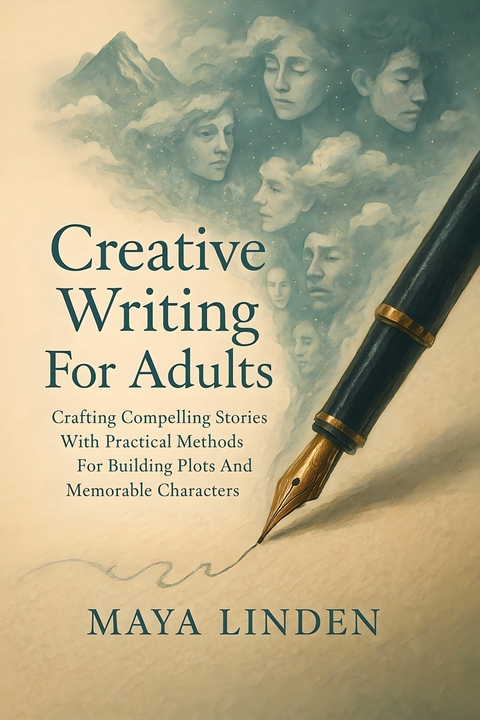
Creative Writing For Adults (eBook)
126 Seiten
Publishdrive (Verlag)
978-0-00-109480-2 (ISBN)
Do you second-guess your ideas, stall in the messy middle, or struggle to finish your stories?
Are you looking for a simple, step-by-step way to build solid plots and unforgettable characters-without academic jargon?
Do you want practical tools that turn blank pages into chapters readers can't put down?
If you answered YES to at least one of these questions, you MUST KEEP READING...
Unlock the Secrets to Writing Page-Turning Fiction With Confidence
Many adult writers start strong, then hit a wall: plots that sag, scenes that wander, characters who feel flat, and revisions that never seem to end. The sheer volume of tips, templates, and 'must-do' rules can be overwhelming-and it's no surprise so many promising ideas get abandoned in a folder labeled 'someday.'
But don't despair-you're not alone in this journey...
Presenting: Creative Writing For Adults: Crafting Compelling Stories With Practical Methods For Building Plots And Memorable Characters ✍️
This book distills proven storytelling techniques into a clear, repeatable system you can use right away. Instead of theory overload, you'll get practical methods, checklists, and bite-size exercises that guide you from idea to outline to polished draft. You'll learn how to shape a protagonist with clear goals, raise meaningful stakes, design scenes that escalate tension, and weave subplots that deepen the emotional payoff. You'll also discover simple ways to sharpen dialogue, choose the right point of view, and revise with purpose-so your story moves, and your characters matter.
Imagine this...
Picture yourself opening your laptop with a roadmap in hand. Your premise is tight, your characters breathe on the page, and each scene pushes the story forward. You know exactly what happens next-and why. Drafting feels focused. Revision is targeted. Whether you're writing short stories or a full novel, you'll build momentum and finish with confidence.
Don't wait any longer-your transformation as a storyteller starts now. Pick up this guide, put its practical methods to work, and craft the unforgettable stories only you can tell.
Chapter 1 — The Premise Engine: From Spark to Logline
If you can say your story in one breath, you can build it in one draft. That’s the power of a sharp premise: it isn’t a tagline, a mood, or an idea in search of justification. It’s the DNA that determines everything—the world, the tone, the cast, even the rhythm of sentences. Weak premises produce beautiful fragments that can’t cohere. Strong premises generate momentum; they attract characters, conflict, and theme like magnets. The paradox is that most writers start too vague, believing they’ll “discover” the premise along the way. In reality, discovery is much faster when the spark is already under pressure. You need a creative engine that forces opposites together until they combust. That’s what the “What If” factory does.
1.1 The “What If” Factory
A story begins with friction—two incompatible elements that can’t coexist but must. “What if” is how you trap that contradiction inside a single sentence. It’s not wishful thinking or random combination; it’s design. You’re building a miniature physics experiment, one that proves something must change. “What if a lawyer discovered the only way to save her client was to destroy the evidence herself?” Already, you have collision: law and ethics, self-interest and justice. A premise that contains paradox naturally generates plot because it demands resolution. Without friction, you’re left with atmosphere, not story.
The fastest way to find paradox is cross-pollination of constraints. Take two ideas that don’t belong together and force them to share oxygen. Start with a genre—say, a legal thriller—and fuse it with a profession or environment that introduces moral or procedural conflict: “hospice nurse.” Then add a destabilizer: “forged consent forms.” The sentence “A hospice nurse uncovers forged consent forms that could implicate her in a patient’s murder” immediately carries moral complexity and urgency. You can feel the pressure already; this world will yield difficult choices. Each addition—genre, profession, pressure—narrows possibility until what’s left is tension.
Constraint is not limitation; it’s leverage. A premise becomes compelling not by adding more elements, but by discovering the right incompatibility. If you keep stacking ideas, you dilute. If you choose two that genuinely strain against each other, you ignite. “Fantasy + accountant” works because imagination and precision rarely coexist. “Romance + meteorologist” becomes interesting only when weather mirrors emotional volatility. The “What If” factory doesn’t generate randomness; it manufactures paradoxes that promise consequence. Every strong premise is a contract with the reader that this tension will evolve, that something vital is at stake.
Another technique is flipping a norm or trope. Familiar structures comfort the reader, but inversion wakes them up. Reverse competence or power. What if the villain is brilliant and the hero unprepared? What if the savior doesn’t believe in salvation? What if the story expected to unfold in a courtroom takes place in a hospice or a submarine? Location, authority, morality—all can be inverted. When you flip expectation, you create oxygen for originality. The same way music gains energy through dissonance, story gains energy through reversal. You’re not discarding convention; you’re repurposing it.
Consider how setting redefines tension. A spy thriller set in wartime Berlin already has stakes, but we’ve seen that. Move it to a small-town nursing home, and the familiar tropes mutate. Surveillance becomes caretaking; secrets hide behind routine. The reader can’t predict outcomes because context has changed. Inversion breathes life into overused patterns without abandoning the scaffolding that makes them work. You can flip character dynamics, too: make the mentee more ruthless than the mentor, the detective emotionally blind, the child wiser than the adults. Each reversal shifts gravity.
Once you’ve fused paradox and flipped expectation, the final lever in the “What If” factory is the ladder of extraordinariness—a method for escalating premise without breaking plausibility. Start with something ordinary, relatable, and specific. Then climb the ladder by adding a resource limit—a countdown, a depletion, or an eroding trust. Time, oxygen, food, love, loyalty—whatever your story’s currency is, drain it. Limitation breeds propulsion.
Imagine a simple scenario: “A man tries to apologize to his estranged daughter.” Now add a constraint: “He has one phone call from prison.” The situation tightens. Add another: “The call is being monitored, and the person listening has their own history with him.” Now the premise hums. Each rung up the ladder adds urgency while keeping the emotional truth intact. The extraordinary grows naturally from the ordinary because limitation clarifies value. The less of something we have, the more it matters.
The ladder also protects against inflation—stories that escalate through spectacle rather than tension. If your premise relies on larger explosions instead of deeper stakes, it exhausts rather than engages. Resource limits refocus attention on the human. In a disaster film, the countdown isn’t to the meteor’s impact; it’s to the moment when someone must choose between saving the world or the one person they love. The external limit (time, space, oxygen) presses the internal limit (faith, courage, morality) until something yields. That’s where emotion hides: not in scale, but in compression.
When you feel your “What If” wobbling under abstraction—when it starts sounding like a concept rather than a situation—run it through the three filters: paradox, inversion, limitation. Ask: what two values collide here? Which expectation have I reversed? What resource is running out? If your premise answers all three, it can carry a novel.
A useful exercise is to test potential premises aloud. A good one fits in a single breath without confusion. If you must pause to explain or qualify, it’s not yet focused enough. “A scientist who clones her dead son” already implies emotional chaos, ethical questions, and urgency. You don’t need to say more. “A journalist discovers a conspiracy” tells us nothing unique; we need the paradox that defines it—what kind of journalist, what personal limitation, what impossible conflict. “A deaf journalist uncovers a conspiracy hidden in sound” suddenly crackles. Constraint (deafness) and paradox (investigating what she cannot hear) create fascination.
Another test: remove one element and see if the engine still runs. If it does, you may not have compressed tension tightly enough. A strong premise collapses when you subtract any component because each part is structural. In “A hospice nurse uncovers forged consent forms,” remove “hospice” and you lose intimacy and moral pressure; remove “forged consent forms” and you lose crime; remove “nurse” and you lose vulnerability. The story’s power lies in the combination.
The “What If” factory works best when you treat idea generation as a disciplined game rather than divine visitation. Write down ten combinations quickly. Don’t judge them yet. Cross-pollinate professions, settings, and stakes until sparks fly. The ones that feel strange or even absurd often hold the most promise, because strangeness is just unfamiliar logic waiting to prove itself. A “ballet thriller about industrial espionage” sounds ridiculous until you realize both worlds hinge on choreography, secrecy, and discipline. Suddenly it’s a mirror, not a joke.
While generating, stay alert for the emotional heartbeat beneath the concept. Premise without heart is gimmick. Ask why this contradiction matters to you personally. The “What If” isn’t just external—it’s the thematic skeleton of what you believe about people. The hospice nurse premise might be about guilt versus mercy; the deaf journalist about isolation versus discovery. The paradox you build for plot often mirrors a paradox you carry internally. When that alignment happens, the story has heat.
In revision, your premise becomes the diagnostic tool for everything else. When a subplot drifts, check whether it serves the central “What If.” When character motivation falters, ask how it ties to the paradox you began with. The premise is not a marketing hook—it’s the gravitational center of meaning. If it’s strong, the rest of the craft decisions simplify because they orbit naturally.
To summarize the spirit (though not the mechanics) of this chapter: the “What If” factory doesn’t ask you to be a genius; it asks you to be a scientist of tension. Mix ingredients until the reaction can’t be contained. Find collisions that reveal truth, flip familiarity until it surprises, and constrain freedom until urgency appears. Do this, and you’ll never again face the terror of the blank page. You’ll have an engine humming beneath you, ready to convert spark into story—a single breath of contradiction that can sustain an entire book.
1.2 Logline Formula & Anti-Formula
If a premise is the spark, the logline is the distillation—the controlled flame you can hold in your hand without getting burned. It’s the sentence that tells you, in miniature, what your story is about, why it matters, and why anyone should care. The most powerful stories, from Casablanca to Breaking Bad, can be expressed in a single breath not because they’re simple, but because they’ve been compressed to their essence. Writing that single line isn’t about marketing; it’s about clarity. When you can articulate your story’s DNA,...
| Erscheint lt. Verlag | 31.10.2025 |
|---|---|
| Sprache | englisch |
| Themenwelt | Geisteswissenschaften ► Sprach- / Literaturwissenschaft |
| ISBN-10 | 0-00-109480-7 / 0001094807 |
| ISBN-13 | 978-0-00-109480-2 / 9780001094802 |
| Informationen gemäß Produktsicherheitsverordnung (GPSR) | |
| Haben Sie eine Frage zum Produkt? |
 EPUB (Adobe DRM)
Größe: 1,6 MB
Kopierschutz: Adobe-DRM
Adobe-DRM ist ein Kopierschutz, der das eBook vor Mißbrauch schützen soll. Dabei wird das eBook bereits beim Download auf Ihre persönliche Adobe-ID autorisiert. Lesen können Sie das eBook dann nur auf den Geräten, welche ebenfalls auf Ihre Adobe-ID registriert sind.
Details zum Adobe-DRM
Dateiformat: EPUB (Electronic Publication)
EPUB ist ein offener Standard für eBooks und eignet sich besonders zur Darstellung von Belletristik und Sachbüchern. Der Fließtext wird dynamisch an die Display- und Schriftgröße angepasst. Auch für mobile Lesegeräte ist EPUB daher gut geeignet.
Systemvoraussetzungen:
PC/Mac: Mit einem PC oder Mac können Sie dieses eBook lesen. Sie benötigen eine
eReader: Dieses eBook kann mit (fast) allen eBook-Readern gelesen werden. Mit dem amazon-Kindle ist es aber nicht kompatibel.
Smartphone/Tablet: Egal ob Apple oder Android, dieses eBook können Sie lesen. Sie benötigen eine
Geräteliste und zusätzliche Hinweise
Buying eBooks from abroad
For tax law reasons we can sell eBooks just within Germany and Switzerland. Regrettably we cannot fulfill eBook-orders from other countries.
aus dem Bereich