


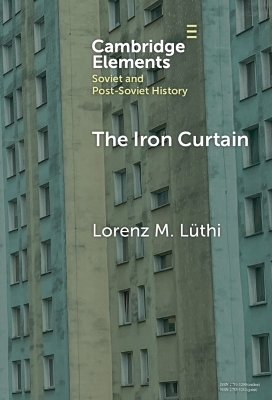
The Iron Curtain
A Short History of Socialist Borders
Seiten
2026
Cambridge University Press (Verlag)
978-1-009-71278-1 (ISBN)
Cambridge University Press (Verlag)
978-1-009-71278-1 (ISBN)
- Noch nicht erschienen (ca. Februar 2026)
- Versandkostenfrei
- Auch auf Rechnung
- Artikel merken
The Iron Curtain remains an iconic representation of the Cold War. Fortified borders to prevent citizens from leaving emerged first in the interwar USSR and then in socialist post-WW II Europe. Fortified borders also appeared at external borders in northern and southeastern Europe, in the Caucasus, and in Asia.
The Iron Curtain remains an iconic representation of the Cold War. But what was it really on the ground? Fortified borders to prevent citizens from leaving emerged first in the interwar USSR and then in socialist post-WW II Europe. Fortifications occurred both at borders between socialist states and at their external boundaries to the non-socialist world, but not in all cases. The most well-known case – the Berlin Wall – was both an extreme example as well as a latecomer. But since 1947, Yugoslavia, Hungary, and Czechoslovakia had fortified their borders to prevent exit. When East Germany started to build walls around West Berlin and at its borders to West Germany in the 1960s, Yugoslavia was already dismantling its border regime and Hungary was granting passports and exit visas to its citizens. Fortified borders also appeared at external borders in northern and southeastern Europe, in the Caucasus, and in Asia.
The Iron Curtain remains an iconic representation of the Cold War. But what was it really on the ground? Fortified borders to prevent citizens from leaving emerged first in the interwar USSR and then in socialist post-WW II Europe. Fortifications occurred both at borders between socialist states and at their external boundaries to the non-socialist world, but not in all cases. The most well-known case – the Berlin Wall – was both an extreme example as well as a latecomer. But since 1947, Yugoslavia, Hungary, and Czechoslovakia had fortified their borders to prevent exit. When East Germany started to build walls around West Berlin and at its borders to West Germany in the 1960s, Yugoslavia was already dismantling its border regime and Hungary was granting passports and exit visas to its citizens. Fortified borders also appeared at external borders in northern and southeastern Europe, in the Caucasus, and in Asia.
1. Introduction; 2. Soviet interwar borders; 3. Churchill's Iron Curtain in East Europe; 4. Yugoslavia's Iron Curtains, 1945–1965 ; 5. Hungary's Iron Curtain, 1945–1955 ; 6. Czechoslovakia's Iron Curtain, 1945–1955 ; 7. East Germany's Iron Curtain, 1945–1955; 8. Czechoslovakia's and Hungary's Divergent Border Regimes, 1955–1989 ; 9. East Germany's Walls; 10. Other Iron Curtains; 11. Conclusion; Bibliography.
| Erscheint lt. Verlag | 28.2.2026 |
|---|---|
| Reihe/Serie | Elements in Soviet and Post-Soviet History |
| Zusatzinfo | Worked examples or Exercises |
| Verlagsort | Cambridge |
| Sprache | englisch |
| Themenwelt | Geschichte ► Teilgebiete der Geschichte ► Militärgeschichte |
| Geschichte ► Teilgebiete der Geschichte ► Wirtschaftsgeschichte | |
| ISBN-10 | 1-009-71278-0 / 1009712780 |
| ISBN-13 | 978-1-009-71278-1 / 9781009712781 |
| Zustand | Neuware |
| Informationen gemäß Produktsicherheitsverordnung (GPSR) | |
| Haben Sie eine Frage zum Produkt? |
Mehr entdecken
aus dem Bereich

aus dem Bereich
von der Wiederbewaffnung bis zur Zeitenwende
Buch | Softcover (2025)
C.H.Beck (Verlag)
CHF 16,80
Deutschlands großer Volksaufstand
Buch | Softcover (2024)
Propyläen Verlag
CHF 30,80


