


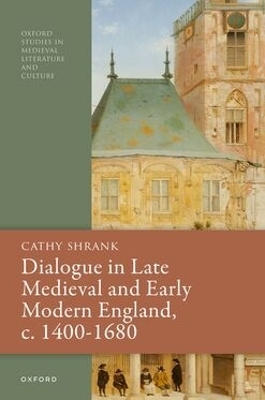
Dialogue in Late Medieval and Early Modern England, c. 1400–1680
Seiten
2026
Oxford University Press (Verlag)
978-0-19-894497-3 (ISBN)
Oxford University Press (Verlag)
978-0-19-894497-3 (ISBN)
- Noch nicht erschienen (ca. Juni 2026)
- Versandkostenfrei
- Auch auf Rechnung
- Artikel merken
This book is the first sustained study of the role and function of dialogue in late medieval and early modern England, and it explores how information and knowledge were disseminated throughout the period.
This book is the first major study of dialogue in England from the fifteenth to the late seventeenth century: a 'golden age' of dialogue, and a crucial period for its development. The spread of humanist education placed a premium on classical forms (including dialogue), whilst the discourse of commonweal had natural affinities with a literary model that evoked, at least on paper, a sense of polyvocality and participation. The arrival of the printing press and increasing levels of literacy also impacted on dialogue, altering expectations about the audience addressed and the forms dialogue took. The book thus traces significant evolutions, including the influence of culturally prominent texts, such as Baldassare Castiglione's Courtier and More's Utopia, and the ways in which Reformation and Counter-Reformation and the political turmoil of the mid-seventeenth century fuelled controversial and satirical modes of dialogue.
Exploring a wide variety of dialogic types, from instructional manuals and civil conversations to political and religious dialogues, it places English dialogue within its wider European contexts, providing powerful testimony to the sustained influence of non-Anglophone material and the intertwining of European literary and intellectual traditions. It asks why writers of this period turned so recurrently to dialogue. What advantages does the form hold over monologic genres? How do writers exploit its formal conventions? What are the resonances and assumptions that cluster around the form and lend it cultural authority? How does dialogue interact and intersect with other genres (dream poetry, familiar letters, drama, prose fiction)? How do dialogic habits of thinking shape the literature and drama of this period? And, in an age in which silence was seen as a female virtue, what place do women have in this conversational form?
An open access title available under the terms of a CC BY-NC-ND 4.0 licence.
This book is the first major study of dialogue in England from the fifteenth to the late seventeenth century: a 'golden age' of dialogue, and a crucial period for its development. The spread of humanist education placed a premium on classical forms (including dialogue), whilst the discourse of commonweal had natural affinities with a literary model that evoked, at least on paper, a sense of polyvocality and participation. The arrival of the printing press and increasing levels of literacy also impacted on dialogue, altering expectations about the audience addressed and the forms dialogue took. The book thus traces significant evolutions, including the influence of culturally prominent texts, such as Baldassare Castiglione's Courtier and More's Utopia, and the ways in which Reformation and Counter-Reformation and the political turmoil of the mid-seventeenth century fuelled controversial and satirical modes of dialogue.
Exploring a wide variety of dialogic types, from instructional manuals and civil conversations to political and religious dialogues, it places English dialogue within its wider European contexts, providing powerful testimony to the sustained influence of non-Anglophone material and the intertwining of European literary and intellectual traditions. It asks why writers of this period turned so recurrently to dialogue. What advantages does the form hold over monologic genres? How do writers exploit its formal conventions? What are the resonances and assumptions that cluster around the form and lend it cultural authority? How does dialogue interact and intersect with other genres (dream poetry, familiar letters, drama, prose fiction)? How do dialogic habits of thinking shape the literature and drama of this period? And, in an age in which silence was seen as a female virtue, what place do women have in this conversational form?
An open access title available under the terms of a CC BY-NC-ND 4.0 licence.
Cathy Shrank is Professor of Tudor and Renaissance Literature at the University of Sheffield. Her publications include Writing the Nation in Reformation England (Oxford University Press, 2004), The Oxford Handbook of Tudor Literature, co-edited with Mike Pincombe (Oxford University Press, 2009), an edition of Shakespeare's Poems, co-edited with Raphael Lyne (Longman Annotated English Poets, 2017), and The Oxford Handbook of Thomas More's Utopia, co-edited with Phil Withington (Oxford University Press, 2023).
| Erscheint lt. Verlag | 7.6.2026 |
|---|---|
| Reihe/Serie | Oxford Studies in Medieval Literature and Culture |
| Verlagsort | Oxford |
| Sprache | englisch |
| Maße | 156 x 234 mm |
| Themenwelt | Geisteswissenschaften ► Sprach- / Literaturwissenschaft ► Anglistik / Amerikanistik |
| Geisteswissenschaften ► Sprach- / Literaturwissenschaft ► Literaturwissenschaft | |
| ISBN-10 | 0-19-894497-7 / 0198944977 |
| ISBN-13 | 978-0-19-894497-3 / 9780198944973 |
| Zustand | Neuware |
| Informationen gemäß Produktsicherheitsverordnung (GPSR) | |
| Haben Sie eine Frage zum Produkt? |
Mehr entdecken
aus dem Bereich


aus dem Bereich
Poetik eines sozialen Urteils
Buch | Hardcover (2023)
De Gruyter (Verlag)
CHF 83,90


