


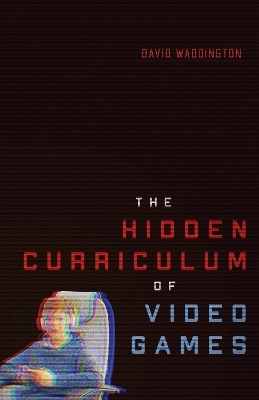
The Hidden Curriculum of Video Games
Seiten
2026
McGill-Queen's University Press (Verlag)
978-0-2280-2788-1 (ISBN)
McGill-Queen's University Press (Verlag)
978-0-2280-2788-1 (ISBN)
- Noch nicht erschienen (ca. Juli 2026)
- Versandkostenfrei
- Auch auf Rechnung
- Artikel merken
Despite decades of inflammatory rhetoric, the real risk of video games lies not in their violent imagery but in the ethical and political sensibilities they normalize. Video games reward speed, efficiency, control, and meritocratic mastery, training players to align with a technolibertarian worldview – one that celebrates individual will, technological power, and skepticism toward collective forms of governance. Rather than asking whether games produce violent individuals, we might more productively ask how they contribute to a commitment to radical capitalism and a belief in highly individualistic worldviews.
In this unsettling work David Waddington traces the philosophical roots of technolibertarianism, founded on faith in technological progress and personal freedom. He identifies a darker turn in this thinking, animated by the ideals of Ayn Rand and her archetype of the “tech hero of capitalism.” Many games, Waddington argues, invite players to inhabit this archetype, treating mastery, control, and relentless striving as moral virtues. While educational research often praises games for motivating students and fostering problem-solving, Waddington asks a deeper question: What kinds of people do games help us become? Drawing on Martin Heidegger and other thinkers, he explores whether gameplay expands human possibility or narrows it by habituating players to efficient yet restrictive systems.
The Hidden Curriculum of Video Games critiques mainstream game design and educational technology, offering hopeful alternatives and examining reflective games that resist dominant gameplay logics. Written with clarity, passion, and philosophical depth, this thought-provoking work opens new horizons on technology, education, and the moral imagination of play.
In this unsettling work David Waddington traces the philosophical roots of technolibertarianism, founded on faith in technological progress and personal freedom. He identifies a darker turn in this thinking, animated by the ideals of Ayn Rand and her archetype of the “tech hero of capitalism.” Many games, Waddington argues, invite players to inhabit this archetype, treating mastery, control, and relentless striving as moral virtues. While educational research often praises games for motivating students and fostering problem-solving, Waddington asks a deeper question: What kinds of people do games help us become? Drawing on Martin Heidegger and other thinkers, he explores whether gameplay expands human possibility or narrows it by habituating players to efficient yet restrictive systems.
The Hidden Curriculum of Video Games critiques mainstream game design and educational technology, offering hopeful alternatives and examining reflective games that resist dominant gameplay logics. Written with clarity, passion, and philosophical depth, this thought-provoking work opens new horizons on technology, education, and the moral imagination of play.
David I. Waddington is professor of education at Concordia University.
| Erscheint lt. Verlag | 21.7.2026 |
|---|---|
| Zusatzinfo | 21 illustrations |
| Verlagsort | Montreal |
| Sprache | englisch |
| Maße | 152 x 229 mm |
| Themenwelt | Geisteswissenschaften ► Philosophie ► Ethik |
| Sozialwissenschaften ► Kommunikation / Medien ► Medienwissenschaft | |
| ISBN-10 | 0-2280-2788-8 / 0228027888 |
| ISBN-13 | 978-0-2280-2788-1 / 9780228027881 |
| Zustand | Neuware |
| Informationen gemäß Produktsicherheitsverordnung (GPSR) | |
| Haben Sie eine Frage zum Produkt? |
Mehr entdecken
aus dem Bereich



aus dem Bereich
Buch | Hardcover (2025)
Suhrkamp (Verlag)
CHF 32,15


