


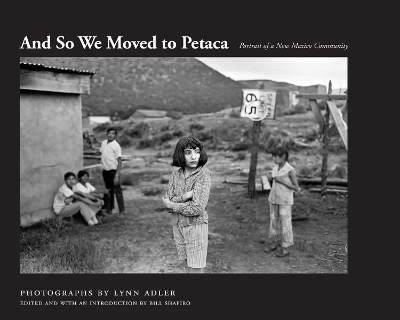
And So We Moved to Petaca
Portrait of a New Mexico Community
Seiten
2026
University of New Mexico Press (Verlag)
978-0-8263-6963-5 (ISBN)
University of New Mexico Press (Verlag)
978-0-8263-6963-5 (ISBN)
- Noch nicht erschienen (ca. Juni 2026)
- Portofrei ab CHF 40
- Auch auf Rechnung
- Artikel merken
A sublime photographic chronicle of the efforts of several counterculture families to adopt a traditional Nuevomexicano life in the tiny village of Petaca, New Mexico, in the early 1970s.
In the early 1970s there weren’t many women photographers, and fewer still who used their camera to make ethnographic studies. Lynn Adler was a self-taught photographer using an old 35 mm camera her mother had left to her. But her instinct for seeing the collision of cultures, along with her savant’s eye for constructing beautiful frames, allowed her to capture a moment both rare and spectacular in a tiny village in Northern New Mexico called Petaca.
At the time, Petaca was home to about fifty very traditional Hispano families with roots in the area going back well over a hundred years. The town had no schools, no hospital, no stoplights; it had one church, one bar, one dry-goods store, and a single gas pump. Spanish was nearly everyone’s first language, and the only real employment had been a mineral mine, shut down in the 1950s. Most families got by as subsistence farmers. These families were joined by people who had left San Francisco and New York City, seeking a simpler life. It was while visiting friends who had made this move that Lynn Adler made these photographs between 1970 and 1974.
Lynn’s photographs show her friends deep in the hard work of homesteading and raising families; they show the local people tending the crops and looking after their animals, and they show when members of both groups came together.
It has been half a century since Adler last looked through her viewfinder at Petaca. The children who ran through her pictures are now deep into middle age, and the older people are gone. And So We Moved to Petaca is a moving portrait of a time and place. If not for these photographs, this fleeting moment would have been lost to time, and this story of community and conflict would never have been shared.
In the early 1970s there weren’t many women photographers, and fewer still who used their camera to make ethnographic studies. Lynn Adler was a self-taught photographer using an old 35 mm camera her mother had left to her. But her instinct for seeing the collision of cultures, along with her savant’s eye for constructing beautiful frames, allowed her to capture a moment both rare and spectacular in a tiny village in Northern New Mexico called Petaca.
At the time, Petaca was home to about fifty very traditional Hispano families with roots in the area going back well over a hundred years. The town had no schools, no hospital, no stoplights; it had one church, one bar, one dry-goods store, and a single gas pump. Spanish was nearly everyone’s first language, and the only real employment had been a mineral mine, shut down in the 1950s. Most families got by as subsistence farmers. These families were joined by people who had left San Francisco and New York City, seeking a simpler life. It was while visiting friends who had made this move that Lynn Adler made these photographs between 1970 and 1974.
Lynn’s photographs show her friends deep in the hard work of homesteading and raising families; they show the local people tending the crops and looking after their animals, and they show when members of both groups came together.
It has been half a century since Adler last looked through her viewfinder at Petaca. The children who ran through her pictures are now deep into middle age, and the older people are gone. And So We Moved to Petaca is a moving portrait of a time and place. If not for these photographs, this fleeting moment would have been lost to time, and this story of community and conflict would never have been shared.
Documentary photographer and filmmaker Lynn Adler is a founder of Optic Nerve, a San Francisco–based film and photography collective, and Ideas in Motion. She has made community-based documentary films and videos around the world. She lives in Berkeley, California. Bill Shapiro is a former editor in chief of LIFE Magazine. He lives in Taos, New Mexico.
| Erscheint lt. Verlag | 2.6.2026 |
|---|---|
| Einführung | Bill Shapiro |
| Verlagsort | Albuquerque, NM |
| Sprache | englisch |
| Maße | 254 x 203 mm |
| Gewicht | 202 g |
| Themenwelt | Kunst / Musik / Theater ► Fotokunst |
| Geisteswissenschaften ► Geschichte ► Regional- / Ländergeschichte | |
| Sozialwissenschaften ► Soziologie | |
| ISBN-10 | 0-8263-6963-4 / 0826369634 |
| ISBN-13 | 978-0-8263-6963-5 / 9780826369635 |
| Zustand | Neuware |
| Informationen gemäß Produktsicherheitsverordnung (GPSR) | |
| Haben Sie eine Frage zum Produkt? |
Mehr entdecken
aus dem Bereich


aus dem Bereich
Träume und Macht : eine Biografie
Buch | Hardcover (2025)
C.H.Beck (Verlag)
CHF 61,60
die Geschichte meiner Urgroßmutter
Buch | Hardcover (2025)
C.H.Beck (Verlag)
CHF 32,15


