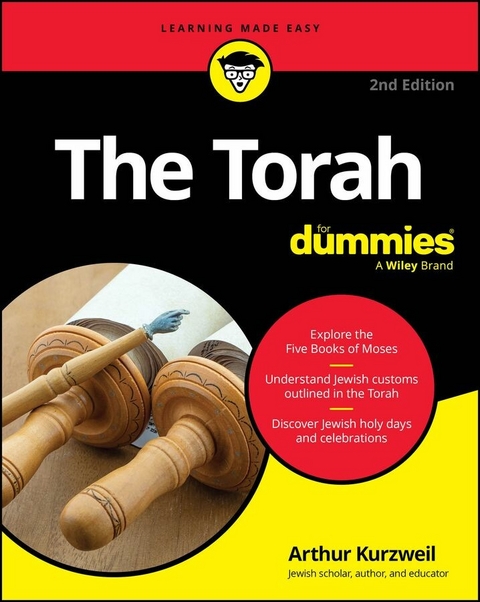
The Torah For Dummies (eBook)
488 Seiten
For Dummies (Verlag)
978-1-394-38000-8 (ISBN)
An accessible and fascinating exploration of the Torah
The Torah For Dummies, 2nd Edition is an easy-to-follow and insightful guide to the first five books of the Hebrew bible: Genesis, Exodus, Leviticus, Numbers, and Deuteronomy. This helpful resource walks you through the foundations of Jewish tradition, religion, and theology, explaining Judaism's rich and ancient history and how its interpreted by modern Jews.
You'll also find discussion on translations of ancient writings, as well as explorations of the resources that preserve and expand Jewish texts and archeological discoveries that shed additional light on old doctrines.
Inside:
- Understand how the Torah is structured
- Discover how the Torah informs the lives of followers
- Explore interpretations, commentaries, and more.
Perfect for practicing Jews who want to better understand their own faith, Christians wanting to know more about the Jewish roots of Christianity, followers of Islamic tradition, and those interested in the roots of Abrahamic faiths, The Torah For Dummies is a can't-miss resource for anyone interested in one of the world's oldest and most fascinating religions and cultures. It's packed with trustworthy information about the laws, teachings, and stories that guide the lives of people of faith all over the world.
Arthur Kurzweil teaches Talmud and Kabbalah courses to adults across the United States. He's the author of The Torah For Dummies, Kabbalah For Dummies, and The Talmud For Dummies. He's a recipient of the Lifetime Achievement Award from the International Association of Jewish Genealogical Societies.
Chapter 1
Beginning with Torah Basics
IN THIS CHAPTER
Meeting the Torah’s author — God
Discovering the most important elements of the Torah
Glimpsing each of the Five Books of Moses
Understanding how to live a righteous life according to the Torah
Seeing how the Torah guides the lives of the Jewish people
The Torah, also known as the Five Books of Moses, is the most sacred object and the most important text of the Jewish people. As a sacred scroll found in every synagogue throughout the world, it’s referred to as a Sefer Torah (say-fehr toe-rah; Torah scroll); as a bound book, it’s referred to as a Chumash (khuh-mahsh; five).
The Torah is more than a text, though; it’s also the spiritual tradition of the Jewish people, communicated by God (the Creator and Master of the universe) to Moses (the greatest prophet of the Jewish people) on Mount Sinai in 1280 BCE and handed down from generation to generation.
You can understand the word “Torah” in a third way as well. Torah is the vast and constantly growing body of teachings and wisdom of Judaism, and in this sense, it even includes what a qualified Jewish teacher will teach tomorrow. The “study of Torah” is not necessarily the same as the “study of the Torah.” “The Torah” usually means the Written Torah, the Five Books of Moses, whereas “Torah” refers to Torah studies in the more general sense.
In this chapter, I introduce you to various aspects of the Torah, such as its structure, teachings, and study. I invite you to explore this chapter and discover some basics about this unique document of documents that has taught the world about charity, love, the importance of educating children, honesty in the marketplace, the concepts of bankruptcy, courts, and witnesses, and so many other aspects of modern experience that are embedded into the fabric of our lives.
Introducing God, the Torah’s Author
Even though the Torah is mainly about God, it’s also important to remember that the Torah’s author is God. Although the first line of the Torah says, “In the beginning of God’s creation of heaven and earth,” it’s God who is speaking. God chose Moses to receive and write down a divine message, which is why the Torah is also known as the Five Books of Moses, but the Torah emanates from God. God reaches into the human world with the Torah.
Jewish tradition teaches that God didn’t create the world out of nothing. God’s creation is an emanation of divine light that God sculpted into all that exists. God is not just “in” everything. Rather, everything is God. This is, of course, a paradox. On the one hand, people live their lives feeling separate from God, while at the same time, Jewish tradition teaches that on the deepest level everything is God.
In studying the Torah, you’ll often encounter paradoxes. Many spiritual teachers teach that when you encounter a paradox, it usually means you’re going in the right direction. The endless struggle to grasp and understand what is meant by God is both the most important activity of life and, at the same time, an impossible task. The study of Torah is the way in which Jews participate in this paradoxical struggle. Some of the ideas that students of the Torah struggle with include
- Humans are created in God’s image.
- God has many names, but no name can possibly be adequate.
- God exists.
- God has no gender.
- God is unique; nothing is like God in any way.
- God is everywhere.
- God is, was, and will be; God transcends time.
- God is beyond human comprehension.
The Torah is mainly God’s communication to people about how to behave. Most of the Torah is directed toward the Jewish people, although it also contains instructions for all other peoples of the world. But for reasons that only God knows, the Jewish people are given extra burdens and responsibilities. God chose the Jewish people, but in no way does this status of being chosen by God imply superiority.
People have responsibilities to God and to each other, and the Torah is filled with instructions about how to fulfill both (see the later section “Living Life According to the Torah” for more about people’s responsibilities to each other). Regarding a person’s relationship to God, the Torah stresses
- Connecting with God through God’s commandments
- Having faith in God
- Maintaining trust in God
- Accepting direction from God
- Understanding that God directs everything that occurs
- Struggling to comprehend God
- Communicating with God through prayer
See Chapter 2 for more information about God, the ultimate author.
Examining the Torah’s Important Elements
Jewish tradition maintains that the Five Books of Moses contains everything. Yes, everything. Although the Torah is a religious document, it isn’t a collection of abstractions in spiritual language. Rather, it uses concrete descriptions in the form of laws and stories to express abstract notions. The Torah also deals with all aspects of life, from business, agriculture, and industry to family life, sexuality, and ritual. The Torah directs human conduct in all its aspects. It urges followers to see the whole world as a Holy Temple in which each student functions as a priest whose job it is to constantly purify and sanctify the entirety of life.
The Torah consists of two parts: One is written, and the other is oral. Flip to Chapter 3 for a full introduction to the treasures of the Torah.
The Written Torah
As the Torah describes, Moses was the greatest teacher and prophet who ever lived. It’s important, however, to always keep in mind that Moses wasn’t a perfect being. He had the noble attribute of humility and was also at times self-effacing, but he didn’t always do the right thing. As my teacher has often said, “In Judaism, there are no plastic saints.”
At Mount Sinai, Moses encountered God in an intimate way unlike anyone before or since, and Moses wrote down what God told him to write. The result was the Five Books of Moses. These five books are the main focus of The Torah For Dummies.Table 1-1 shows you the names of the Five Books of Moses, which come from Greek because a few thousand years ago the Torah was translated into that language. The table also gives you the Hebrew names of the books and their translations.
TABLE 1-1 The Five Books of Moses
| Greek Name | Hebrew Name | Translation of Hebrew Name |
|---|
| Genesis | Bereshit | “In the beginning” |
| Exodus | Shemot | “the names” |
| Leviticus | Vayikra | “and He called” |
| Numbers | Bamidbar | “in the wilderness” |
| Deuteronomy | Devarim | “words” |
The Torah isn’t the Bible. The Jewish Bible is the book that Christians call the Old Testament, and the Five Books of Moses are the first five sections of the Jewish Bible. The other sections are the books of the Prophets (of which there are eight) and the books of other sacred writings (of which there are 11). In all, there are 24 books in the Jewish Bible, also often referred to as the Hebrew Scriptures.
The Oral Torah
When Moses encountered God and received God’s message, the divine transmission included oral teachings that were never meant to be written down. An oral tradition allows for flexibility; too often when an oral teaching is written down, it’s taken too literally and loses its power to adapt to changing times and circumstances. It was only after much debate and discussion that the great sages of the Jewish people decided to write down the oral teachings in a process that began a few thousand years ago. This compromise was based on the historical fact that the enemies of the Jewish people were killing so many of the Children of Israel, the sacred traditions were at a great risk of being lost.
The major elements of the Oral Torah include
- The Mishnah (mish-nah; repetition): A book consisting of six sections, written in Hebrew, that serve as a summary of the oral teachings as handed down by Moses, along with the Written Torah, to the elders of the Jewish people.
-
The Gemara (geh-mah-rah; completion): Additions, written mostly in Aramaic, that serve to analyze the Mishnah, define its fine points, and also illustrate how the Five Books of Moses and the Mishnah are applied to the ever-changing conditions of life.
The Mishnah and the Gemara appear together in the Talmud (tahl-mood; learning), which is a set of books consisting of 63 sections and also includes additional commentaries by great teachers throughout the centuries.
- The Midrash (mid-rahsh; interpretation): A few dozen books...
| Erscheint lt. Verlag | 27.10.2025 |
|---|---|
| Sprache | englisch |
| Themenwelt | Geisteswissenschaften ► Religion / Theologie ► Judentum |
| Schlagworte | is the torah in the bible? • jewish archaeology • Jewish basics • jewish doctrine • Jewish laws • Jewish religion • Jewish texts • Jewish Traditions • Judaism basics • Torah basics • torah codes • what is Judaism? • what is the torah? |
| ISBN-10 | 1-394-38000-3 / 1394380003 |
| ISBN-13 | 978-1-394-38000-8 / 9781394380008 |
| Informationen gemäß Produktsicherheitsverordnung (GPSR) | |
| Haben Sie eine Frage zum Produkt? |
 EPUB (Adobe DRM)
Kopierschutz: Adobe-DRM
Adobe-DRM ist ein Kopierschutz, der das eBook vor Mißbrauch schützen soll. Dabei wird das eBook bereits beim Download auf Ihre persönliche Adobe-ID autorisiert. Lesen können Sie das eBook dann nur auf den Geräten, welche ebenfalls auf Ihre Adobe-ID registriert sind.
Details zum Adobe-DRM
Dateiformat: EPUB (Electronic Publication)
EPUB ist ein offener Standard für eBooks und eignet sich besonders zur Darstellung von Belletristik und Sachbüchern. Der Fließtext wird dynamisch an die Display- und Schriftgröße angepasst. Auch für mobile Lesegeräte ist EPUB daher gut geeignet.
Systemvoraussetzungen:
PC/Mac: Mit einem PC oder Mac können Sie dieses eBook lesen. Sie benötigen eine
eReader: Dieses eBook kann mit (fast) allen eBook-Readern gelesen werden. Mit dem amazon-Kindle ist es aber nicht kompatibel.
Smartphone/Tablet: Egal ob Apple oder Android, dieses eBook können Sie lesen. Sie benötigen eine
Geräteliste und zusätzliche Hinweise
Buying eBooks from abroad
For tax law reasons we can sell eBooks just within Germany and Switzerland. Regrettably we cannot fulfill eBook-orders from other countries.
aus dem Bereich