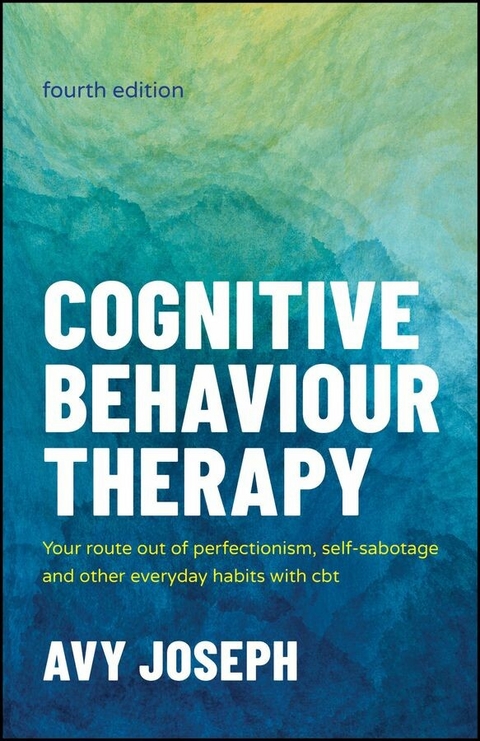
Cognitive Behaviour Therapy (eBook)
278 Seiten
Capstone (Verlag)
978-1-907312-88-5 (ISBN)
An intuitive and expert guide to some of the most effective techniques in Cognitive Behaviour Therapy
In the newly revised fourth edition of Cognitive Behaviour Therapy: Your Route Out of Perfectionism, Self-Sabotage and Other Everyday Habits with CBT/REBT, accredited therapist Avy Joseph delivers an up-to-date exploration of proven cognitive behaviour therapy (CBT) philosophy and techniques that work to improve your own life and the lives of others. Joseph explains how to challenge irrational, negative thoughts and unhealthy beliefs about yourself and your life. You'll learn to improve your outlook, mindset, and mood at home and at work. This latest edition of Cognitive Behaviour Therapy offers updated scenarios and exercises you can start using immediately, as well as:
- Discussions of the theory of the Multiplicity of Origins, a model explaining the development of unhealthy beliefs
- Understand that we have a biological predisposition to irrationality when something negative happens and how to use our free will to direct our mind to rationality and act constructively achieve our goals
- Step-by-step strategies to change our unhealthy beliefs and unhelpful behaviours that sabotage our goals in the real world, including methods for understanding the solution intellectually and transforming it into emotional understanding
A powerful and hands-on resource for everyone facing significant personal and professional challenges, Cognitive Behaviour Therapy is a collection of evidence-based personal improvement techniques that also belongs in the libraries of CBT practitioners and therapists.
An intuitive and expert guide to some of the most effective techniques in Cognitive Behaviour Therapy In the newly revised fourth edition of Cognitive Behaviour Therapy: Your Route Out of Perfectionism, Self-Sabotage and Other Everyday Habits with CBT/REBT, accredited therapist Avy Joseph delivers an up-to-date exploration of proven cognitive behaviour therapy (CBT) philosophy and techniques that work to improve your own life and the lives of others. Joseph explains how to challenge irrational, negative thoughts and unhealthy beliefs about yourself and your life. You'll learn to improve your outlook, mindset, and mood at home and at work. This latest edition of Cognitive Behaviour Therapy offers updated scenarios and exercises you can start using immediately, as well as: Discussions of the theory of the Multiplicity of Origins, a model explaining the development of unhealthy beliefs Understand that we have a biological predisposition to irrationality when something negative happens and how to use our free will to direct our mind to rationality and act constructively achieve our goals Step-by-step strategies to change our unhealthy beliefs and unhelpful behaviours that sabotage our goals in the real world, including methods for understanding the solution intellectually and transforming it into emotional understanding A powerful and hands-on resource for everyone facing significant personal and professional challenges, Cognitive Behaviour Therapy is a collection of evidence-based personal improvement techniques that also belongs in the libraries of CBT practitioners and therapists.
1
Understanding CBT for Goal Achievement
‘People are not disturbed by events but by the view they hold about them’.
Epictetus, Stoic philosopher c. AD 75
This chapter will introduce you to some of the basic ideas and principles of cognitive behaviour therapy (CBT) and how you can use it to help you achieve your goals. First, though, what does CBT actually mean?
Cognitive simply means our ‘thinking processes’: how we think, how we acquire information and knowledge, how we store it in our head, how we evaluate it and how we base some of our decisions on it.
Behaviour means our action or reaction to something. It's the doing bit. Our behaviour can be conscious or unconscious (out of our conscious awareness). In CBT, the word ‘behaviour’ comes from a branch of psychology called ‘behaviourism’, which is concerned with what can be observed rather than what can be speculated or assumed. It is based on what you have learned and become accustomed to, how this affects your actions and feelings and how you can unlearn what you have learned in order to change.
Therapy means the treatment for a health problem, after a diagnosis or an assessment has been made.
CBT is one of the counselling therapies that examines how our thinking, attitudes, beliefs, opinions and behaviour are formed; how they affect our success, our lives and feelings and how changing them impacts on our performance. The ideas stem from both ancient and modern thinking in philosophy, science, psychology, common sense and humanity.
Here are some of the basic principles central to CBT. Many may be shared by other therapeutic approaches but the combination of these principles goes some way towards understanding CBT.
THE EMOTIONAL RESPONSIBILITY PRINCIPLE
‘People are not disturbed by events but by the view they hold about them’.
This principle is at the heart of nearly all emotional and behavioural change. It can be challenging because you may believe that it's what has happened to you that ‘makes’ you feel how you feel and do what you do in the here and now.
I hope that by questioning this you will learn that what you believe may be stopping you from empowering yourself to move forward with your life. This in turn may help you in the pursuit of your desired goals.
Is it true that events, situations or people make us feel what we feel?
First, let's look at the popular notion that your feelings are ‘caused’ by events, situations or other people.
Think of a past event that you think ‘made’ you feel and do something. By this logic the only way you can change your feelings now is to wish the event had not happened in the first place.
Maybe you think there's someone else who has ‘made’ you feel and act in a certain manner. In which case, the only way you can change your feelings now is to get that person from the past to undo what they did or said. And if that person is now deceased, how can this be done?
Believing that the past, or a particular situation or person, causes our feelings today means that no one would ever be able to move forward or to change. We would all be totally stuck without any possibility or hope of ever changing anything. We would be slaves to the things that had happened to us or the people we had been involved with.
Can you imagine what it would be like if everyone felt hurt every time they experienced a rejection of some sort?
- Rejection = Hurt
- 10 people rejected = 10 people feeling hurt
- 100 people rejected = 100 people feeling hurt
- 1,000 people rejected = 1,000 people feeling hurt
As an example, when you experience rejection you might feel hurt. However, if you believe that your feelings are caused by others, you may then believe that being rejected by someone is the cause of your hurt feelings. But don't some of us experience different emotions if rejected by someone we like? Maybe anger, sadness, depression or relief?
In fact, different people may feel different emotions when they experience the same event:
- Some people feel hurt.
- Some people feel angry.
- Some people feel depressed.
- Some people couldn't care less.
Why do different people feel different things and what is at the heart of their feelings?
Is it true that events or people make us do what we do?
Let's think about what we do and assume that situations or people make us behave as we do.
- A colleague criticizes you = You start avoiding them
If it is true that a colleague's criticism ‘made’ you avoid them, this means that every criticism made by your colleague would have the same effect on everyone. It means that avoidance is the only possibility whenever your colleague criticizes you, or anyone else for that matter.
- A colleague criticizes 10 people = 10 people avoid them
- A colleague criticizes 100 people = 100 people avoid them
- A colleague criticizes 1,000 people = 1,000 people avoid them
Does this make sense?
The problem is that people say, ‘he made me do it’ or ‘she made me lose my temper’. It is as if they have absolutely no control over their behaviour. Once again, if we do not have a part to play in how we behave, then we would be completely stuck, unable to move forward, learn or do anything useful. Is this what you see happening to everyone around you?
So, what provokes your feelings and behaviour? Most of the time the simple answer is that you do. You provoke your feelings and actions by the way you think, the attitudes you've formed, the habits you no longer question and the beliefs you hold.
This is the principle of Emotional Responsibility: You are largely responsible for the way you feel and act.
The principle of emotional responsibility can be challenging, particularly if you are going through a difficult time or have experienced trauma or personal tragedy. It's natural to feel angry, sad, depressed or hurt in response to accidents, illness and other challenges in life, but if you get stuck in these feelings then you can change them.
The thought manifests as the word; The word manifests as the deed; The deed develops into habit;
And habit hardens into character;
So watch the thought and its ways with care. (Buddha)
The way you think about something affects how you feel and how you behave. Here are some examples:
- If you think that your partner's late arrival for dinner proves that you are not lovable, then you might feel hurt and sulk.
- If you think that your partner was nasty and selfish because they arrived late for dinner, then you might feel angry and shout.
- If you think that your partner's late arrival for dinner is no big deal, then you can feel calm about it and ask what happened.
This shows that it is not the situation or what happens to us that provokes our feelings and behaviour. It is the way we think about the situation. The way we think about something can then influence how we behave.
THE BEHAVIOURAL PRINCIPLE
CBT considers behaviour as significant in maintaining or in changing psychological states. If, for example, you avoid some event, such as giving a presentation to your team, then you will deny yourself the opportunity to disconfirm your negative thoughts about yourself or your capabilities. Furthermore, avoidance only sabotages what you want to achieve. Changing what you do is often a powerful way of helping you change your thoughts and emotions, and ultimately what you can achieve.
THE ‘HERE AND NOW’ PRINCIPLE
Traditional therapies take the view that looking at problems in the here and now is superficial. They consider that successful treatment must uncover the childhood developmental issues, hidden motivations and unconscious conflicts that are supposed to lie at the root of the problem. These approaches argue that treating the current problem rather than the supposed hidden ‘root’ causes would result in symptom substitution, that is, the problem would resurface in another form later on. There is little evidence to support this idea. Behaviour therapy also showed that such an outcome, although possible, was very rare.
CBT offers theories about how current problems are being maintained and kept alive and how they can be changed.
THE SCIENTIFIC PRINCIPLE
CBT offers scientific theories. Scientific theories are designed in a way so that they can be tested. CBT has been evaluated rigorously using evidence rather than just clinical anecdote. This is important for a couple of reasons:
- The treatment can be founded on sound and well‐established theories.
- Ethically, CBT therapists can have confidence in the therapy they are advocating.
Exercise
List five things that people manage to change about themselves despite doing it badly at first (for example, learning to drive).
- 1.
- 2.
- 3.
- 4.
- 5.
List five positive things that you have learned in your life despite experiencing difficulties (for example, moving on from a failed...
| Erscheint lt. Verlag | 24.10.2025 |
|---|---|
| Sprache | englisch |
| Themenwelt | Geisteswissenschaften ► Psychologie |
| Schlagworte | CBT • cbt book • CBT self-help • CBT techniques • CBT therapy • Change • emotional change • Free Will • goals • irrational behaviours • irrational beliefs • irrational responses • multiplicity of origins • Philosophy • Psychological Self-help • REBT • Self-Help • Self-talk • unhealthy beliefs |
| ISBN-10 | 1-907312-88-9 / 1907312889 |
| ISBN-13 | 978-1-907312-88-5 / 9781907312885 |
| Informationen gemäß Produktsicherheitsverordnung (GPSR) | |
| Haben Sie eine Frage zum Produkt? |
 EPUB (Adobe DRM)
Kopierschutz: Adobe-DRM
Adobe-DRM ist ein Kopierschutz, der das eBook vor Mißbrauch schützen soll. Dabei wird das eBook bereits beim Download auf Ihre persönliche Adobe-ID autorisiert. Lesen können Sie das eBook dann nur auf den Geräten, welche ebenfalls auf Ihre Adobe-ID registriert sind.
Details zum Adobe-DRM
Dateiformat: EPUB (Electronic Publication)
EPUB ist ein offener Standard für eBooks und eignet sich besonders zur Darstellung von Belletristik und Sachbüchern. Der Fließtext wird dynamisch an die Display- und Schriftgröße angepasst. Auch für mobile Lesegeräte ist EPUB daher gut geeignet.
Systemvoraussetzungen:
PC/Mac: Mit einem PC oder Mac können Sie dieses eBook lesen. Sie benötigen eine
eReader: Dieses eBook kann mit (fast) allen eBook-Readern gelesen werden. Mit dem amazon-Kindle ist es aber nicht kompatibel.
Smartphone/Tablet: Egal ob Apple oder Android, dieses eBook können Sie lesen. Sie benötigen eine
Geräteliste und zusätzliche Hinweise
Buying eBooks from abroad
For tax law reasons we can sell eBooks just within Germany and Switzerland. Regrettably we cannot fulfill eBook-orders from other countries.
aus dem Bereich