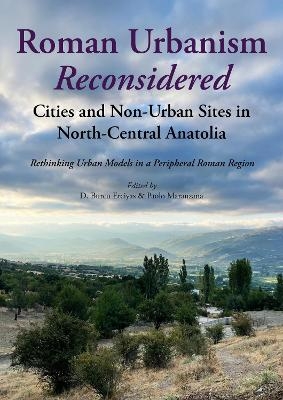
Roman Urbanism Reconsidered: Cities and Non-Urban Sites in North-Central Anatolia
Casemate Publishers (Verlag)
979-8-88857-250-4 (ISBN)
- Titel nicht im Sortiment
- Artikel merken
The Roman Empire was characterised by its extraordinary urban expansion, with cities functioning as vital centres for socio-economic, political, and religious life across its vast territories. While urbanism was not unique to Roman society, the Roman conquests in the Mediterranean spurred an unparalleled proliferation of cities, even in challenging regions such as the Central Anatolian Plateau. Scholarship on Roman urbanism has been particularly robust in the Western Mediterranean, with much more limited analysis of the eastern, more peripheral provinces, highlighting the need for a focused investigation into a crucial yet understudied aspect of Roman urban history.
This book presents a comprehensive examination of urban emergence and development in Roman central Anatolia with an emphasis on the northern territories. While the central Anatolian Plateau was traditionally considered less urbanised than the western and southern coastal zones, recent archaeological investigations have uncovered substantial new evidence of its urban growth. Yet, much of this evidence remains under-examined, particularly in terms of its contextual significance within broader patterns of Roman urbanism. Contributors here seek to address this gap by focusing on the distinctive characteristics of Roman urbanisation in north-central Anatolia and by integrating these findings into the broader framework of Roman imperial urbanism.
The papers, covering a broad geographical area from Gordion in the west to Komana in the east and Sagalassos in the south-west, demonstrate that the Romans employed distinct methods of administration across different regions of Anatolia. Recent archaeological data, particularly from the north-west, indicate substantial Roman military investment in the region. While a small number of ‘new’ cities were founded, such as Pompeiopolis and Hadrianopolis, existing cities with long traditions of settlement, such as Gordion, Hattuşa, and Komana, were primarily repurposed for military use. Roman urbanism can also be understood through various forms of non-urban data, and the transformation of the region through various mechanisms of power and administrative control is explored, providing discussions of both urban and rural investment. Questions of urbanism are explored through epigraphy, historical sources, coinage, architecture, and settlement patterns.
Burcu Erciyas specialises in the archaeology of the Black Sea region, Hellenistic, Roman, and Medieval Anatolia, public archaeology, and theory in archaeology. She has been conducting archaeological research (surveys and excavations) at Komana in Tokat since 2004. She has been a faculty member at the City and Regional Planning Department and the Graduate Program in Settlement Archaeology at METU since 2001. Paolo Maranzana is currently a faculty member of the Department of History at Boğaziçi University, where he teaches Roman Archaeology and History. His research focuses on Roman cities and their impact on the local economy and ecology in Anatolia, Black Sea, as well as the greater Ravenna region, with ongoing fieldwork since 2011.
1. Introduction
Burcu Erciyas and Paolo Maranzana
2. The Impact of Roman Urbanism on the Development of Public Spaces in Roman Imperial Pisidia (South-west Anatolia)
Bas Beaujean and Peter Talloen
3. Urbanisation Dynamics and Changes in the Roman Period of Pisidian Seleukeia
Bilge Hürmüzlü Kortholt
4. Comana Pontica During the Roman Period: Glimpses at Settlement Dynamics and Urban Patterns (1st to 4th centuries CE)
Burcu Erciyas and Max Ritter
5. Bogazköy: A Rural Landscape in Eastern Galatia - Between Innovation, Adaptation, and Tradition
Dominique Krüger, Jil Kremser and Mareke Johanne Ubben
6. Who Built the Dam? Roman Hydraulic Engineering and the Örükaya Dam in North-Central Anatolia
Emine Sökmen Adalı
7. A Roman Synoikismos in Paphlagonia: Kaisareia Proseilemmenitae
Ersin Çelikbaş
8. An Exemplar of Liminal Dynamics: Roman Gordion at the Convergence of Galatia’s Urban Territoria
Andrew Goldman
9. Imperial Urbanism and Institutional Change in Roman Northern Anatolia: New Evidence from the Courtyard Granary in Pompeiopolis
Julia Koch
10. A Roman City in Central Anatolia: Juliopolis
Mustafa Metin and Ali Metin Büyükkaya
11. The Emergence and Development of the Roman City in the Upper Sakarya River Valley: A Top-down Approach?
Paolo Maranzana
12. Central Anatolian Urbanism in the Longue Durée: A Lack of Definite Places as Seen from Late Antiquity
Philipp Niewoehner
13. Conclusions
Burcu Erciyas and Paolo Maranzana
| Erscheint lt. Verlag | 18.6.2027 |
|---|---|
| Sprache | englisch |
| Maße | 170 x 240 mm |
| Themenwelt | Geisteswissenschaften ► Archäologie |
| Geschichte ► Allgemeine Geschichte ► Vor- und Frühgeschichte | |
| Geschichte ► Allgemeine Geschichte ► Altertum / Antike | |
| ISBN-13 | 979-8-88857-250-4 / 9798888572504 |
| Zustand | Neuware |
| Informationen gemäß Produktsicherheitsverordnung (GPSR) | |
| Haben Sie eine Frage zum Produkt? |
aus dem Bereich